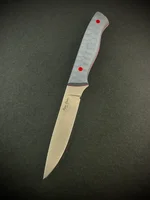
I was expecting to see RWL34 featured
Do you not rate It ?
Has it been super ceded by better products?
J
Do you not rate It ?
Has it been super ceded by better products?
J


I dont think there are better and worse so much as " difference " must say cannot remember seeing it recently but some steels are changed slightly or copied and sold under a different name for less money by another mill or in a better format AEB-L and SF100 are basically the same product but AEB-L is American owned and rolled in coil under Licence in Germany , SF 100 is rolled as flat plate in Sheffield /Rotherham in the Uk .I was expecting to see RWL34 featured
Do you not rate It ?
Has it been super ceded by better products?
J
I am familiar with it but i dont use it , a phone around would likely find some at a stockholder , thinking on i wonder if i bought a bar not to long back as it was cheap on clearance ? in an oddball sizeA powder technology from Sweden (I think)
Fairly high on the Rockwell scale but also rust resistant (SS)
Good edge retention - but a bugger to sharpen

will have a route aboutCould be interested in a knife if you have such a bar
Though I need another knife like a need a hole in the head
Was wrong its a stick of N690 equivalent stainless 30x5.5 for some dispatch knivesCould be interested in a knife if you have such a bar
Though I need another knife like a need a hole in the head
What about Bohler N695?For those who want the real facts , seek to enhance their knowledge of one of mans oldest tools and its use in the field . What factors to consider in use and selection of materials to give great " property balance" , its a risky thread for a maker to post tbf but reading through an existing one I though that an actual professional knife maker and long time stalkers take on things might be of use to those of the forum membership who seek the facts that should be foremost in a stalkers mind.
There is no perfect material as regards knife steels , what we have is a selection of different steels both High carbon and stainless steel . Be aware that both of these come in a massive range of enhanced features (Properties) and also to achieve high performance in one thing other things will need to reduce. Think this like a high performance super car , its fast, looks cool but also drinks petrol like there is a hole in the tank and is difficult to park and climb in and out of . No room to stuff a hind in either !
The main three properties of a knife steel are 1. Toughness . 2. Edge retention 3. Corrosion Resistance 4. Hardness
The variables in different steels play off these four factors and the reason i do not have sharpness in the above is the fact that its largely geometry
Personally speaking and this might change as new products are developed
It might be worth pointing out that there is a book written specifically on Knife steels the heat treating of them and their geometry. Knife Engineering by DR. Larrin Thomas a son of a knifemaker who has done much work in development of processes and steels and has actually compiled a table of knife steel ratings covering 1,2,3 above including and a max working hardness .
To compare two steels and explain selection of properties i will take three steels and explain why i personally choose which
AEB-L ( interchangeable with SF100 ) Stainless
Toughness rating 9.5
edge retention 3
corrosion resistance 7
Max 63-64
440 A
toughness rating 3.5
edge retention 3.5
corrosion resistance 8.5
max 60-61 Rc
Elmax
toughness rating 4
edge retention 5.5
corrosion resistace 8
63-64 Rc
now for something different
Rex 121
toughness 1
edge retention 10
corrosion resistance 3.5
70-71 Rc
The last just to show the price paid for enhancing one thing and remember very high edge retention makes the sharpening job a harder , no free rides !
In practice during tests AEB-L / SF100 in the hands of a truly competent user will last 100 large species deer without begging for the stone, toughness means no missing tips so removing heads or dropping your knife onto a hard surface is a lot safer and i have yet to mistreat and neglect cleaning my knife and i do not use my knives in saltwater spearfishing so i am all good .
Selection of the right steel involves ballance for the task at hand . There will never be the ultimate steel for all tasks . High edge retention for instance tends to compromise toughness ( a bit like a faster accelerating car gives a lower mpg ) .What about Bohler N695?
My main stalking knife is a Boker made from N695. The edge retention is superb and the blade seems very light.
It's not that easy to sharpen but if stropped regularly after use it rarely if ever needs it.
I'd like more knives made from this steel.
What do you make of CruWear - the latest trendy knife steel?

Cru-Wear isn't even close to the latest (it's been around since 1994) and I wouldn't call it "trendy", either — but as a hunting-knife steel goes, the CPM version is absolutely fantastic stuff, since the balance of properties it offers is about as optimal as it gets. It's heavily biased toward toughness, still has excellent wear resistance, and though the chromium content is below the 10.5% threshold for being classified as stainless at 7.5%, my Cru-Wear blades are spotless. Another great characteristic is that it takes and holds a keen edge very nicely with excellent stability, gives good feedback while sharpening, and gives great cutting performance with with any sort of edge finish from toothy to mirror-polished.What do you make of CruWear - the latest trendy knife steel?
stainless isn't just about Chromium content , its importantly how its used . D2 has enough to qualify as stainless yet it is not stainless and shouldn't be rated as one because it uses the Chromium to make carbides not a passive filmCru-Wear isn't even close to the latest (it's been around since 1994) and I wouldn't call it "trendy", either — but as a hunting-knife steel goes, the CPM version is absolutely fantastic stuff, since the balance of properties it offers is about as optimal as it gets. It's heavily biased toward toughness, still has excellent wear resistance, and though the chromium content is below the 10.5% threshold for being classified as stainless at 7.5%, my Cru-Wear blades are spotless. Another great characteristic is that it takes and holds a keen edge very nicely with excellent stability, gives good feedback while sharpening, and gives great cutting performance with with any sort of edge finish from toothy to mirror-polished.
It's a truly premium steel and is highly-regarded by people who are into quality knives for a reason. In fact, about the only steels I might prefer to CPM Cru-Wear for some hunting applications would be Vanax and CPM Magnacut, along with K390 if it's for a smaller knife and corrosion resistance isn't a big consideration. Even among those other top-of-the-heap steels, it's hard to beat Cru-Wear for a field knife because of its superior toughness.