Steff
Well-Known Member
Until recently I have largely negated the influence of neck tension on accuracy. Party based on own experience ( I don‘t anneal) and also backed up by a test performed by Sead on the Accurate Reloading Forum.
I was right - and then again not.
The other week I brought 100 new Lapua .308 cases into operation which had been lying in my cupboard for 20 years. On seating the bullets for the test loads I noticed how tight the necks were. The test firing gave my quite severe vertical spreads, regardless of the charge weights. The trend was, 3 were perfect, 1 was 2“ low and one in between. Very unsatisfactory.
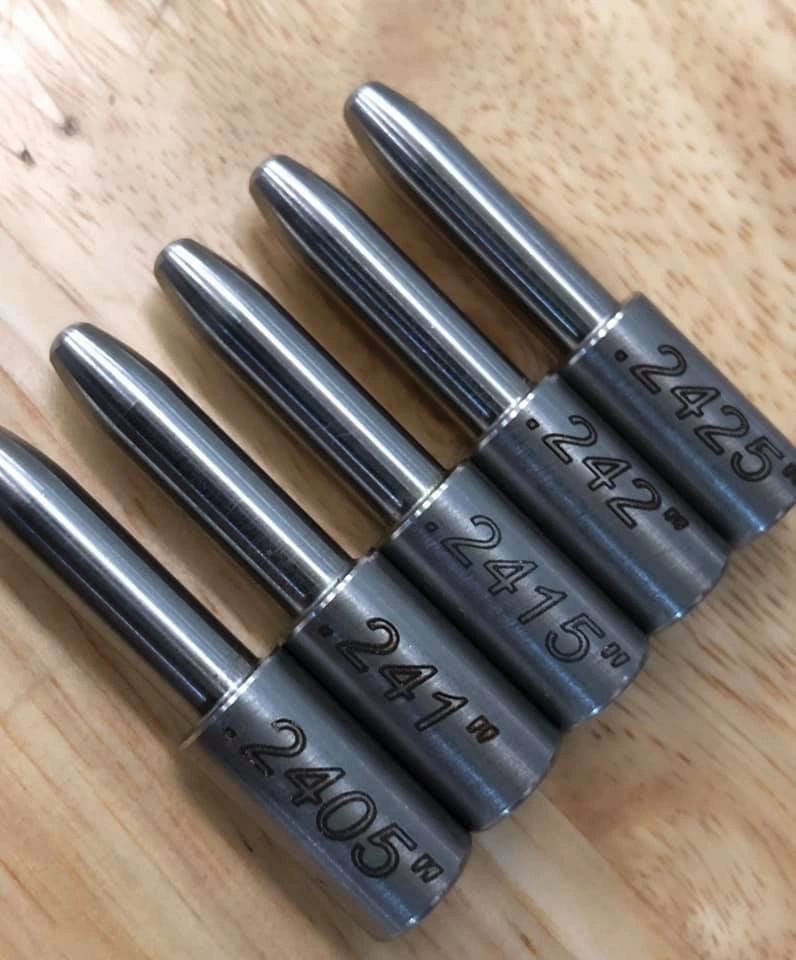
Remembering the tight bullet seating I ran the expander ball of my Redding neck sizing die without the bushing installed in and out of the rest of the yet unfired cases using some graphite.
Bingo, no more vertical spread. So my new theory is that high neck tension will indeed induce problems if it is not perfectly constant. On a lower level variations in neck tension have a negligible effect. A steep statement, but it reflects what I have seen so far.
I was right - and then again not.
The other week I brought 100 new Lapua .308 cases into operation which had been lying in my cupboard for 20 years. On seating the bullets for the test loads I noticed how tight the necks were. The test firing gave my quite severe vertical spreads, regardless of the charge weights. The trend was, 3 were perfect, 1 was 2“ low and one in between. Very unsatisfactory.
Remembering the tight bullet seating I ran the expander ball of my Redding neck sizing die without the bushing installed in and out of the rest of the yet unfired cases using some graphite.
Bingo, no more vertical spread. So my new theory is that high neck tension will indeed induce problems if it is not perfectly constant. On a lower level variations in neck tension have a negligible effect. A steep statement, but it reflects what I have seen so far.