Rifle barrels onto a H&H Paradox?

one barrel with a rifled choke and the other with a smooth choke then you have a drilling

Or rather a combination gun, they're quite popular in Scandinavia when you hunt grouse, capercaillie etc. with spitz. They're also quite affordable and you can have "real" rifle chambering instead of inferior slug with poor accuracy, trajectory etc.
 
Peak pressure does not bare on the breach face as Heym sr20 suggests.
You may find the rifle cases bare less in the breech due to higher presser causing the case to stick to the chamber better than a shot gun hull!

If this was not true how come a light spring can hold a bolt shut on semi automatic rifles of blow back design?
pressure is not directional
it is universal.

When a light shotgun action is used to build a double rifle it is most definitely the breech face and joint that takes the brunt when they let go!
Ask me how I know!!

I had the pleasure of testing several H&H doubles
and the displeasure of shooting one that let go due to a weakness in the action
the 240 H&H Flanged built on what was likely to have been a 20b action
 
pressure is not directional
it is universal.

When a light shotgun action is used to build a double rifle it is most definitely the breech face and joint that takes the brunt when they let go!
Ask me how I know!!

I had the pleasure of testing several H&H doubles
and the displeasure of shooting one that let go due to a weakness in the action
the 240 H&H Flanged built on what was likely to have been a 20b action
Thank you yes. I should of stated it better.
Peak pressure does not bear fully on the breech face because it is also on the chamber and the case sticks to the chamber, momentarily.
It may not be equal therefore.
Experiments have demonstrated this.
 
As others have said the cost may well be too prohibitive.

One consideration could be two full length einstucklauf.
This solution offers several advantages
Cost
Not unduly effecting weight (well a bit)
Easy to regulate both barrels to preferred point of aim/ distance / sights etc
Does not damage the gun in any way
Easily removable

It will help if you can speak German when trying to source said items

Ade 😎

1689174859690.jpeg
1689175030338.jpeg
 
Last edited:
Thank you yes. I should of stated it better.
Peak pressure does not bear fully on the breech face because it is also on the chamber and the case sticks to the chamber, momentarily.
It may not be equal therefore.
Experiments have demonstrated this.
I guess one should nevertheless keep in mind that the gun is probably proofed to 3.25 tons per sq in or so, rather than the 19 or so more common for rifles?
 
I guess one should nevertheless keep in mind that the gun is probably proofed to 3.25 tons per sq in or so, rather than the 19 or so more common for rifles?
Absolutely.
I was trying to make a point that no one can assume via simple maths what is exerted on the breech or locking mechanism.
The majority of the pressure traps the case against the chamber due to a greater surface area than the case head.
The case ,as pressure drops, releases from the chamber and then bears back on the breech at a lower pressure than peak.

Regards proof and the h&h. All proof loads are a significant percentage higher than the service pressure.
No one makes a firearm that just about handles a service pressure.
Another point with regards to proof is to take a look at an older firearm. You often can see proof stamp on the barrel and action. Why the action? Because the proof was done twice, once for the barrel and second with a lubricated cartridge to help it bear more than normal pressure on the breech. This gives substance to the belief peak pressure does not fully bear on the breech.
 
Just been watching a video of a guy shooting rifled 12 bore slugs in a shotgun with rifled chokes. He shot a 5 shot 3/4" group at 50 yards. With 400gr slugs at 1460fps you would have a muzzle energy of 1892ft/lbs. Deer legal in England and Wales. I reckon that would make a fantastic woodland stalking gun. You could even have one barrel with a rifled choke and the other with a smooth choke then you have a drilling you could shoot just about anything that walks or flies in this country with.

A lot cheaper than getting a pair of rifle barrels made.

In Scotland however you'd be breaking the law if you took deer with it
I have used slugs to shoot deer in the UK and abroad without any problems.my unrifled Auto 5 will put 5 shots in a beer mat at 50 yards all day long with either oz or 1-18 th oz slugs
I also had a Beretta silver sable rifle that is built on a 20 bore action but with a strengthened breach face and firing pins in 9.3x74r
 
Last edited:
Absolutely.
I was trying to make a point that no one can assume via simple maths what is exerted on the breech or locking mechanism.
The majority of the pressure traps the case against the chamber due to a greater surface area than the case head.
The case ,as pressure drops, releases from the chamber and then bears back on the breech at a lower pressure than peak.

Regards proof and the h&h. All proof loads are a significant percentage higher than the service pressure.
No one makes a firearm that just about handles a service pressure.
Another point with regards to proof is to take a look at an older firearm. You often can see proof stamp on the barrel and action. Why the action? Because the proof was done twice, once for the barrel and second with a lubricated cartridge to help it bear more than normal pressure on the breech. This gives substance to the belief peak pressure does not fully bear on the breech.
Interesting points - though I'm not sure that oiling cases would be particularly carried out with non-metallic-cased cartridges.
As to the breech being stamped as well as the barrels, is that not simply because both the breech and the barrel/s together (i.e. the firearm) have been subjected to proof? I can't see why you'd shoot an unoiled proof round to check the barrels, then an oiled one to check the standing breech. Oiling of metal-cased proof rounds still seems to appear in the Rules of Proof, interestingly.

I suppose the thing is that the breech does have to be able to take peak pressure, as it will have to (or nearly) if the cases/chamber are wet, or the brass lets go.
 
When the firing pin hits the primer and the powder starts to burn the brass case expands in all directions till it is firmly against all the walls of the chamber, whether its the side of the barrels or the breech face. The brass case will grip the walls and will the case head back somewhat, but if there is any excess head space the brass cartridge will stretch and take this up.

By the time pressure builds towards it maximum all the brass will be firmly against all the surfaces of the chamber and case is transferring the pressure directly to the walls. Pressure of 60,000 psi will felt all surface, whether it is the breech face, walls of the barrel or base of the bullet. Given that it is a fluid gas everywhere will receive the same pressure.

As for oiling the cartridge case / chamber walls, this may well stop the case gripping the walls as well a clean case and may allow some gas leakage, but given the temperature and pressures I suggest any oil will vapourise and combust. In any case oil is a fluid that is incompressible and if it remains a fluid it will simply transmit the force to the other surfaces. Think hydraulics.
 
I have used slugs to shoot deer in the UK and abroad without any problems.my unrifled Auto 5 will put 5 shots in a beer mat at 50 yards all day long with either oz or 1-18 th oz slugs
I also had a Beretta silver sable rifle that is built on a 20 bore action but with a strengthened breach face and firing pins in 9.3x74r
Slugs kill thousands of deer every year and just plain work. Range is somewhat limited and trajectory is a bit loopy - on a par with a 22 long rifle. But a 1oz slug at 1200 fps will have more energy than most calibre rifles.

I haven’t shot deer with slugs. I did once track a wounded lion and I had a rattly old side by side double 12 bore that belonged to the local chief loaded with 2 slug cartridges. My job was to protect the tracker whilst the other two had 375s. I am sure that if it did charge I would have had a sporting chance. We followed it most of the day in thick bush with a constant blood trail. It was never very far ahead and you could smell it and see the bushes move. But I never saw it nor got a chance to shoot it.
 
Slugs kill thousands of deer every year and just plain work. Range is somewhat limited and trajectory is a bit loopy - on a par with a 22 long rifle. But a 1oz slug at 1200 fps will have more energy than most calibre rifles.

I haven’t shot deer with slugs. I did once track a wounded lion and I had a rattly old side by side double 12 bore that belonged to the local chief loaded with 2 slug cartridges. My job was to protect the tracker whilst the other two had 375s. I am sure that if it did charge I would have had a sporting chance. We followed it most of the day in thick bush with a constant blood trail. It was never very far ahead and you could smell it and see the bushes move. But I never saw it nor got a chance to shoot it.
Down on one knee to start firing is apparently the way so the target is in the same plane and more chance of hitting it. Just glad mine was just the one shot and dead
 
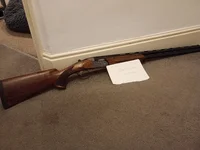
I have a Holland and Holland Royal paradox 1905 with the muzzle end 2" rifled this gun could shoot 700 grain slugs. The gun was a sleeper having been sent to India waiting for its owner and unfortunately he was killed in an hunting accident in the UK before he set off. The gun was returned from India in the 60s having not been used and the chokes opened up unfortunately removing the rifling. Wondered what the pressures may have been to proof this gun for a 700grain slug and would the action take the pressure of say a 30-06 or 308 if I had a set of rifle barrels made for it.
Thoughts? anyone know of a rifle smith experienced with double rifles?


If it were mine, my first contact would be with Holland and Holland and ho from there
 
As for oiling the cartridge case / chamber walls, this may well stop the case gripping the walls as well a clean case and may allow some gas leakage, but given the temperature and pressures I suggest any oil will vapourise and combust. In any case oil is a fluid that is incompressible and if it remains a fluid it will simply transmit the force to the other surfaces. Think hydraulics.
The lubricated metallic case, I never mentioned oil, just allows more bolt thrust than without.
Yes the pressure is equal but the surface area is less at the rear than the sides.
A metalic case gets thicker the closer to the head. It's resistance to set back against the bolt or breech increases where as the thinner brass near the case mouth it thrust against the chamber quicker than the head does rear ward.
Google PO Ackley bolt thrust experiments for more info.
 
The lubricated metallic case, I never mentioned oil, just allows more bolt thrust than without.
Yes the pressure is equal but the surface area is less at the rear than the sides.
A metalic case gets thicker the closer to the head. It's resistance to set back against the bolt or breech increases where as the thinner brass near the case mouth it thrust against the chamber quicker than the head does rear ward.
Google PO Ackley bolt thrust experiments for more info.
Googled it.


The experiments were carried outwith 30-30 which is pretty low in pressure and there was enough headspace that primer was pushed out but not pressure to push the rest of the case back against the breech face. But when lubricated with oil the case slid back and hit the breech face.

In a high velocity rifle running at 50,000 psi plus, primers are pretty much always flush with case head indicating that case head has been in firm contact with breech face.

Have a read of the closing paragraph of the above article.
 
The problem with any Paradox gun is that it tries to do two things. One of which it does very very well and the other it does well enough but at a cost or weight and heft. What has to be considered is what the Paradox tried to be and where it was mostly intended to be used. That was as a 12 bore double rifle, in India, on large thin skinned non-dangerous game but in a habitat where winged game might also perhaps be expected to be encountered.

The Paradox is, in effect, the successor to the old black powder and "cordite for black powder" 12 bore rifle the use of which is quite well detailed in such as "Gun Rifle and Hound" by "Snaffle". So the Paradox is a rifle that can be used as a shotgun where winged game is encountered by chance but not by intent instead of the expected large thin skinned dangerous game that you actually primarily went out to shoot.

But as a shotgun to actually go out to shoot winged game it is overheavy and over hefty. And if winged game was the primary objective of the day but where nevertheless if you saw large non dangerous thin skinned game you have a shot at it you'd simply have taken a shotgun and two or three "lethal ball" or solid ball or similar slug loadings. You wouldn't take a Paradox gun out on a day such as that.

So what I am clumsily trying to say is that a Paradox gun is a far far better 12 bore "double rifle" than is a shotgun firing a "lethal ball" but that shotgun is a far far better shotgun than is a Paradox gun firing birdshot. And taking out the rifling leaves one with that last. Beautifully made but as a shotgun a poor substitute.

So what's to do for the OP if he wants to have again that Paradox dual ability? Look maybe at what Fabarm offered in their side by side smoothbore guns which were screw in rifled choke tubes for use with slug. And have the gun worked on to accept both those and screw in standard smooth choke tubes. That way subject to appropriate lawful authority (and if the work can be done) you've gotten it back to actually being a Paradox gun in function.

See these links and the red outlined arrow in the cut and paste. Viking Arms were, at one time, Fabarm importers into the UK. Rifled chokes on their own, like any screw in choke, require no authority to acquire or possess. It is only when fitted to the gun that the gun itself then becomes IMHO a s1 firearm instead of s2:


Fabarm.jpg
 
Last edited:
Googled it.


The experiments were carried outwith 30-30 which is pretty low in pressure and there was enough headspace that primer was pushed out but not pressure to push the rest of the case back against the breech face. But when lubricated with oil the case slid back and hit the breech face.

In a high velocity rifle running at 50,000 psi plus, primers are pretty much always flush with case head indicating that case head has been in firm contact with breech face.

Have a read of the closing paragraph of the above article.
With higher pressure cartridge the greater pressure only makes the case grip the chamber more.

The fact a primer is flattened proves the point!
It does ride back onder high pressure, bloat and when the case does relax its grip the rapidly dropping pressure is sufficient to swage the primer into the primer pocket except of course the bit we observe.
Higher pressure cases also have thicker brass around the head of the case compared to 30-30 class cases.

The point is, a division of surface area is not an accurate way of determining what will be exerted on a bolt or breech face.

If we were asking the case to hold these pressures indefinitely they would fail everytime within seconds. Time is also another very important factor, that is it is a very short time , nano seconds. This fact is important also in the equation but is often overlooked.
 
With higher pressure cartridge the greater pressure only makes the case grip the chamber more.

The fact a primer is flattened proves the point!
It does ride back onder high pressure, bloat and when the case does relax its grip the rapidly dropping pressure is sufficient to swage the primer into the primer pocket except of course the bit we observe.
Higher pressure cases also have thicker brass around the head of the case compared to 30-30 class cases.

The point is, a division of surface area is not an accurate way of determining what will be exerted on a bolt or breech face.

If we were asking the case to hold these pressures indefinitely they would fail everytime within seconds. Time is also another very important factor, that is it is a very short time , nano seconds. This fact is important also in the equation but is often overlooked.
I imagine that the sequence on firing is, that as the pressure builds, first the thinner parts of the case above the web stretch to meet the chamber-wall and there hang on to it a bit. At the same time, the primer pops out to meet the breech-face. Higher pressure will then cause the web to stretch causing the case-head to rejoin the primer on the breech-face - at which point the primer may assume a slightly-squished appearance. Also, the breech-face will be subject to whatever the pressure in the chamber is at that time.
 
Back
Top