Quick Maths (Easy bullet drop calculations)

User00040

Well-Known Member
Might be of use to some, definately shows the benefit of the Mils system vs MOA!

Applies to most rifles between 2,500-3,000fps shooting a bullet between G1 0.4-0.6 BC

Higher speed and higher BC mean less drop, vice versa for lower speed and BC. Will require minor +/- corrections past 300 yards.

Yards to Mils

100 Y - Zero

200 Y- 0.5 Mil

300 Y- 1 Mil

400 Y- 2 Mil

500 Y- 3 Mil

600 Y- 4 Mil

700 Y- 5 Mil

Keep it simple...

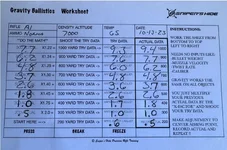
Credit for the sheet below goes to Snipershide and their 'Gravity Ballisitics' app (not available outside North America, yet)
1000006125.webp
 
Have always gone with zero @200 yards and anywhere between 50 to 300 yards its point and shoot for a safe kill. If its less than 50 yards, aim a little low and beyond 300 yards, try to get closer.

On the range, work out the number of clicks between distances, record it and adjust on the day. Also is varies between bullet weight, so best to enjoy shooting and less into the physics. Holding over never worked for me as windage gets even more tougher to be precise with the exception of maybe first focal point scopes. Easier to shoot than learn physics as by the time i am done with the calculations, the range will be shut.
 
Have always gone with zero @200 yards and anywhere between 50 to 300 yards its point and shoot for a safe kill. If its less than 50 yards, aim a little low and beyond 300 yards, try to get closer.

On the range, work out the number of clicks between distances, record it and adjust on the day. Also is varies between bullet weight, so best to enjoy shooting and less into the physics. Holding over never worked for me as windage gets even more tougher to be precise with the exception of maybe first focal point scopes. Easier to shoot than learn physics as by the time i am done with the calculations, the range will be shut.
Surely you aim high at less than 50 yards?
 
Might be of use to some, definately shows the benefit of the Mils system vs MOA!

Applies to most rifles between 2,500-3,000fps shooting a bullet between G1 0.4-0.6 BC

Higher speed and higher BC mean less drop, vice versa for lower speed and BC. Will require minor +/- corrections past 300 yards.

Yards to Mils

100 Y - Zero

200 Y- 0.5 Mil

300 Y- 1 Mil

400 Y- 2 Mil

500 Y- 3 Mil

600 Y- 4 Mil

700 Y- 5 Mil

Keep it simple...

Credit for the sheet below goes to Snipershide and their 'Gravity Ballisitics' app (not available outside North America, yet)

View attachment 345779
I don’t follow the logic at all.

Where does the initial 0.6 come from?

And the numbers on the card don’t match the numbers you give?
 
Once again I will advocate Frank Galli’s book and his weaponised math. No app required.

 
Once again I will advocate Frank Galli’s book and his weaponised math. No app required.

Thanks for the link @scotch_egg just nabbed a copy 👍
 
I don’t see the benefit either - it’ll be “close” but so does saying 1 moa at 100 is around 2 at 200 and so forth….

So what’s the benefit?
The more I look at what’s on that card and try to reconcile it with the numbers he posted, the less useful it looks.

Unless it’s as a way to get starting points for zero adjustments at different distances for new loads, which I suppose is what it is, rather than a reference tool for adjustments when actually shooting.

If it is the latter, it’s not clear why you’d use it these days, rather than a ballistic app.
 
Most of these rules of thumb apply for a bit at shorter ranges. It’s usually works fine to 3-400m then it goes wonky.
Like the mph gun thing. Mine is a 6mph wind gun. Ie if you have a six mph full value cross wind, you need to correct 0.2 mil at 200m 0.3 mill at 300m and so on which works fine to about 500m and is a useful stalking ready reconer but pretty useless at long range beyond - 600m
 
Last edited:
As the bullet will be on an upward trajectory, wouldn't aiming high miss the target?
Scope is above the bore, usually by between 1.5 and 2 inches.

So bullet leaves barrel well below line of sight, travelling upward. It takes some distance for it to cross the line of sight, and until it does, it will hit below the point of aim. At very close range, this can be quite a lot lower. So at close range you need to aim high.

For most people with a 100m zero, it’s really only the first 20-30m where this is a noticeable issue. For instance, a head shot at 10-20m can go low enough to cause a problem if not adjusted.
 
Unless it’s as a way to get starting points for zero adjustments at different distances for new loads, which I suppose is what it is, rather than a reference tool for adjustments when actually shooting.

If it is the latter, it’s not clear why you’d use it these days, rather than a ballistic app.
Reading the instructions on the paper, it's a way of getting your dope by shooting each yardage. You will only have to guess 200y dope, or actually you don't, just shoot and see what it is. Then multiply with the given X factor for next distance. It just keeps you on paper, compared to guessing the dope for next yardage. And in a pinch would enable you to generate somewhat accurate data for a bit longer distance than you've actually shot.

I can see the benefit of app while testing loads etc. but when the load is selected I much prefer something that doesn't require electricity etc. (i.e. piece of paper).
 
Might be of use to some, definately shows the benefit of the Mils system vs MOA!

Applies to most rifles between 2,500-3,000fps shooting a bullet between G1 0.4-0.6 BC

Higher speed and higher BC mean less drop, vice versa for lower speed and BC. Will require minor +/- corrections past 300 yards.

Yards to Mils

100 Y - Zero

200 Y- 0.5 Mil

300 Y- 1 Mil

400 Y- 2 Mil

500 Y- 3 Mil

600 Y- 4 Mil

700 Y- 5 Mil

Keep it simple...

Credit for the sheet below goes to Snipershide and their 'Gravity Ballisitics' app (not available outside North America, yet)

View attachment 345779
It’s usually easy to remember stalking distance drops but mine are close to this out to 350m
I think I’m
200m +0.4
250m +0.6
300m +1
350m+ 1.3
400m+ 1.7
That about how far i remember and once you go on my drops start to diverge from your estimation quite a bit
700m for example is 4.5mil only half a mil but at that range that’s 35cm
 
Back
Top