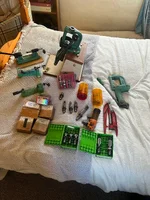
Thinking of reloading,

I just ran the numbers for you. It took literally, 40 seconds to do.
0.223 cal, Hornady bullet, Alliant Reloader 10X 20 to 24gn.
Alliant are REALLY conservative. 20gn gives a pathetic 2400 ft/s, peak of just 26,000 psi, 765ft/lb.
The warning signs for your combo are at 25gn, danger at 26gn.
24gn gives peak pressure of 44K psi, 3242ft/s, and over 1000ft/lb the legal minimum for deer.

So going with a factory load using a 0.223 Reloader 10X would break the law for deer. A good demo of why Gordon's tool is essential for a reloader, unless you spend a lot of time with a chrono.

If using 24gn, making a +4gn error will increase your max pressure to 73K psi, but the load would be 106% full so would be obviously wrong.

Put in your rifle twist and barrel length to refine these figures. Using a max allowed pressure of 55K psi for the above. Looking for pressure signs, one may be able to do 60K (or may not), and get a barrel burning 3600ft/s.
 
Last edited:
Good you are asking questions when uncertain. That is a really good trait, especially when learning and starting out. Well done. Lots of reloaders are on here can help.

Various people have posted about using the powder manufacturer's loads, when in fact you need Gordon's Reloading Tool as I recommended earlier. It would answer your questions on load, COAL etc, telling you what is safe and what is not, as well as how close you are to the limits.

DO NOT use a 4gn overload without checking with Gordon's tool. Putting in 4gn extra can mean the difference between perfectly fine 60,000 PSI and a burster 100,000 psi. You are working with 60K psi, not just 10K unless you are loading for pistols (which your helpful pictures show you are not): all these are serious pressures. In contrast, a 2''' difference in COAL is nothing.

Gordon's Reloading tool is free. See start [Gordons Reloading Tool Community]. No reloader should work without it. Or Quickload which does the same but costs.

Just because a manufacturer shows a maximum of 22.2gn does not mean you can use it in your rifle: you are meant to start with the lightest published load and then work up to the max, checking for over-pressure signs along the way, and if you see any of them, stop immediately and work back a bit. If you had Gordon's tool, you put in the manufacturer's load and then the tool will tell you what that load does in your rifle and save yourself some time.

You have discovered the reason for the advice given earlier, that you need two sets of scales. Beam scales can stick, the slides can be set in error or nudged, or a grain of powder can get just where you do not want it. Either check using a volume measure (which is surprisingly consistent if used properly), or better, check using another scale, especially if you are working near the limits. The beam is perfect for making the load, but use an electronic scale to check either every load, or one in 5 loads. A cheap 0.02gn resolution scale, accurate to 0.1gn, costs as little £14 on Amazon. PM me if you need a link.

Various people have badly advised you to use published loads. Manufacturer's data is sometimes very conservative, sometimes is not, it often does not include the powder - case - bullet combination you want to use, does not take account of YOUR rifle (twist rate, barrel length), or the COAL or seating depth or jump that you are using, but Gordon's tool does the lot. A published load is a good starting point, not the end position.

BTW your seating depth looks too deep.
Pressure tested published data is the industry standard, some is very conservative others right on the edge of the pressure standard. We as reloaders do not have the tools to reliably do pressure testing. What I have seen offered and not bought may not been in business now some 15 years after learning about the tool. The simple fact that the case, projectile, primer and other changes may not exactly match published data means a very controlled slow work up in powder charge. Safety above all else.
 
im getting warning signs at 23.00g,
Your simulation has also confirmed how anaemic the load is. It is also telling you, that you are using the wrong powder because Reloader 10X burns too slowly for this case/load/bullet/jump combo.

When I have a moment, I will check the other parameters for you, as I am getting slightly different numbers, with warnings at 25gn not 23gn. However, a couple of immediate observations: the OAL you measured is 2.248, so adjust that in GRT (it is showing 2.2598). You can tweak the case length also. Doing that corrects for the right jump which makes a difference in pressures.

NP435 has kindly reiterated the most essential advice: whether using manufacturer's data and a chrono, or GRT, do a slow work up in charge.

Remember: Just because a manufacturer shows a maximum of 22.2gn does not mean you can use it in your rifle: you are meant to start with the lightest published load and then work up to the max, checking for over-pressure signs along the way, and if you see any of them, stop immediately and work back a bit. Using Gordon's tool, you put in the manufacturer's load and then the tool will tell you what that load does in your rifle and save yourself some time but you still need to check that load is actually safe in YOUR rifle. Slight differences in chamber size, jump and barrel, creates differences in pressure. Published pressure tested data does not cover all these corner cases, hence the need for GRT and a gradual build up of load.

With good judgement one can go to the right load in one step, but you need good judgement first, and that comes from experience, and experience comes from a lot of bad judgement. Here the rule of slow build up of load, enables you to grow experience safely without injuring yourself or anyone around you. Warning sign on GRT means be careful on your tolerances, and check it by working up to that rather than assuming that load is OK. Some competition shooters run loads way into the danger warning sign area, "safely", because their barrels are fat and bolts have magnum lugs while using non-magnum cartridges: 75,000 psi is not uncommon in that community, but it would result in a face of shrapnel if one did it in a stalking rifle.

One even more essential of advice is worth repeating: do not reload in areas children have access too or in which food is prepared. Primers, spent or otherwise, are highly toxic. Do not eat at the place you are reloading.
 
Last edited:
The other point is SAAMI pressures (55,000 psi) are different to CIP (62,366 psi) , we fall under CIP in the UK . I can't remember if there's a CIP .223 in the drop down , just to add to the confusion . Stick with book data , including C.O.L and work up , keep an eye on pressure signs .
Whatever you do , don't start measuring C.O.L as you complete each round then adjusting . You'll be chasing your tail , once set leave it alone . The seating die seats from the ogive which is more consistent than the bullet tip .


It is also telling you, that you are using the wrong powder for this combination because Reloader 10X burns too slowly for this case/load/bullet/jump combo.

The OAL you measured is 2.248, so adjust that in GRT (it is showing 2.2598). You can tweak the case length also. Doing that corrects for the right jump which makes a difference in pressures. When I have a moment, I will check the other parameters for you, as I am getting slightly different numbers, with warnings at 25gn not 23gn.

As NP435 has kindly reiterated the most essential advice: whether using manufacturer's data and a chrono, or GRT, do a slow work up in charge.

Remember: Just because a manufacturer shows a maximum of 22.2gn does not mean you can use it in your rifle: you are meant to start with the lightest published load and then work up to the max, checking for over-pressure signs along the way, and if you see any of them, stop immediately and work back a bit. If you had Gordon's tool, you put in the manufacturer's load and then the tool will tell you what that load does in your rifle and save yourself some time but you still need to check that load is actually safe in YOUR rifle. Slight differences in chamber size creates differences in pressure. Even more so does differences in jump. Published pressure tested data does not cover all these corner cases, hence the need for GRT.

This ^^^^^ . Don't get disheartened , reloading can be frustrating .
 
55gr vmax load for my 223rem 24 gr,s viht 133, no pressure signs, primers not flattened, bolt lift great, cases eject smooth,quarry dead and ive never used a computer or chrono to do my reloading,in 40 years get reloading, keep off your pc, it sounds like you have to much information overloading your noggin, its easy gl you will get there bs
 
My load data for MY rifle...don't duplicate it without working up to it as it may not be suited to your rifle...is RS40 23.8gr with zero pressure signs and approx 3150fps. I'll be looking to have a play with higher powder charges to see if accuracy can be improved
 
55gr vmax load for my 223rem 24 gr,s viht 133, no pressure signs, primers not flattened, bolt lift great, cases eject smooth,quarry dead and ive never used a computer or chrono to do my reloading,in 40 years get reloading, keep off your pc, it sounds like you have to much information overloading your noggin, its easy gl you will get there bs
You won't have any pressure signs, because your load is slightly under performing. It is getting 3040 ft/s, with a peak pressure of 46K psi. 1133ft/lb.

For FoxyTales: The 0.223 CIP dropdown is the .223 REM (5.56 x 45 NATO) round. One can then edit the case parameters to tune it as you know.

BTW, Apologies for writing "children have access too" instead of "to" in my post above: out of time to correct the typo. I find it annoying when people use "too" instead of "to" or even "two", or "there" instead of "their", then type too fast and do the same myself.
 
Last edited:
You won't have any pressure signs, because your load is slightly under performing. It is getting 3040 ft/s, with a peak pressure of 46K psi. 1133ft/lb.

For FoxyTalesL The 0.223 CIP dropdown is the .223 REM (5.56 x 45 NATO) round. One can then edit the case parameters to tune it.

BTW, Apologies for saying "children have access too" instead of "to" in my post above: out of time to correct the typo. I find it annoying when people use "too" instead of "to" or even "two", or "there" instead of "their", then type too fast and do the same myself.

I couldn't be bothered to get the laptop out and check 😂 , yes NATO 5.56 runs at 62k psi but the chamber dimensions aren't identical .

I wouldn't be too sure that Bluesakos' load isn't performing , I use 23.1 grains of N133 under a Sierra 55gr bullet and see 3110fps out of a 22" barrel over the chrono . I only use GRT as a guide !
 
I couldn't be bothered to get the laptop out and check 😂 , yes NATO 5.56 runs at 62k psi but the chamber dimensions aren't identical .

I wouldn't be too sure that Bluesakos' load isn't performing , I use 23.1 grains of N133 under a Sierra 55gr bullet and see 3110fps out of a 22" barrel over the chrono . I only use GRT as a guide !
Your extra inch of barrel may be what gives you the extra 50fps. I had 21" set up for 0.223 for the numbers quoted.

On Bluesako's load, it is the peak pressure of a 46K psi in a chamber designed for 62.5K, that makes it an under performer. One could get much more zip, and barrel wear, by using a fast powder with a larger load (for that powder). Of course, he may intend to have a slower load ... but flat shooting and less wind drift from a zipper would be my preference.

Bullets with a boat tail, or grooves, get more speed as well for the same wear, as you know.
 
all read and nearly understood, i think im going to stop making any bullets until im sure im making something worth using, for the time being i wont be doing to much messing about, i wont be ever searching for that perfect bullet on bullet round (although it would be nice) anything under 1" moa at this stage will do, 1/2 moa would be nice though, i will obviously have to work up loads with the powders iv got and bullets and see if any comb works well, so far iv made 5 with RL 10 v max bullet with 19.5g and 5 with 20.4g, im thinking of making 5 more with 21.3g then go out and test them, but as were due rain here all week, it will probably have to be next weekend,
 
, i think im going to stop making any bullets until im sure im making something worth using,
You won’t know until you test the loads. There is often an accuracy sweet spot that often isn’t the maximum load. You won’t know this until you fire these in your rifle!
 
we're
Your extra inch of barrel may be what gives you the extra 50fps. I had 21" set up for 0.223 for the numbers quoted.

On Bluesako's load, it is the peak pressure of a 46K psi in a chamber designed for Pre62.5K, that makes it an under performer. One could get much more zip, and barrel wear, by using a fast powder with a larger load (for that powder). Of course, he may intend to have a slower load ... but flat shooting and less wind drift from a zipper would be my preference.

Bullets with a boat tail, or grooves, get more speed as well for the same wear, as you know.

I'm confused as to how getting different figures from GRT for Bluesako's load , plus I'm using 0.9 grain less ? I know it's possible to trim the parameters , I just don't bother going further than entering my own case volumes.


17058413004808949345593405160192.webp

24 grains N133 @ 98.9% case capacity using GRTs case volume .
21" barrel
C.O.L 2.260
Bullet - 55 grain Vmax

Calculated pressure = 52134 psi
Predicted velocity = 3139 fps

Anyway this is a discussion for another time , as I don't wish to derail the thread any further .
 
You won’t know until you test the loads. There is often an accuracy sweet spot that often isn’t the maximum load. You won’t know this until you fire these in your rifle!
true, im now going to work off GRT, its a bit strange that every dook i look at or powder manufacturer all quote different stats, i guess its just a case of "suck it and see" i just dont want it to be a case of ( &*^% around and find out) i will just work up slowly and keep an eye out for pleasure signs,
 
all read and nearly understood, i think im going to stop making any bullets until im sure im making something worth using, for the time being i wont be doing to much messing about, i wont be ever searching for that perfect bullet on bullet round (although it would be nice) anything under 1" moa at this stage will do, 1/2 moa would be nice though, i will obviously have to work up loads with the powders iv got and bullets and see if any comb works well, so far iv made 5 with RL 10 v max bullet with 19.5g and 5 with 20.4g, im thinking of making 5 more with 21.3g then go out and test them, but as were due rain here all week, it will probably have to be next weekend,
If you keep the bullet seating the same, and load up a batch of ammunition with 0.4gr increment, marking on the case the load, this would be the way of finding the maximum load for your rifle and components combination.
You waste components shooting 3 or 5 at a time.

By changing only one parameter at at time you can follow a logical process.

Keep it all as simple as possible....

Brass is trimmed and full length sized
Seat primer
Add powder
Seat bullet
Write powder charge on the case (if doing a pressure test)

You even don't need to shoot at the target as the sole purpose is to learn one thing - maximum safe load.

Take notes of the day

The next step is to go down 1.5gr away from your safe working maximum at start to make batch of 3 rounds going up in 0.2 or 0.3 gr increment.
The 223 case isn't big and it's easy to pass by consistent accuracy.
Shoot on a big bit of paper with crosses that match similar dimension of the reticle of the scope (thick Sharpie all the way down to biro)
 
i will just work up slowly and keep an eye out for pleasure signs,
A Freudian slip perhaps?
Don’t worry about other people’s results just get a chronograph and test your loads. When you are happy just use that as your pet load.
I always tried to get a load similar to a factory one but a good group with a similar poi to the factory one was more important to me. I started on 303 and .455 as these were my first firearms and factory ammo was scarce when I started!
Don’t worry too much about the published data, factory from your barrel may be different to the published so fire a test round or two first to establish that and also gets the chronograph running. Chrono results are notoriously difficult to guarantee so I’ve always stated that the indicated readings were x and used the same chrono throughout to try and establish a baseline.

Most of all enjoy the fact that you will spend more time shooting with a sense of purpose.
 
Is it?
It’s a byproduct of testing surely as the main purpose is to create an accurate load in your weapon!
Accurate loads can be found how you suggest, but I am trying to simplify it to a single process to follow one step at a time for the beginner.
As experience is gained, then you can condense the steps.

Simple steps to follow is a must for starting out
 
Accurate loads can be found how you suggest, but I am trying to simplify it to a single process to follow one step at a time for the beginner.
As experience is gained, then you can condense the steps.

Simple steps to follow is a must for starting out
Agreed but is that what he is after?
Even when I’m developing a new load I will have a target up to give me some indication of the potential in the recipes.
from what i saw looked easy enough, but i guess thats only when you know what your doing and have the right gear, i think my main objective will be saving a couple of quid, not bothered about the initial outlay, a good hunting load mainly thats accurate, and then some long range stuff for fun on the odd occasion, (targets only)
from that post I’d say even testing each load onto a separate target would be worthwhile if not you would be trying to do it all again just for accuracy!
 
Back
Top