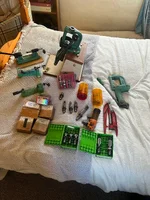
Thinking of reloading,

We all have our preferences in our methods, and as long as they are safe, logical and can create a repeatable process to learn and build upon, then we are splitting hairs.

If there is no mentor in front of him, I like to do simple processes to learn one thing at a time to build on.
In my case, I like to pass on what a the start of a dangerous round feels like, and how to stay away from it.
If you don't know what you are looking at or why things happen, it can be a potential dangerous process, hence change one step at a time and test, writing down every piece of information as you go.
 
We all have our preferences in our methods, and as long as they are safe, logical and can create a repeatable process to learn and build upon, then we are splitting hairs.

If there is no mentor in front of him, I like to do simple processes to learn one thing at a time to build on.
In my case, I like to pass on what a the start of a dangerous round feels like, and how to stay away from it.
If you don't know what you are looking at or why things happen, it can be a potential dangerous process, hence change one step at a time and test, writing down every piece of information as you go.
No need for him to worry about going too far, from what he’s written so far he seems to be a sensible person. He did however state he wanted an accurate load and unless he shoots the loads at a target all he will be doing is highlighting any difference between the published load and how it performs in his rifle.
Writing everything down is good, I’ve seen very experienced shooters panic when they misplace their record notebook.
I like to find that sweet load, make a few and put away whilst printing up a list of favourite loads by calibre and laminating it to keep it safe. You can always amend with a sharpie should your favourite powder get banned by the Eu!
 
I appreciate he comes over as a sensible chap, but anyone else who reads this post may also be a novice just starting out and may not be just as careful even if they think they are doing so.
I just like to give novices a safe working point, learning one thing at a time.
If it goes wrong, it can go really wrong...

A book is as important as the ammo and reloading tools...

I run a book for every barrel or rifle I load for, keeping targets in the same folder with the book.
Hopefully the targets should improve...🙈🤣

At the experienced end of the scale, in competition or testing I also run a portable weather station with mini post-its to mark similar weather conditions to compare components and accuracy.
 
evening chaps, first question today is how do i sort this out, and what are the reasons for it happening,
so i was making 10 rounds up today to finish of my first test round, i was priming them on the lee hand loader, first 6 went fine as expected, then one with the usual amount of pleasure would not seem to click into place, so i tried a different case, and the same thing happened, i didnt want to squeeze any harder as i didnt know what may happen, i dont know if it would blow up, go bang or nothing, so took primers out and it seemed to go ok, then on the last one it did it again, only this time the primer when in a bit but not fully, so now im left with a case stuck in the shell holder with the primer half in half out, and no idea what to do about it, IMG_8692.webp
 
today i did 10 more and decided for now to just stick with the Hornady book as i started with that, and the data seems to be near enough the same as GRT,
so iv 5 each of the different powder weights, all with 55g V-max bullets using alliant RL 10X, 19.5g 20.4g 21.3g and 22.2g, case length 1.750 and C.O.L 2.250.
so unless anyone tells me not to fire any of them rounds, they will be my test loads,

and on another note, i read in one of the posts that the RL 10 was not as fast burning as the N-133, in my ABC book of reloading there's a chart with a list of powders ranging from fastest to slowest,
RL 10 is No 77 and N-133 is No 80, make no wonder in confused.com :lol:
 
evening chaps, first question today is how do i sort this out, and what are the reasons for it happening,
so i was making 10 rounds up today to finish of my first test round, i was priming them on the lee hand loader, first 6 went fine as expected, then one with the usual amount of pleasure would not seem to click into place, so i tried a different case, and the same thing happened, i didnt want to squeeze any harder as i didnt know what may happen, i dont know if it would blow up, go bang or nothing, so took primers out and it seemed to go ok, then on the last one it did it again, only this time the primer when in a bit but not fully, so now im left with a case stuck in the shell holder with the primer half in half out, and no idea what to do about it, View attachment 347223
Flick it out using a pencil. I prefer universal primer tools as you don’t need the shell holder. Is it a military case? Perhaps using the cleaning tool may help, if not try a primer pocket crimp remover. It only needs doing once to each case!
 
evening chaps, first question today is how do i sort this out, and what are the reasons for it happening,
so i was making 10 rounds up today to finish of my first test round, i was priming them on the lee hand loader, first 6 went fine as expected, then one with the usual amount of pleasure would not seem to click into place, so i tried a different case, and the same thing happened, i didnt want to squeeze any harder as i didnt know what may happen, i dont know if it would blow up, go bang or nothing, so took primers out and it seemed to go ok, then on the last one it did it again, only this time the primer when in a bit but not fully, so now im left with a case stuck in the shell holder with the primer half in half out, and no idea what to do about it, View attachment 347223

Stand primer down over a hole in a bench or similar and gently but firmly push the primer out using a slim punch , wear eye protection and gloves . You could always wrap in a damp towel first to absorb any flash if you're worried but they require percussion to detonate .
 
Flick it out using a pencil. I prefer universal primer tools as you don’t need the shell holder. Is it a military case? Perhaps using the cleaning tool may help, if not try a primer pocket crimp remover. It only needs doing once to each case!
its a hornady v max varmint case, pretty sure i dont have a primer pocket crimp remover ,i do have a primer pocket uniforming tool, and a flash hole deburing tool, that is actually to big, was going to get a smaller one till i saw someone say there not needed,
 
Stand primer down over a hole in a bench or similar and gently but firmly push the primer out using a slim punch , wear eye protection and gloves . You could always wrap in a damp towel first to absorb any flash if you're worried but they require percussion to detonate .
that sounds like a safe option. id feel better with a bomb disposal suit on though :lol: am i knocking it back out the way i tried to put it in,
 
all read and nearly understood, i think im going to stop making any bullets until im sure im making something worth using, for the time being i wont be doing to much messing about, i wont be ever searching for that perfect bullet on bullet round (although it would be nice) anything under 1" moa at this stage will do, 1/2 moa would be nice though, i will obviously have to work up loads with the powders iv got and bullets and see if any comb works well, so far iv made 5 with RL 10 v max bullet with 19.5g and 5 with 20.4g, im thinking of making 5 more with 21.3g then go out and test them, but as were due rain here all week, it will probably have to be next weekend,
Do you realise 1/2 moa is the mecca of bench rest shooters? You will be kissing frogs expecting that sort of accuracy from a hunting rifle, if you get it then its a keeper.
 
evening chaps, first question today is how do i sort this out, and what are the reasons for it happening,
so i was making 10 rounds up today to finish of my first test round, i was priming them on the lee hand loader, first 6 went fine as expected, then one with the usual amount of pleasure would not seem to click into place, so i tried a different case, and the same thing happened, i didnt want to squeeze any harder as i didnt know what may happen, i dont know if it would blow up, go bang or nothing, so took primers out and it seemed to go ok, then on the last one it did it again, only this time the primer when in a bit but not fully, so now im left with a case stuck in the shell holder with the primer half in half out, and no idea what to do about it, View attachment 347223
Put it all in the woodburner, it will blow itself off.
 
that sounds like a safe option. id feel better with a bomb disposal suit on though :lol: am i knocking it back out the way i tried to put it in,
If you are just unlucky with primer sizes it may be worth using the uniforming tool on your pockets the once. I’d be happy with nipping the stuck primer out with a pair of pliers tbh. I have bifocal safety glasses because I didn’t want to have non safety bifocals at work!
 
evening chaps,

im thinking of getting into reloading for my 223, read reviews saying its not worth the outlay, some saying rounds are costing less than half price,
i dont mine the time it will take as im sure i will enjoy it,
so my questions are, what exactly will i need to do a decent job, how much all the gear costs,

thanks,

lee
you will not save money just end up shooting more ha ha
 
Do you realise 1/2 moa is the mecca of bench rest shooters? You will be kissing frogs expecting that sort of accuracy from a hunting rifle, if you get it then its a keeper.
i was pretty much there with factory ammo, gameking and blitzking, have no idea why im reloading:lol:

 
I’m all for ensuring one’s approach to reloading is as anal & OCD as is acceptable without soliciting strange looks from one’s FEO, but how is it this thread has turned into one advocating the need for rocket-like science and allied computer modelling to achieve the following basics?

1. De-prime and resize case
2. Prime case
3. Fill case with proscribed amount of chosen powder as detailed manufacturer’s pamphlet
4. Seat bullet in accordance with reloading manual guidance
5. Head to a MOD or other suitably safe rifle range and send bullet into target and backstop.

K
 
Don’t worry about other people’s results just get a chronograph and test your loads.
I am feeling controversial this evening, so will ask, what does the chrono tell you that the vertical drop does not?
I have a chrono sitting here doing nothing much, because I know the speed difference across a set of loads straight away from the drop.
Even absolute speed is easily determined from the difference in drop between say 100m and 200m, using the published ballistic coefficient of the bullet and a ballistic calculator app.
All the chono is good for, it telling you how consistent your load is, which a £14 scale does even better.
3. Fill case with proscribed amount of chosen powder as detailed manufacturer’s pamphlet

Using a "proscribed amount" would definitely make the range more fun, or one's membership being withdrawn. Another Freudian slip, but being less of a tearaway by using a prescribed load, who is doing the prescribing, and what are they achieving, are they achieving it in your rifle? Are you really sure? That is where computers come in. When Alliant are doing the prescribing, the loads seem to be severely anaemic.
 
Last edited:
I am feeling controversial this evening, so will ask, what does the chrono tell you that the vertical drop does not?
I have a chrono sitting here doing nothing much, because I know the speed difference across a set of loads straight away from the drop.
Even absolute speed is easily determined from the difference in drop between say 100m and 200m, using the published ballistic coefficient of the bullet and a ballistic calculator app.
All the chono is good for, it telling you how consistent your load is, which a £14 scale does even better.
All a chronograph does is confirm what speed the bullet leaves the muzzle allowing you to calculate muzzle energy and see what any particular load does in that rifle.
If you think that your method is best fill your boots. Bullet drop also depends an awful lot upon the setting that you have your sights set at and at what point your bullet crosses the line between your barrel and target on the way up and back down.
 
I have 3-4 loads for varying bullets for my 223 and not one of them has gone over a chronograph. Once I've settled on a load I then confirm drop data by firing at those ranges, a chrono is very helpful but the bullet doesn't lie and in the end the bullet impact is whats to be led by. Chronographs will get you very close but always worth verifying.

I saw Todd Hodnett verifying 4 rifle systems in this,manner and each of them needed a tweak to get POA /POI dialled in. Admitted this was at long range but even more so important at those ranges.
 
Back
Top