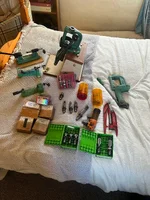
Thinking of reloading,

would you not bother with the 20.7 21.7 and 22.7, if you were me,
I personally would not. But then again, I personally have seen a few stuck bolts and primers with ejector marks ;) especially years ago when I learnt reloading in the US, working with someone who took a risk or two. It takes a bit of judgement to know what is unsafe and what is a bit of an overpressure but still "safe". 23.7gn is where I personally would start on this run. Others might start lower, and learn something more on the way. You make your own decision. If you get a pressure sign, then back off a bit and try again. 23.7gn is most unlikely to cause your gun to be damaged: the proof house ran two shots at 78K psi on your rifle without damage.

The point Fox Tales makes is a very good one: when starting out you need to run something rather lower than the optimum to check everything is calibrated properly. Having extra case capacity, differences in jump, etc make a difference to the max pressure. Looking at your load, 23.7gn should do that for you. Someone more conservative would go back to 23.2gn or even lower, though a modern rifle does not suddenly go bang if you go a bit over the 62.5k psi for a single shot - the GRT warning marks are simply warning you to be careful but warning marks on cases are real.
A few I know, rarely stray outside the GRT danger sign marks but that is definitely not where to begin, especially in a lightweight hunting rifle, nor is there any need to.

Going up in 0.5gn increments would be the normal thing to do. Whole grain jumps are a big jump.
 
Last edited:
Going up in 0.5gn increments would be the normal thing to do. Whole grain jumps are a big jump.
100% agree, if looking for that accuracy sweet spot 1/10th or maybe 2/10ths as steps, assuming you dont have a massive range of weights to pick from.
 
changed my case volume from 31 what it was, to 29, its now changed the max charge to dangerous, on the parameters there are things i dont even know what they are, let alone what they shoud be changed to, View attachment 347424

Now you can see how quickly things can slide downhill and why @25Sharps recommends using factory data .
We were all new to reloading once , at this stage I would err on the side of caution . It's worth noting hot loads have a negative affect on brass life , GRT is useful but you need to learn to drive it .

Hopefully I've given the correct bullet data from the Sierra App' , for some reason I thought you were using SBK's .🤦‍♂️
 
As an aside to this I have on my bench a sheet of white milk glass that was lying around my house since we came over here from the UK 22 years ago. It is a great help as you will sometimes spill powder which then shows up so well against the white backdrop. Normal glass can be painted white underneath ( I did a radio bezel back in the 1970s that's how I know) and you will get a high gloss white top surface.
 
Eric Cortina states that many powder nodes are approx .3gn apart, I used to do .5gn and switched to .3gn to test for myself and did indeed find some good nodes
 
well chaps, it was kind of fun whilst it lasted, but due to what iv luckily picked up on today, im going to have to end my reloading journey.
100% my fault i know, but im also surprised know one picked up on it , i only noticed today after weighing out some powder and then checking in the case that id done them all with a torch, it was my second batch that should of been 20.5g, i noticed there seemed to be a lot of powder in the case so started looking for the reason why. i will let my pictures do the explaining, Screenshot 2024-01-23 154036.webpScreenshot 2024-01-23 154147.webpScreenshot 2024-01-23 155048.webp
 
well chaps, it was kind of fun whilst it lasted, but due to what iv luckily picked up on today, im going to have to end my reloading journey.
100% my fault i know, but im also surprised know one picked up on it , i only noticed today after weighing out some powder and then checking in the case that id done them all with a torch, it was my second batch that should of been 20.5g, i noticed there seemed to be a lot of powder in the case so started looking for the reason why. i will let my pictures do the explaining, View attachment 347470View attachment 347471View attachment 347472

I'm confused that looks like 15.9 grains , did you double charge or was there a lot of empty case ? Either way , don't be so hard on yourself ! You picked up on a mistake , take that as a win . Discard GRT for now , you've got the Hornady data and that's safe .
None of us are perfect .
 
Last edited:
I'm confused that looks like 15.9 grains , did you double charge or was there a lot of empty case ? Either way , don't be so hard on yourself ! You picked up on a mistake , take that as a win . Discard GRT for now , you've got the Hornady data and that's safe .
None of us are perfect .
yest that is 15.9g, but should of been 19.5g, and if id of not picked up on it today instead of a 22.5g id of done a 25.2g,
 
A lad on YouTube, Passion For Rifles i think, uses a £15 digital scale from amazon and his groups are epic!! If interested I can send a.link
 
yest that is 15.9g, but should of been 19.5g, and if id of not picked up on it today instead of a 22.5g id of done a 25.2g,

Take a step back , a deep breath and start again , it's a lesson you won't forget and it's knocked your confidence . The important bit was you were being diligent and picked up on it .
I would concentrate on one bullet and powder combination , adhere to the factory data as regards COL and charge weights . Load in 0.3 grain increments to maximum and mark the charge weights on the cases with a Sharpie as you go .
You've already taught yourself the basics ,sizing, trimmer, priming and bullet seating . You're incredibly close to having workable , completed ammo .
 
Last edited:
Why? You used the data from that to put into GRT and GRT is now giving you nice loads. 23.7 to 24.7gn.
GRT is giving you a full 100% burn of Reloader 10X, with that combo. Load ratio is great at 97%.
Start with 23.7, try 24.2 and 24.7gn, and stop there. With a lot of experience, one could go straight to 24.7gn, but use the two lower loads (23.7 and 24.2) as your workup to check everything is correct.
CHECK ALL THE PARAMS ARE RIGHT, then time to put the tools down, load and head to the range.
Inexperience talking right there!!

No one with experience jumps straight to a top end load.

Just because GRT / quick load etc says that 24.7 is best it doesn’t mean it will be in that rifle. You may well find a lower load is more accurate and consistent in your particular barrel.

For example in my creedmoor 46 grains of N160 is the theoretical best kid yet 41.5 gives repeatable .35 MOA accuracy. A perfect load for 200/300 yard Mcqueens where epic speeds are. It required.

Also with simulations it’s easy for a new reloader to get confused with all of the inputs and outputs and potentially get one wrong.

New reloaders should stick with published data to start with and get a couple of loads under there.
changed my case volume from 31 what it was, to 29, its now changed the max charge to dangerous, on the parameters there are things i dont even know what they are, let alone what they shoud be changed to, View attachment 347424
so stick to published data, leave the simulators well alone, for now
 
Inexperience talking right there!!

No one with experience jumps straight to a top end load.

Just because GRT / quick load etc says that 24.7 is best it doesn’t mean it will be in that rifle. You may well find a lower load is more accurate and consistent in your particular barrel.

For example in my creedmoor 46 grains of N160 is the theoretical best kid yet 41.5 gives repeatable .35 MOA accuracy. A perfect load for 200/300 yard Mcqueens where epic speeds are. It required.

Also with simulations it’s easy for a new reloader to get confused with all of the inputs and outputs and potentially get one wrong.

New reloaders should stick with published data to start with and get a couple of loads under there.

so stick to published data, leave the simulators well alone, for now
*are not required
 
I personally would not. But then again, I personally have seen a few stuck bolts and primers with ejector marks ;) especially years ago when I learnt reloading in the US, working with someone who took a risk or two. It takes a bit of judgement to know what is unsafe and what is a bit of an overpressure but still "safe". 23.7gn is where I personally would start on this run. Others might start lower, and learn something more on the way. You make your own decision. If you get a pressure sign, then back off a bit and try again. 23.7gn is most unlikely to cause your gun to be damaged: the proof house ran two shots at 78K psi on your rifle without damage.

The point Fox Tales makes is a very good one: when starting out you need to run something rather lower than the optimum to check everything is calibrated properly. Having extra case capacity, differences in jump, etc make a difference to the max pressure. Looking at your load, 23.7gn should do that for you. Someone more conservative would go back to 23.2gn or even lower, though a modern rifle does not suddenly go bang if you go a bit over the 62.5k psi for a single shot - the GRT warning marks are simply warning you to be careful but warning marks on cases are real.
A few I know, rarely stray outside the GRT danger sign marks but that is definitely not where to begin, especially in a lightweight hunting rifle, nor is there any need to.

Going up in 0.5gn increments would be the normal thing to do. Whole grain jumps are a big jump.
Primers with ejector marks?
 
well chaps, it was kind of fun whilst it lasted, but due to what iv luckily picked up on today, im going to have to end my reloading journey.
100% my fault i know, but im also surprised know one picked up on it , i only noticed today after weighing out some powder and then checking in the case that id done them all with a torch, it was my second batch that should of been 20.5g, i noticed there seemed to be a lot of powder in the case so started looking for the reason why. i will let my pictures do the explaining, View attachment 347470View attachment 347471View attachment 347472
When loading set everything out then speak out loud the load you are doing, check the setting on the scale whilst you say the powder weight, that way you’ll pick up on things like the above.

Each time you move the weight, say it out loud to yourself, visually checking as you do so…..
 
Remember the essential safety advice about using two scales, the second can be a cheapo £14 electronic scale from Amazon?

You did fine getting 15 grains, but errors can also go the other way.

Use the second to check the first load, and then either every load or every 5th? Murphy's law says when a grains get stuck it chooses to get stuck just where you don't want them.

Primers with ejector marks?
A typo, meant primers cratered or out and cases with really distinct ejector marks. Can upload a few pics if anyone wants a smile ... A memorable lot of rounds were given to me for a bench rifle I bought from a competition champion shooter. GRT said they were 20% over the max when I later took the remaining ones apart and measured then calculated. Always take a mallet to the range, for getting bolts open again :). Going 10% under the calculated optimum seems to avoid all that while not wasting much on the work up. The chap I learnt reloading from in the US, also used hot rounds before the days of GRT and the only thing to suffer was hearing. Be careful of experienced guys, who play with the limits. His process was start with a manufacturer's light load, then go up in quite big steps until there are obvious pressure signs then go back slightly. Never believed in finding the tightest group, as he put it down to stats variation and instead worked on COAL and jump to get grouping. Trouble with that, is pressure is not always consistent as tolerances play into it, and the tolerances were wider than now.
Life is about learning. Still learning new things, such as even with a light load, don't mix cases from different rifles.
 
Last edited:
Back
Top