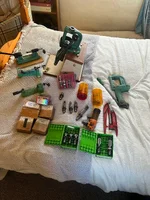
Just a few safety things worth mentioning if you are starting out reloading:
1. Don't reload or process cases in an area that is used for food or that children can access at any time, e.g. your kitchen or living room. If a child eats a spent primer, there is still enough lead styphnate in it to give lead poisoning. Metallic lead and white lead oxide are much less of a problem because they do not dissolve in water, but there is a chap on the US sniper site with life long injuries from lead due to playing in his father's reloading area where he had repeated exposure to lead dust. Same for tumbling cases - not something to do in a house - you need a shed. In a house use wet tumbling. I am of the generation where we used our teeth to close lead fishing weights, poured lead in the house and handled mercury but am now a little wiser.
2. Do not believe other people's loads. Download Gordon's Reloading Tool and use it to check every load. It is free, and revealing. Cross check it with the powder supplier's recommended load data when starting out. How do I know this? I copied loads from a champion shooter that I bought a rifle from once without checking the load data ... that was dumb, especially when they had increased COAL to hard jam. Fortunately, saw the pressure signs on first round then did the sums - it was almost 100,000 psi. Good job it was a huge fat barrel.
3. Do not use any load under 60% full, as sooner or later you will double load. If your load works out at under 60% full, then get a different powder. Most other don'ts are common sense or are widely reported.
On the toys you need:
1. You need two scales. A simple beam scale is ideal, especially with a trickler, but get in addition a cheap scale that shows grains to 0.02 to check: beam scales can stick and the level adjustment can give you a significant error if used blind.
2. Targetmaster tricker and a beam scale, is a steal. £110 well worth spent, even if you go for an RCBS chargemaster later.
3. Chinese verniers are often out by +/-0.2mm. A good vernier is accurate to +/-0.02mm (e.g. Mitutoyu, Sylvac or M-Sure), a micrometer is ten times better than that but you need a few sizes. Go for M-Sure if your budget is limited. How I know this: I am a professional engineer and I do calibrate verniers against calibration blocks once a year, and scrap many calipers especially the sub £30 ones from China. I have never had need to scrap a Mitutoyu, Sylvac or M-Sure.
Other than that, buy what you need once and get the proper kit from the outset. If you don't like it, you can always sell it on here to those further down the food chain.




 , iv also converted my callipers to mm rather than inches as i can understand the difference of half a mm or so, not so much 1/10.000 of an inch,