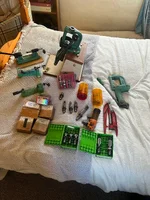
Thinking of reloading,

thanks chaps, iv decided not to give in, i will buy some digital scales too and double check my loads,
now, lets talk bullet pullers, do they save the case and bullet or one or the other, iv seen the hammer type that look simple to use, no name one £15 or a lyman for £30 i think it was, iv 25-30 loads i need to not exist anymore,
 
thanks chaps, iv decided not to give in, i will buy some digital scales too and double check my loads,
now, lets talk bullet pullers, do they save the case and bullet or one or the other, iv seen the hammer type that look simple to use, no name one £15 or a lyman for £30 i think it was, iv 25-30 loads i need to not exist anymore,
Pullers save the lot.
No name kinetic (inertial) pullers work fine.

If neck tension is low afterwards, resize the necks only to save the primers: I would be too nervous to do a FLS with a primed case though I am sure others may say it is fine if one goes slow and wears PPE as it does not deform the base.
 
Last edited:
15.9g, but should of been 19.5g, and if id of not picked up on it today instead of a 22.5g id of done a 25.2g,
@tikkat1x

Whilst I do not wish to add to your woes (and you are not the only one on this thread):-

The symbol for grains is gr

The symbol for grammes is g

If you are talking about reloading it helps to have the nomenclature correct - it will help with your understanding and reduce confusion.

It's the same for 'bullets'...but l for one have lost the will to live trying to sell that.
 
@tikkat1x

Whilst I do not wish to add to your woes (and you are not the only one on this thread):-

The symbol for grains is gr

The symbol for grammes is g

If you are talking about reloading it helps to have the nomenclature correct - it will help with your understanding and reduce confusion.

It's the same for 'bullets'...but l for one have lost the will to live trying to sell that.
As a teenager it was always called projectile vomiting, never heard of head puking.
 
Just a few safety things worth mentioning if you are starting out reloading:
1. Don't reload or process cases in an area that is used for food or that children can access at any time, e.g. your kitchen or living room. If a child eats a spent primer, there is still enough lead styphnate in it to give lead poisoning. Metallic lead and white lead oxide are much less of a problem because they do not dissolve in water, but there is a chap on the US sniper site with life long injuries from lead due to playing in his father's reloading area where he had repeated exposure to lead dust. Same for tumbling cases - not something to do in a house - you need a shed. In a house use wet tumbling. I am of the generation where we used our teeth to close lead fishing weights, poured lead in the house and handled mercury but am now a little wiser.
2. Do not believe other people's loads. Download Gordon's Reloading Tool and use it to check every load. It is free, and revealing. Cross check it with the powder supplier's recommended load data when starting out. How do I know this? I copied loads from a champion shooter that I bought a rifle from once without checking the load data ... that was dumb, especially when they had increased COAL to hard jam. Fortunately, saw the pressure signs on first round then did the sums - it was almost 100,000 psi. Good job it was a huge fat barrel.
3. Do not use any load under 60% full, as sooner or later you will double load. If your load works out at under 60% full, then get a different powder. Most other don'ts are common sense or are widely reported.

On the toys you need:
1. You need two scales. A simple beam scale is ideal, especially with a trickler, but get in addition a cheap scale that shows grains to 0.02 to check: beam scales can stick and the level adjustment can give you a significant error if used blind.
2. Targetmaster tricker and a beam scale, is a steal. £110 well worth spent, even if you go for an RCBS chargemaster later.
3. Chinese verniers are often out by +/-0.2mm. A good vernier is accurate to +/-0.02mm (e.g. Mitutoyu, Sylvac or M-Sure), a micrometer is ten times better than that but you need a few sizes. Go for M-Sure if your budget is limited. How I know this: I am a professional engineer and I do calibrate verniers against calibration blocks once a year, and scrap many calipers especially the sub £30 ones from China. I have never had need to scrap a Mitutoyu, Sylvac or M-Sure.

Other than that, buy what you need once and get the proper kit from the outset. If you don't like it, you can always sell it on here to those further down the food chain.
On your recommendation I've got an M-sure caliper on the way.
 
thanks chaps, iv decided not to give in, i will buy some digital scales too and double check my loads,
now, lets talk bullet pullers, do they save the case and bullet or one or the other, iv seen the hammer type that look simple to use, no name one £15 or a lyman for £30 i think it was, iv 25-30 loads i need to not exist anymore,

If you buy a kinetic hammer , push a foam ear plug into the bottom . That way you'll protect the bullet tip / meplat from damage. 😉
 
If you can buy decent quality second hand and it doesn’t need to cost much. Don’t need a lot of kit that some use. Your chamber dims can be ascertained with a vernier calliper which is an essential piece of kit anyway, something to stand your cases in, a pad for lubing, a bottle of lube, neck brush with primer pocket cleaner, a powder thrower, scales, press of course with suitable dies, hand chamfer tool. I prefer inserting primers with a hand press (cheap), and some will say a case trimmer, but you could get away with that.

Gives you the ability to load small amounts when needed that’ll be exactly the same as your previous batch unless you do it in a hurry and do something silly like I did when loading 10 rounds of 243 partitions at the end of a season and loaded 48g rather than 40.8g of H4350. Shot 2 sika prickets in quick succession and thought the bolt was a bit stiff after the first shot 🙄
It is nice to see a box ready to go with what you know will produce as long as you’ve done your bit.
 

Attachments

  • IMG_1285.webp
    IMG_1285.webp
    258 KB · Views: 8
And don’t forget the case cleaning:

K
Now those are nice and clean cases you posted, and they are in an ultrasonic cleaner tray. They look great.
I never got brass as clean as that it an ultrasonic cleaner. What solvent are you putting in the cleaner, and what temperature and duration are you using?

I am using vibratory cleaners with corn or walnut shell media (2 of them, both needing repair), and a tumbler with pins (also needing repair - cleaning is becoming a bit like fixing lawnmowers), adding a bit of brasso to each. Ultrasonic cleaners are much easier to work with, and have nice 3L one here that is 100% functional, so can you disclose your trick?
 
Now those are nice and clean cases you posted, and they are in an ultrasonic cleaner tray. They look great.
I never got brass as clean as that it an ultrasonic cleaner. What solvent are you putting in the cleaner, and what temperature and duration are you using?
I am using vibratory cleaners with corn or walnut shell media (2 of them, both needing repair), and a tumbler with pins, adding a bit of brasso to each. Ultrasonic cleaners are much easier to work with, so can you disclose your trick?
Cases have only just gone in the cleaner as they’ve been subject to trimming, FLS, neck turning, flash hole de-burring, primer pocket uniforming, neck turning and case mouth chamfering. All of which has ensured they are oil/lubricant contaminated.

I can assure you they will come out of ultrasonic de-greasing process looking 100 times less clean/shiny than when they went in!

K
 
im happy to take suggestions:)
I have just swapped from hand turned chamfering in a bit holder to using a battery drill. Hm, how do I run it slowly enough as my finger began to vibrate after 200 cases? Solution like on the old wooden bow saws, by twisting a piece of string with an allen key to get the desired tension then locking the key under the drill body. Easy. Now I have done 300 Cineshot 30-06s with very little effort.
You can see the milk glass surface I use below the drill.
 

Attachments

  • SlowMo.webp
    SlowMo.webp
    24.9 KB · Views: 13
So, all my mistakes aside and waiting on the bullet puller,
iv now 5 round in each of the 4 weight differences with both the hornady and sierra bullets ready to go, weather is looking of to get them tested tomorrow,
im confident iv made no mistakes this time:) so if i haven't blown myself up, tomorrow night i will get on working up some more loads with the N-133 and test them sunday,
iv speeded up a good bit after realising i was being a clown and when resizing y brass i was setting it back to zero every time then re adjusting for each case rather than realising they if it was set at 1.750 then it would do them all the same, i was doing the same thing whilst seating the bullet, turning it a good turn before seating the bullet then working it down to 2.250 instead of again not realising if the case was the same then the seating depth would be the same:banghead:, iv also converted my callipers to mm rather than inches as i can understand the difference of half a mm or so, not so much 1/10.000 of an inch,
 
Back
Top