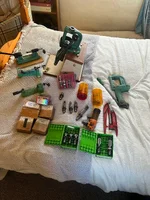
Thinking of reloading,

This^^^^

Always anneal before fireforming; especially if it's a radical change. Otherwise you risk splitting necks and shoulders in the fireforming process. Especially if the parent case brass has been once fired.
Thanks, that will give me something to do in the evenings as I will be back to the UK as of next Friday for three weeks all alone with nothing to do. The customs at the port might raise an eyebrow or two though with the annealing machine and 220 cases stowed in the trunk and me without an active UK FAC anymore.
 
PS, that sounds like a lot of walking to me🙀
I do have a Minox spotting scope that I bought new and never used just because you could add their Minox digiscoping gizmo to the occular, then six years later I finally bought the gizmo but the tech had moved on and I am too old for all that now.
 
so just checking out some load data for the N-133 and its all conflicting again, even to the point of danger, iv changed my max preasure on GRT back to 55,000 psi rather than 62.000 psi to stay on the sage side for now.

so with the N-133 using Hornady 55g V-max GRT has 18.5gr 19.5gr 20.5gr 21.5gr 22.5gr max.
Hornady manual says, 19.8gr 20.8gr 21.8gr 22.7gr,
Viht says 21.5gr - 25.0gr, but at 25.0gr GRT has that at 111% do not use.

sierra 55g SPT, sierra site has it at 21.4gr 22.1gr 22.8gr 23.5gr 24.2gr 24.9gr, GRT has the last 2 as over pressure with the 24.9gr being 64.464 psi.
GRT has the sierra at 19.5gr 20.5gr 21.5gr 22.5gr 23.5gr, max,
whats a man to do, im thinking of going with GRT on this one??
iv 40 cases ready, for powder and bullets :D

Sierra 55 grain SPT - max' charge 23.5 grain of N133 . From the Sierra App' .

Use the most up-to-date data available . Forget GRT for now .Screenshot_20240130-093558.webp
 
sounds like a plan, and i only went with the GRT figures as they seemed a happy medium without going to far to start with, more homework, finding out what a ladder test is, and what OCW means :D
and i thought seating depth was determined by the COAL,
i did take a picture of mine verses the factory loads, only mine is using s spitzer and the factory load is a gameking, factory load is on the right, hornady factory load is on the left View attachment 348541.
That is quite a big difference in seating depth. I realise one bullet had a flatter head than the other, but the whole bullet on the right is seated more deeply than the one on the left. Jump distance is important. Why is there such a variation in depth with your process?
 
That is quite a big difference in seating depth. I realise one bullet had a flatter head than the other, but the whole bullet on the right is seated more deeply than the one on the left. Jump distance is important. Why is there such a variation in depth with your process?
i just worked to the recommended 1.750 CL and 2.250 OCL, i did measure the 2 as i noticed the difference, sierra was 2.210 and the hornady was 2.240,
 
i just worked to the recommended 1.750 CL and 2.250 OCL, i did measure the 2 as i noticed the difference, sierra was 2.210 and the hornady was 2.240,
Amongst all the kit you have bought, did you buy a comparator set so that you can measure to the Ogive of the bullet and not to the tip, and the accompanying case length comparators so that you measure to the datum on the shoulder rather than the full case length when resizing?
Both simple pieces of equipment that improve the consistency of your loads.
 
both of them have been mentioned to me before, but i guess i was trying to buy every bit of equipment on the market for this hobby i was told was inexpensive to start up,
and although i say im not trying to be a master bullet builder, i probably am :D and some bits of equipment i look at i think "do i really need one of them" if the answer is yes then ill have one here in a couple of days, when i look at my results from the other day on my first attempt i think how much better can it get, for shooting live quarry, its already very nearly as good as any of the same factory loads i tested, within a few mm, but i will buy anything at any cost if its something then will prevent me from making mistakes that will harm me or my rifle👍
 
Amongst all the kit you have bought, did you buy a comparator set so that you can measure to the Ogive of the bullet and not to the tip, and the accompanying case length comparators so that you measure to the datum on the shoulder rather than the full case length when resizing?
Both simple pieces of equipment that improve the consistency of your loads.
I have both, they really changed my method.
 
both of them have been mentioned to me before, but i guess i was trying to buy every bit of equipment on the market for this hobby i was told was inexpensive to start up,
and although i say im not trying to be a master bullet builder, i probably am :D and some bits of equipment i look at i think "do i really need one of them" if the answer is yes then ill have one here in a couple of days, when i look at my results from the other day on my first attempt i think how much better can it get, for shooting live quarry, its already very nearly as good as any of the same factory loads i tested, within a few mm, but i will buy anything at any cost if its something then will prevent me from making mistakes that will harm me or my rifle👍
You can check the shoulder bump position with a fired deprimed 9mm pistol case and a vernier caliper which was what I did before going 1st class it is all over youtube.
 
i just worked to the recommended 1.750 CL and 2.250 OCL, i did measure the 2 as i noticed the difference, sierra was 2.210 and the hornady was 2.240,
30''': difference looks like it is more like 40''' to 50''' but could be just an illusion. See what just 3''' difference does: .

I may be a bit OTT on variances but like my loads to be well under 1''' in COAL variation. On top of that two different bullets will group totally differently and are normally optimised with a different load so best to focus on one bullet to start with rather than Sierra + Hornady.
The groups you posted were pretty good for first shots, so it would be interesting what optimised loads do for you with all variations removed.
 
Last edited:
both of them have been mentioned to me before, but i guess i was trying to buy every bit of equipment on the market for this hobby i was told was inexpensive to start up,
and although i say im not trying to be a master bullet builder, i probably am :D and some bits of equipment i look at i think "do i really need one of them" if the answer is yes then ill have one here in a couple of days, when i look at my results from the other day on my first attempt i think how much better can it get, for shooting live quarry, its already very nearly as good as any of the same factory loads i tested, within a few mm, but i will buy anything at any cost if its something then will prevent me from making mistakes that will harm me or my rifle👍
As you've found out, bullet lengths vary, the Ogive position is much more consistent.
Without a comparator when you set up your seating die and load a round to a certain length, often you check the next round and it's a slightly different length, chances are that it's the tip that is a different length, but the length to the Ogive is the same, only a comparator will tell you.
I've helped a fair few folk out with reloading and they try to get consistency, so they measure the COAL to the tip and find it wanders from round to round, so they Bggr about with the die and end up with a box of made up cartridges, with quite a few are not the same length to the Ogive, so the jump to the lands isn't the same.
If you want the Ogive to have the same length of jump before it engages in the rifling the only way to do that is to measure your length to the with a comparator.
My standard practice is to start with the calibre diameter as the length of bullet shank in the neck as long as it fits in the mag and doesn't jam in the rifling (it never has), and measure it to the Ogive.
When I have a powder charge that produces good groups I can then try to tighten them further by moving the Ogive closer or further from the rifling in 10-15thou increments, being wary that if I get too close to the lands pressure may spike and if I put a lot more shank in the neck pressure will rise because the powder may become compressed.
The COAL doesn't really matter unless the bullet has a really weird profile because the key part of the equation is how far the Ogive has to travel before engaging in the rifling.
 
As you've found out, bullet lengths vary, the Ogive position is much more consistent.
Without a comparator when you set up your seating die and load a round to a certain length, often you check the next round and it's a slightly different length, chances are that it's the tip that is a different length, but the length to the Ogive is the same, only a comparator will tell you.
I've helped a fair few folk out with reloading and they try to get consistency, so they measure the COAL to the tip and find it wanders from round to round, so they Bggr about with the die and end up with a box of made up cartridges, with quite a few are not the same length to the Ogive, so the jump to the lands isn't the same.
If you want the Ogive to have the same length of jump before it engages in the rifling the only way to do that is to measure your length to the with a comparator.
My standard practice is to start with the calibre diameter as the length of bullet shank in the neck as long as it fits in the mag and doesn't jam in the rifling (it never has), and measure it to the Ogive.
When I have a powder charge that produces good groups I can then try to tighten them further by moving the Ogive closer or further from the rifling in 10-15thou increments, being wary that if I get too close to the lands pressure may spike and if I put a lot more shank in the neck pressure will rise because the powder may become compressed.
The COAL doesn't really matter unless the bullet has a really weird profile because the key part of the equation is how far the Ogive has to travel before engaging in the rifling.
Wouldn't agree entirely on the COAL, but we would be splitting hairs because with plastic tips the uniformity to ogive is phenomenal. Agree he needs a comparator or socket.

Your post reminded me to tikkat1x with the recommendation to get the stick on ruler.
Stick on ruler on your reloading bench enables you to sort things by weight and length fast. Taking out the outlier bullets helps.
 
To trust measurements taken at some point on the ogive, bullets will likely need to be very concentric for this to be a more reliable and trustworthy over measuring o/a length with a quality, likely tipped bullet. I used to check concentricity with a jig I made and would not use anything for load development beyond 3 though of eccentricity. However, I haven’t bothered with this for the last 4 loads I’ve done as I don’t think it’s important unless of course you’ve loaded it like a banana.
I’ll model it later this evening, just 5 mins work and will give you a good idea how much eccentricity affects measuring to the ogive.
 
this is just blowing my mind now:eek: so hard to understand when you dont understand, words i dont even know what they are, and out of the measurement of 2.250 i dont even know which part of the is 1/1000th of an inch,
 
this is just blowing my mind now:eek: so hard to understand when you dont understand, words i dont even know what they are, and out of the measurement of 2.250 i dont even know which part of the is 1/1000th of an inch,
Bud, keep it simple, one bullet, one powder, simple kit, accurate measurements and take it from there.
If one bullet/brass/powder/primer combination doesn't work just change one component at a time.
Tumblers, ultrasonics, annealing etc, way down the road, you now have a load that will kill foxes without an issue, how far you want to finesse it depends on how much you want reloading to be a hobby in itself or just simply a means to make accurate ammunition ;)
Feel free to PM.
 
To trust measurements taken at some point on the ogive, bullets will likely need to be very concentric for this to be a more reliable and trustworthy over measuring o/a length with a quality, likely tipped bullet. I used to check concentricity with a jig I made and would not use anything for load development beyond 3 though of eccentricity. However, I haven’t bothered with this for the last 4 loads I’ve done as I don’t think it’s important unless of course you’ve loaded it like a banana.
I’ll model it later this evening, just 5 mins work and will give you a good idea how much eccentricity affects measuring to the ogive.
So I've just measured some 6.5 bullets for accuracy of o/a length:-

Accubond with a polymer tip, max variation over 10 bullets of .0025"
Yew Tree with an aluminium (I assume) tip, max variation over 10 bullets of .0005"

From the quick drawing I've done to approximate a 6mm Nosler BT, with an eccentric bullet of only .002", means a contact variation at the ogive of .013"

Loading with decent kit, RCBS and good brass, Norma, using good bullets, Nosler, I found that eccentricity up to .003" or even .005" was common. I concluded that when the bullet leaves the case and moves down a degree of free bore, eccentricity of these dimensions are irrelevant with the bullet eased into the rifling in a short distance and then travelling down a long barrel. Eccentricity measured at ogive will always produce bullets further from the land than planned, therefore you could say safer as athough the bullets I measured for o/a length are quality and therefore accurate, maybe there are bullets out there that are not so good.

This was the reasoning that although I have a precision mic for measuring to the ogive, I no longer bother as hunting ammo is more than capable of being produced by measuring the arguable more accurate o/a length. The OP I believe was interesting in loading within a budget and hence the reason I do not believe he needs to invest in precision micrometers.
 

Attachments

  • Ogive Contact.webp
    Ogive Contact.webp
    41.3 KB · Views: 9
this sound like what i need, and a head space kit, or head space bushing if it will work with the comaparator body £130:doh:
were only here the once👍

 
Last edited:
Back
Top