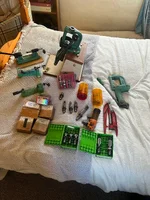
something like thisNo. Old fashioned vibratory with some kind of media and a shot of Brasso. Strictly for outdoor use and with gloves when removing cases. I left cases in the tumbler for 24-hours.
K


something like thisNo. Old fashioned vibratory with some kind of media and a shot of Brasso. Strictly for outdoor use and with gloves when removing cases. I left cases in the tumbler for 24-hours.
K
Isn't Brasso an absolute No No, because it contains Ammonia which leaches Zinc from the Brass and causes deterioration of the case?No. Old fashioned vibratory with some kind of media and a shot of Brasso. Strictly for outdoor use and with gloves when removing cases. I left cases in the tumbler for 24-hours.
K
That's my understandingIsn't Brasso an absolute No No, because it contains Ammonia which leaches Zinc from the Brass and causes deterioration of the case?
You did not write the primer used on the target, go to the back of the class

 to correctly fit in the Contenders chamber, it went surprisingly smoothly as it is twenty years ago now that I last did this operation, only one case showed a little buckling but that should iron out with fireform. Not decided yet if to anneal before or after the fireforming.
Tell my 25-year old RWS 22 Hornet brass!Isn't Brasso an absolute No No, because it contains Ammonia which leaches Zinc from the Brass and causes deterioration of the case?

In agreement. Tools are a capital cost. If you buy good 2nd hand your widow can probably sell them for what you paid. And you don’t need a lot.Is the handloaded ammo cheaper? I don't really know in spite of loading my own from 1978 on. What I value is if I have the makings I have ammo. There is a certain satisfaction when you get to hunt with a single shot rifle and bring home a deer killed with a handload. I am also a high volume varminter and if limited to factory offerings I could not afford to do so. Tools are expensive but with decent care last forever. I am open to pm on what you need to buy. Good luck.
I have found that keeping a batch together, with a little 'record card' is quite helpful.so, today was the day, and once again the mother of all F&^% ups, got my gear together, went to the farm, got all set up only to find the ammo case i got with the reloading kit i bought had rather a tall lid on it so when i opened the box they were all over the place, no idea what weights were where, so it was a none starter, thought id chamber a few make sure they went in my mag ok and check for bolt stiffness, only to find not one or the 40 id made up had primers in them FFS


amendedYou did not write the primer used on the target, go to the back of the class

Just to add to this. I measured the thickness of some new .225 Win cases wall with my ball micrometer (I know) they were at 0.0165" so quite thick as my .270 cases are usually 0.013" after the necks were opened out from 0.226 (once fired cases ) to 6.5mm the wall thickness was reduced to 0.0135" by the sideward stretching out.I have just had a therapeutic two days of lubing and sizing up once fired .225 Win (otherwise known as unicorn tears or rocking horse droppings) cases after pin cleaning to the 6.5 JDJ calibre size, the next step will be fireforming them with old reclaimed primers and free powder given to me by the local bomb disposal team
Before will give the best possible results for fire form. One of the most attractive Ruger No 1's saw in photo was a .225 win with a full octagon barrel, wish it was mine but not possible.I have just had a therapeutic two days of lubing and sizing up once fired .225 Win (otherwise known as unicorn tears or rocking horse droppings) cases after pin cleaning to the 6.5 JDJ calibre size, the next step will be fireforming them with old reclaimed primers and free powder given to me by the local bomb disposal team
This^^^^Before will give the best possible results for fire form. One of the most attractive Ruger No 1's saw in photo was a .225 win with a full octagon barrel, wish it was mine but not possible.
Consider that Sierra has pressure tested there data, I trust that way more than a program. Data conflicts exist, barrel dimensions vary and some are conservative max loads. I look at all I can before choosing my start and end point. Chronographs will tell you if you are in the ball park, when the load is close too or at pressure published data its time to stop adding powder, should you be at max charge and not see the result listed by the book stop adding powder. You may not ever get the shown results.so just checking out some load data for the N-133 and its all conflicting again, even to the point of danger, iv changed my max preasure on GRT back to 55,000 psi rather than 62.000 psi to stay on the sage side for now.
so with the N-133 using Hornady 55g V-max GRT has 18.5gr 19.5gr 20.5gr 21.5gr 22.5gr max.
Hornady manual says, 19.8gr 20.8gr 21.8gr 22.7gr,
Viht says 21.5gr - 25.0gr, but at 25.0gr GRT has that at 111% do not use.
sierra 55g SPT, sierra site has it at 21.4gr 22.1gr 22.8gr 23.5gr 24.2gr 24.9gr, GRT has the last 2 as over pressure with the 24.9gr being 64.464 psi.
GRT has the sierra at 19.5gr 20.5gr 21.5gr 22.5gr 23.5gr, max,
whats a man to do, im thinking of going with GRT on this one??
iv 40 cases ready, for powder and bullets

 .
.If you have a decent run of land to test loads on OCW is easy.sounds like a plan, and i only went with the GRT figures as they seemed a happy medium without going to far to start with, more homework, finding out what a ladder test is, and what OCW means
and i thought seating depth was determined by the COAL,
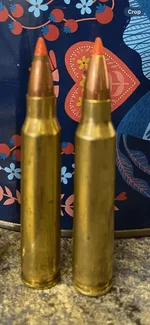
i did take a picture of mine verses the factory loads, only mine is using s spitzer and the factory load is a gameking, factory load is on the right,
hornady factory load is on the left, View attachment 348541View attachment 348542
 i have a perfectly flat field to shoot on thats a good 200-250 yard,that some sheep have just come off so its like a bowling green, albeit a wet one, and some larger, up to 950 yards but that would be shooting slightly up or down hill, i think im up for the OCW test, but i will leave the ladder test for now, get a few loads under my belt first, thanks.