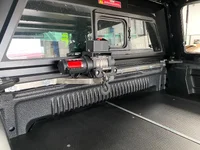
A winch @20 quid, half an acrow prop bit of 50mm box couple of pulleys etc.. 2hrs in the work shop..I added some castors to try to avoid any such damage and aid the loading.
Also lifts my mobile welder in...

A winch @20 quid, half an acrow prop bit of 50mm box couple of pulleys etc.. 2hrs in the work shop..I added some castors to try to avoid any such damage and aid the loading.

@Suilven Just be careful with those motorbike ramps - some don't have the 2 sides in the photo above but have very "grippy" slots cut into them. Ideal for getting traction on bike tyres and also idea for tearing the bottom of your drag tray to bits!
There's a close up photo in this link (second image along): VonHaus Motorbike Ramp Portable - 400kg Max Weight, 200kg Per Ramp - Folding Heavy Duty Loading Ramps for Van (Galvanised Steel) | DIY at B&Q
But I reckon something wider like this would be great: https://www.amazon.co.uk/LIEKUMM-Aluminum-Capacity-Motorcycle-Foldable/dp/B09CPNB9L1?th=1


If it’s working for you then that’s all that matters, do you have any pictures of your set up ?Adding my six pence worth - I bought a portable battery powered winch. Had a mate of mine run battery cables through the truck from the engine bay and into the truck bed at the back. Winch sits in a box and then when I need to lift anything the winch goes on the top of the box to give it height and as much mecehanical advantage as I can manage. The winch itself fixes to the rails at the back of the truck bed with a couple of large D rings. I also carry a short length of cut down scaffold board (with a notch cut into the top so it sits on the tail gate nicely). All I need is to get anything bigger than about 70kg over the tail gate. So sled goes on the board and is winched up until the weight is over the tail board. Once it's over I just manouver the sled until it fits nicely in the back. The reason I went portable rather than fixed was that if I change truck I can take the winch with me easily and additionally if I've got a tricky retrieve I can take the winch out of the back! Works for me...

Or make 20m pulley system with 60m of rope (remember that no-stretch rope like used for climbing costs £1 per meter and upwards) and make two additional ropes 20m each and loops at each end. So with 60 + 20 + 20 meters of rope you get 60 meters hauling distance (minus something for loops and knots). Yes you have to reset the system twice but pulley systems are easier when they're shorter.I did think that 50m should be the max hauling distance and was thinking if 3:1 then a 150m rope ?
Don't doubt that, but I'd rather have a system with built-in motor and adapted for batteries that are used in regular tools. Maybe it's redundancy thing, if you have just the stud you can attach a battery drill to, you can always crank it by hand tool if the drill dies, battery dies, you didn't remember to bring those, the guy carrying the drill and batteries didn't make it to the scene etc.Don't disagree with most of your post but mountain rescue teams in the Alps do use battery drills for crevasse rescue with a similar type of hoist (although probably more robust and certified).
Climbing rope is NOT no-stretch - its designed to absorb fall energy so stretches as much as 10-15% under dynamic load. For winching, old climbing ropes are useless and you need a double braided polyester rope - I have just purchased 100m for less than a £1/m delivered for use with a PCW3000 petrol capstan winch.Or make 20m pulley system with 60m of rope (remember that no-stretch rope like used for climbing costs £1 per meter and upwards) and make two additional ropes 20m each and loops at each end. So with 60 + 20 + 20 meters of rope you get 60 meters hauling distance (minus something for loops and knots). Yes you have to reset the system twice but pulley systems are easier when they're shorter.
Also think how you can store the pulley system while keeping it untangled. It's no fun sorting out a tangled pulley system. And systems I've used are much shorter like 20m rope for 6m drag.
This is my portable set up - it can fit the NAS receiver on the rear or be used remotely up to the length of the cables. Sadly, its a very heavy and bulky arrangement so I'm now fitting a small concealed winch on the front and going to rely on a PCW3000 for "remote" pulls. I hope never to get that bogged that either solution cannot get it going againAdding my six pence worth - I bought a portable battery powered winch. Had a mate of mine run battery cables through the truck from the engine bay and into the truck bed at the back. Winch sits in a box and then when I need to lift anything the winch goes on the top of the box to give it height and as much mecehanical advantage as I can manage. The winch itself fixes to the rails at the back of the truck bed with a couple of large D rings. I also carry a short length of cut down scaffold board (with a notch cut into the top so it sits on the tail gate nicely). All I need is to get anything bigger than about 70kg over the tail gate. So sled goes on the board and is winched up until the weight is over the tail board. Once it's over I just manouver the sled until it fits nicely in the back. The reason I went portable rather than fixed was that if I change truck I can take the winch with me easily and additionally if I've got a tricky retrieve I can take the winch out of the back! Works for me...


 www.thestalkingdirectory.co.uk


^I think you'll struggle off the power socket in the cab - direct the battery will be likely as some of these winches draw a fair bit of current.
I should have been more precise. There are two types of rope, static (no-stretch) and dynamic (stretch). Dynamic ropes are also rated only for so many falls before retiring.Climbing rope is NOT no-stretch
Save yourself shedloads of mithering and just shoot smaller deer.. ‘‘tis easyHas anyone fitted a removable or semi permanent winch system in the load bed of their truck?
The last couple of stags have been 130kg+ and even with a ramp/drag tray and two of us it's been a grunt, I'm looking for ideas that do not require drilling into the metal of the load bed, the only fixing points are the corner tie downs, Which don't look like they would take much strain. I'm thinking a winch that will work off the power socket in the cab and be semi permanent or removable and ideally interchangeable between my Hilux (twin cab) and my mates (same model) I will need to be able to remove it during the summer months. Or am I asking too much! We have a petrol capstan winch for extraction.
I've done the search and nothing seems to be coming up.
Thanks'


I used to use an old throwaway door to ride my motor bike up into the ute. Even a painters plank or two will do the job. I remember a sambar spikey that was gutted and left overnight and next day it was basically frozen, we stood it on its back legs and toppled it in lo.Forget the costly ramps, not necessary, I use a 12mm piece of ply board it works just fine

 au.vicoffroad.com

I have a capstan winch, very usefulI used to use an old throwaway door to ride my motor bike up into the ute. Even a painters plank or two will do the job. I remember a sambar spikey that was gutted and left overnight and next day it was basically frozen, we stood it on its back legs and toppled it in lo.
If one is to go with a boat winch its important to get a three speed/geared one. I have weighed a large stone suspended and it went from memory 560 lbs.
I also used it to pull my ute backwards when it was stuck. Very handy.
FIERYRED Hand Winch 3000kg/6615lbs 3 Speed 8m Webbing Strap Car Boat
Shop FIERYRED Hand Winch 3000kg/6615lbs 3 Speed 8m Webbing Strap Car Boat Trailer 4WD online at Vicoffroad. Get fast shipping, easy returns & a friendly service.
Would love the dimensions of your cuts as plan on making the same for my 3.0 HiLuxThis frame uses the tie down threads, the fact it is braced front and rear negates any concern about their strength, it’s happily winched 190kg stags in with ease and has been it 3 different hilux’s I’ve owned.