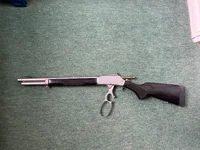
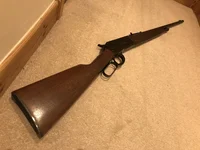
45/70 nitro factory loads in a modern Marlin Lever Action

Vince1968

Well-Known Member
Hi does anyone know how much nitro powder is loaded into factory loads for a 45/70 cartridge please ?

I’ve not been able to find the data online.

I intend to use the load in a Modern Marlin Trapper at 100 yards bench rested and could you recommend a powder too.

I’ve got an assortment of lead bullet heads cast by a friend including 320/ 330/ 350/ 405/ 450/ 500 grains

I’ve only shot 50 yards free standing with 11 grains of Titegroup and a 405 grain lead bullet head, it felt reasonably stout 🙄

I’m hoping to use as little as I can get away with powder wise as I don’t want the rifle to kick the 💩 out of my shoulder 😂

Looking forward to your replies 😃
 
There is any amount of data for reloading 45/70 buddy.
There is reloading data I know, but I specifically asked how much powder was in a factory load ?

So that I could reload something similar or slightly less

They’re £2 or £3 a bullet factory load , I don’t want to have to take one apart
 
There is reloading data I know, but I specifically asked how much powder was in a factory load ?

So that I could reload something similar or slightly less

They’re £2 or £3 a bullet factory load , I don’t want to have to take one apart
It doesn't work like that buddy. For starters you won't know what powder is in the factory round.
You have to research based on what powder you have or can get.
If for instance say a factory round held 50gn of something unknown and you go and duplicate it with some faster powder you will run the risk of damage .
 
16-19 grs 2400 is a good start for any big bore rifle .
I can hit the advancing target at warcop out to 300m with cast if I aim over .🙄
 
Some of the RCBS printed reloading manuals listed three loads for .45/70. The first for original Trapdoor carbines, the next for modern lever action rifles and the third for, I think, modern falling block rifles? Perhaps look on eBay? And with that I am out of this topic...
 
Powders vary in their speed, fast to slow.

To slow and performance may be poor.

To fast and it might be so exciting you need a new gun.

Get some shooting glasses and wear them after you have read up on reloading.

After over 40 years reloading I don't know how much powder is in a factory load, its irrelevant as they use bulk powders.

Canister powders should be consistent so the amount I used 40 years ago produces the same result as today's powder.
 
Why ?

I said my available powders, I got Titegroup, HP38 and green dot
Because you clearly know very little about reloading.

Buy a manual, read the manual, understand the importance of following data and minimum and maximum loads. Then think about reloading, you need to follow the data not make it up as you go along.

Then when you’ve done all of that go for trap door load data, if you want a soft shooting load. I reload 405 cast at around 900 fps, it’s a pussy cat load. I also load 300 gr jacketed with modern powders to marlin data at 2100 it sound like that load would scare you into submission.

Hodgdon do not list either titegroup or HP38 for 45-70, so they are not really suitable.
 
There is reloading data I know, but I specifically asked how much powder was in a factory load ?

So that I could reload something similar or slightly less

They’re £2 or £3 a bullet factory load , I don’t want to have to take one apart
Even if you do you won’t know what the powder is!

Find the velocity of the factory load you like, find a bullet that matches then find load data that will reproduce the velocity with the bullet, work up from minimum to the data until you reach pressure signs or get the velocity you want. If you reach pressure before velocity start again with a different powder.

That’s how you replicate a factory load, not Dropping random amounts of powder in a case and hoping it will be okay!
 
Hi Chaps,

Please let me apologise for my thread, I didn’t mean to get you wound up at all !

I’ve been shooting 30 years mainly clay pigeon and using factory 303, 243, 6.5 for hunting, deer stalking and pest control.

For gallery rifle competition at 20 yards in the Northumbria & Cumbria Target Shooting Association Leagues and Lightweight Sporting Rifle Competition, Cowboy Action Shooting, I’ve been reloading 38/357/44/ at minimum velocity in compliance with the range restrictions.

I do have a reloading manual and have used it to work up a low load for competitions.

I’ve been reloading 45/70 for 6 months and have only shot it down loaded at 25 and 50 yards using load data I have found on an American reloading site that uses Titegroup.

I thought I would research some information for upping the 45/70 load for use at 100 yards range where I usually Rimfire.

I can see now reading your comments that for 100 yards , it would be best to stick to a Recommended Powder for 45/70 that is tried and tested in the reloading manual.

I do appreciate your comments and feedback on this thread,

Regards Vince
 
This is the information I used for Titegroup, the calibre is down the side of the webpage

View attachment 390951View attachment 390952
Yes sure special loads often use small amounts of fast powder but just don't expect it to go above low power loads. Push it to hard and it will bite back.
The reason why special low power loads use such a small amounts of powder is not because those powders are weak, no it's because they are strong to quickly!
They will develop huge pressure values before the bullet has chance to move, that's bad!

When you want more power you want more progressive powders relative to the calibre and cartridge you are using.
 
This is the information I used for Titegroup, the calibre is down the side of the webpage

View attachment 390951View attachment 390952
Interesting. That's a different scenario entirely to just guessing. You do have some load data to start with there for the 405gr cast bullets. I think the important part of any approach to this is that you need to start with a safe load and work up checking for signs of pressure. You might find GRT a useful piece of software to help you do this: start [Gordons Reloading Tool Community] Although you can in theory use it to find a starting load to work up from, you have load data from the gmdr.com site to start from so I would plug that into GRT and see what it does for the lighter bullet weights, then start from what should be the lowest and theoretically safest load using Titegroup and go up from there whilst looking for signs of pressure. Once you are around the area you want to use and there are no pressure signs you can start looking for accuracy nodes. Lighter bullets will generate less pressure than heavy ones generally but bullet construction also plays a part so err on the side of caution. When you run the loads through GRT you need to pay attention to the pressure chart and make sure you work up from a start load that is well below the max allowable pressure for your cartridge and rifle. Please don't do any guessing, you need to work from known safe loads as closely as possible, this is why manufacturer's data or bullet maker's data are usually the start points for working up a load.

From the gmdr.com site you put up, it looks like you should be starting at 8gr of Titegroup, GRT also shows 8gr of HP-38 doing around 900fps with maximum pressure around 11000psi.

GRT shows 15gr of either Titegroup or HP-38 looking dangerously close to maximum pressure for the 45-70 with some standard settings and a 405gr cast bullet. I definitely wouldn't do that if I were you.
 
Last edited:
Hi Chaps,

Please let me apologise for my thread, I didn’t mean to get you wound up at all !

I’ve been shooting 30 years mainly clay pigeon and using factory 303, 243, 6.5 for hunting, deer stalking and pest control.

For gallery rifle competition at 20 yards in the Northumbria & Cumbria Target Shooting Association Leagues and Lightweight Sporting Rifle Competition, Cowboy Action Shooting, I’ve been reloading 38/357/44/ at minimum velocity in compliance with the range restrictions.

I do have a reloading manual and have used it to work up a low load for competitions.

I’ve been reloading 45/70 for 6 months and have only shot it down loaded at 25 and 50 yards using load data I have found on an American reloading site that uses Titegroup.

I thought I would research some information for upping the 45/70 load for use at 100 yards range where I usually Rimfire.

I can see now reading your comments that for 100 yards , it would be best to stick to a Recommended Powder for 45/70 that is tried and tested in the reloading manual.

I do appreciate your comments and feedback on this thread,

Regards Vince
Don’t use American reloading sites! You have no way of knowing the loads are safe, use published data and work up.

Can’t help with the data I am using as every powder I use is REACH banned.

RS36, which is a close replacement for reloader 7, will do what you need, email them and they’ll send you data for your bullet choice 👍
 
Interesting. That's a different scenario entirely to just guessing. You do have some load data to start with there for the 405gr cast bullets. I think the important part of any approach to this is that you need to start with a safe load and work up checking for signs of pressure. You might find GRT a useful piece of software to help you do this: start [Gordons Reloading Tool Community] Although you can in theory use it to find a starting load to work up from, you have load data from the gmdr.com site to start from so I would plug that into GRT and see what it does for the lighter bullet weights, then start from what should be the lowest and theoretically safest load using Titegroup and go up from there whilst looking for signs of pressure. Once you are around the area you want to use and there are no pressure signs you can start looking for accuracy nodes. Lighter bullets will generate less pressure than heavy ones generally but bullet construction also plays a part so err on the side of caution. When you run the loads through GRT you need to pay attention to the pressure chart and make sure you work up from a start load that is well below the max allowable pressure for your cartridge and rifle. Please don't do any guessing, you need to work from known safe loads as closely as possible, this is why manufacturer's data or bullet maker's data are usually the start points for working up a load.

From the gmdr.com site you put up, it looks like you should be starting at 8gr of Titegroup, GRT also shows 8gr of HP-38 doing around 900fps with maximum pressure around 11000psi.

GRT shows 15gr of either Titegroup or HP-38 looking dangerously close to maximum pressure for the 45-70 with some standard settings and a 405gr cast bullet. I definitely wouldn't do that if I were you.

So I loaded 5 bullets starting with 6 grains titegroup and went up 0.5 grains each time with a batch of bullets

6/6.5/7/7.5/8/8.5/9/9.5/10/10.5/11 using the 405 grain cast lead bullet

I let the barrel cool down and examined the barrel inside and out after brushing the bore out after every 5 shots

It took quite a bit of time and patience but I finally settled on 6.5 titegroup for indoors 25 yards and 11 titegroup for outdoors at 50 yards

I think 11 titegroup would be my maximum and shall try 5 bullets at 100 yards

Otherwise, I’ll look at a proper Rifle powder for 45/70 as mentioned by the more experienced people that have commented on this thread

Thanks again
 
Back
Top