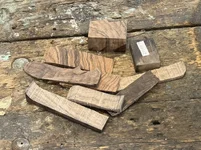
Walnut scraps for practicing oil finishing - where can I get them from?

MidlandsPaperPuncher

Well-Known Member
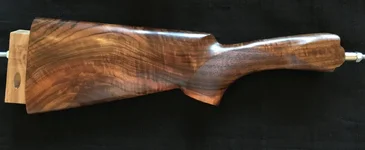
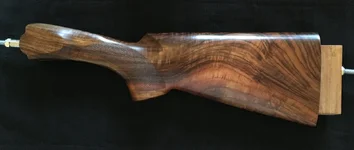
I've got a CZ555 with a rather nice stock (a bit of figuring/chatoyancy) that's been let down by a cheap factory polyurethane finish, and loads of visible pores.

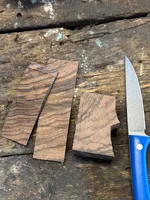
I'm wanting to properly oil finish it, but I would very much like to practice on something a little more disposable first, so ideally I'd like some smaller chunks of walnut to practice on.

I've oil finished birch plywood furniture before and was quite happy with the results, but there's a bit more at stake here.

I'm struggling to find any offcuts or small cheap bits, so any recommendations would be greatly appreciated.
 
I've got a CZ555 with a rather nice stock (a bit of figuring/chatoyancy) that's been let down by a cheap factory polyurethane finish, and loads of visible pores.

I'm wanting to properly oil finish it, but I would very much like to practice on something a little more disposable first, so ideally I'd like some smaller chunks of walnut to practice on.

I've oil finished birch plywood furniture before and was quite happy with the results, but there's a bit more at stake here.

I'm struggling to find any offcuts or small cheap bits, so any recommendations would be greatly appreciated.
Gun smith with a scrap stock
 
Ebay. Plenty of american black walnut staves and cheap offcuts, new and re-purposed to choose from. Finishing stocks and in my work, oil finishing various timber pieces is something I've been doing for years. Best advice is take your time, choose the right finishing oil blends, ensure stock (or other blank) is sanded to at least 240 grit and pores/knots filled before a final rub down and clean of the surfaces. Oil choice can be bewildering but I've settled on my own blends, incorporating boiled linseed oil, tung oil, red root oil and walnut oil using turps or white spirits to thin the first few coats to aid penetration.

Apply the first coat and lightly sand any fibres that swell up before repeating, using a 40/60 mix of turps to oils and leave for 24 hrs. Go to a 20/50 mix and apply another few coats over a few days, then use purely the oil blends and build up, one coat per day until you have at least 10 coats applied. You will have to rub down the stock lightly after the third, 4th and possibly 5th coat until all the grain is filled. Most newcomers to stock finishing seem to make the same mistake of applying too much oil too soon. Once the grain is filled, you should only apply thin coats worked in well. I used to use the heal of my hand to work the oil coats with the grain as the heat build up helped thin and start the curing. A light buff with a clean lint free cloth before the next coat helps. I have needed to apply up to 23 coats in the past, depending what blend I used. The secret is to keep coats thin and evenly applied. Once you have the sheen that you want, leave the stock for at least a week to cure before a final buffing with a clean cloth. You can clean and maintain the finish using a little orange or lemon oil from time to time. You can use off the shelf oil compounds such as the London Gun Co. stock refinishing kit which includes a resin hardener for the last few coats. This is the kit I'd recommend if you don't want to experiment with your own blends. Liberon Fine finishing oil mixed with a little red root oil is also another good recommendation.
 
There was an advert on here a while back selling walnut work top off cuts. Do a search you may be lucky and get a good chopping board as well.
D
 
I have some American black walnut. I can also mix some grain filler up and have some very fine abrasive papers. I am just north of Derby. Send me a PM
 
OK, I've dug up my recipe for gunstock finishing oil. This is if you want to make and batch your own oils for gunstock finishing.

There's two main oils used: (recipes for each will be posted below)

1. red oil derived from Alkanet root and boiled linseed oil: this imparts a reddish warm hue to the wood and brings our grain contrast to its best
2. Finishing oil. This is made using a combination of oils and a carrier spirit for helping with penetration and achieving a thin enough consistency (more on this below).

For the Red oil, you can buy a red Alkanet root chippings from any UK soap making ingredient site for a few pounds.

You want about 75 to 100g, put into a jar and topped up with boiled linseed oil. You may wish to add a little turps or white spirits to help with timber penetration when applying the final oil. You'll need to leave it for 4 to 6 months until it turns a blood red colour. Shake the jar daily to ensure you mix it up. Once achieved, strain off the oil from the root into a jar, put the lid on and store.

For the finishing oil

My own recipe uses the following oils. To make up 550ml (probably more than you'd ever need) use the following:

- 465ml boiled linseed oil
- 15ml pure tung oil
- 20ml Walnut oil
- 25 to 30ml Turpentine or White Spirits
- 1Tblspn of Carnuaba wax chippings
- 10ml Venice Turpentine (you need this; it is a resin (hardener), not really an oil as such)

Mix all the ingredients in a pan, thoroughly, then bring to a medium heat over a camping stove (you may want to do this outside to avoid fumes and fire risk as boiled linseed oil can unpredictably combust with heat), simmer for 10 minutes then leave to cool before transferring to two jars. Put the lid on the first (and an old trick I was taught...) for the second jar, leave the lid off to allow this batch to thicken up a bit over time. You use the first one for the first 3 to 5 coats over an initial 3 to 4 coats of red oil (or as many red oil coats you need to achieve the required contrast and colour depth). Use the thicker oil as desired but bear in mind it will need longer to cure.

Once you've properly finished prepping the gun stock (including wetting surface after sanding to raise fibres which you then burn off with a heat gun or carefully using a torch), sand a final time with wet & dry to about 400 grit or even 600 grit. Initial sanding will only need 240 grit finishing paper.

Next, apply an initial thin coat of red oil and leave to dry. Apply more coats until you have the contrast and colour you want, then leave for at least 3 to 5 days to properly dry and cure, somewhere dry and warm. Buff with a lint free cloth.

Now take your thinner finishing oil and a lint free cloth and apply the first finishing coat, working well into the grain. leave 10 minutes, then gently wipe any excess off and leave for at least a day. Repeat this stage at least two or three more times: Note, you may want to dilute your finishing oil a little more, to a max of 50% with white spirits to help initial coats to soak into the timber, then go to the undiluted thinner oil stock for the next three coats. Keep building up until all grain pores are filled. For some stocks this might only be 7 coats, for others it may need triple that, depending on the finish you want. The final finish will be a deep satin sheen, NOT a high gloss. The problem with most high glass finishes like True Oil, is they scratch easily and can chip, whereas satin sheen (which I use on my loudspeaker cabinets and other furniture) maintains a good finish for far longer and is easily renourished using a little orange oil or lemon oil, or a thin coat of finishing oil.

Once you have the required depth of finish, stop and leave for at least a week to cure before a final buff up. Do NOT use pure wax finishes if you want to reoil again as you may have to partially strip the finish using meths or white spirits to remove the surface wax. You can use a little synthetic Renaissance wax if you must but the oil finish alone should do the job.

You can simplify the mixture for the finishing oil by omitting the tung and/or walnut oil, and making up with more linseed, but the addition of a little tung oil helps elasticity and durability, when combined with the venice turpentine resin.

Hope this is of interest to anyone looking for the satisfaction of trying their hand at their own oil finishes. I much prefer this finish over many high gloss commercial products and it's very similar in make up to the excellent London Gun Stock kits except they add resin hardeners over the last few coats of oil.
 
OK, I've dug up my recipe for gunstock finishing oil. This is if you want to make and batch your own oils for gunstock finishing.

There's two main oils used: (recipes for each will be posted below)

1. red oil derived from Alkanet root and boiled linseed oil: this imparts a reddish warm hue to the wood and brings our grain contrast to its best
2. Finishing oil. This is made using a combination of oils and a carrier spirit for helping with penetration and achieving a thin enough consistency (more on this below).

For the Red oil, you can buy a red Alkanet root chippings from any UK soap making ingredient site for a few pounds.

You want about 75 to 100g, put into a jar and topped up with boiled linseed oil. You may wish to add a little turps or white spirits to help with timber penetration when applying the final oil. You'll need to leave it for 4 to 6 months until it turns a blood red colour. Shake the jar daily to ensure you mix it up. Once achieved, strain off the oil from the root into a jar, put the lid on and store.

For the finishing oil

My own recipe uses the following oils. To make up 550ml (probably more than you'd ever need) use the following:

- 465ml boiled linseed oil
- 15ml pure tung oil
- 20ml Walnut oil
- 25 to 30ml Turpentine or White Spirits
- 1Tblspn of Carnuaba wax chippings
- 10ml Venice Turpentine (you need this; it is a resin (hardener), not really an oil as such)

Mix all the ingredients in a pan, thoroughly, then bring to a medium heat over a camping stove (you may want to do this outside to avoid fumes and fire risk as boiled linseed oil can unpredictably combust with heat), simmer for 10 minutes then leave to cool before transferring to two jars. Put the lid on the first (and an old trick I was taught...) for the second jar, leave the lid off to allow this batch to thicken up a bit over time. You use the first one for the first 3 to 5 coats over an initial 3 to 4 coats of red oil (or as many red oil coats you need to achieve the required contrast and colour depth). Use the thicker oil as desired but bear in mind it will need longer to cure.

Once you've properly finished prepping the gun stock (including wetting surface after sanding to raise fibres which you then burn off with a heat gun or carefully using a torch), sand a final time with wet & dry to about 400 grit or even 600 grit. Initial sanding will only need 240 grit finishing paper.

Next, apply an initial thin coat of red oil and leave to dry. Apply more coats until you have the contrast and colour you want, then leave for at least 3 to 5 days to properly dry and cure, somewhere dry and warm. Buff with a lint free cloth.

Now take your thinner finishing oil and a lint free cloth and apply the first finishing coat, working well into the grain. leave 10 minutes, then gently wipe any excess off and leave for at least a day. Repeat this stage at least two or three more times: Note, you may want to dilute your finishing oil a little more, to a max of 50% with white spirits to help initial coats to soak into the timber, then go to the undiluted thinner oil stock for the next three coats. Keep building up until all grain pores are filled. For some stocks this might only be 7 coats, for others it may need triple that, depending on the finish you want. The final finish will be a deep satin sheen, NOT a high gloss. The problem with most high glass finishes like True Oil, is they scratch easily and can chip, whereas satin sheen (which I use on my loudspeaker cabinets and other furniture) maintains a good finish for far longer and is easily renourished using a little orange oil or lemon oil, or a thin coat of finishing oil.

Once you have the required depth of finish, stop and leave for at least a week to cure before a final buff up. Do NOT use pure wax finishes if you want to reoil again as you may have to partially strip the finish using meths or white spirits to remove the surface wax. You can use a little synthetic Renaissance wax if you must but the oil finish alone should do the job.

You can simplify the mixture for the finishing oil by omitting the tung and/or walnut oil, and making up with more linseed, but the addition of a little tung oil helps elasticity and durability, when combined with the venice turpentine resin.

Hope this is of interest to anyone looking for the satisfaction of trying their hand at their own oil finishes. I much prefer this finish over many high gloss commercial products and it's very similar in make up to the excellent London Gun Stock kits except they add resin hardeners over the last few coats of oil.
Looks very similar to Diggory Hadeokes on Vintage Guns. Produces a good finish, which I have used.

However go to a good Artshop and buy some best quality boiled Linseed oil.

Use some to make a red oil with Alkanut Root - the longer you leave it the better - use red oil if you want to add a reddish colour to the wood and bring out the contrast.

Finish the wood to c 320 grit paper. Raise the grain - with a damp cloth, and whisker it off with sharp 320 paper. Do this a couple of times.

Then start oiling. Use the red oil first. Apply it liberally and let it soak in for an hour. Apply some more and then take fine wet and dry paper- preferably the red garnet paper rather than the grey coloured and use this to rub in the oil. It should form a slurry of oil and saw dust and you want to push this into the grain. Let it set up gir a few hours. The buff it off with a course cloth. And repeat.

Once you have desired depth of colour switch to clear linseed oil. Keep sanding in the coats till the grain is filled.

Then just apply oil, let it go tacky, polish off and repeat. After a period leave the stock for longer after polishing.

If you are using oils with waxes and varnishes in there you may get a skin forming on the surface. That’s fine. But grind it back with 600 grit paper, or even 1000 grit with oil to lubricate. Fine Talcum powder or jewellers rouge can also be used. Take it back to the top of the wood. Wipe it clean and then leave to harden.

Oil finishes take time. They are not hard to do. In the first two or three months they do feel quite green and soft, but after a few months of occasional oiling and then polishing they get a wonderful luster to them.

I have found that a pair of well worn old jeans provides the ideal cloth for the early polishing. It has enough bite to cut the top surface. I finish off with yellow dusters. Plenty of elbow grease helps.


Edit / ps. Choice of oil does depend on the wood. With open pores you do want something a bit thicker than fine linseed oil. If you have some traditional yacht varnish (not polyurethane but traditional tung oil based) add a teaspoonful or two to a some oil and add a bit of turps as well and use this to build up and then grind off using fine paper or oil/ cup grease mixed with pumice or talc powder- This is an old short cut.
 
Last edited:
And quality of finish is also a function of the underlying wood. A lot of modern guns have cheap fast grown wood. It will never take a good finish. Old slow grown wood that is hugely strong will finish beautifully.

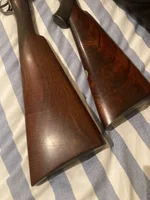
Two guns below - the plainer one is a 16 Webley & Scott from 1930’s. The figured is 1880’s rook rifle. Both were pretty much black with grime. Cleaned up with soft soap. Let dry. Then took the top layers of blackened oil off with fine paper and clean oil. Raised the worst of the dents. Wiped off the slurry and did again. The rook rifle almost had a cracked varnish type film on it. Each has had about 20 coats of oil.

The 16 I pretty had finished by September. It has had a few good days shooting this year including in the wet and snow. Dried it off well. And cleaned as normal. It will never have the beauty of the Rook - the wood is plane but strong.

With old guns I don’t like a full back to new type restoration - just a clean up.

IMG_8932.webp
 
Looks very similar to Diggory Hadeokes on Vintage Guns. Produces a good finish, which I have used.

However go to a good Artshop and buy some best quality boiled Linseed oil.

Use some to make a red oil with Alkanut Root - the longer you leave it the better - use red oil if you want to add a reddish colour to the wood and bring out the contrast.

Finish the wood to c 320 grit paper. Raise the grain - with a damp cloth, and whisker it off with sharp 320 paper. Do this a couple of times.

Then start oiling. Use the red oil first. Apply it liberally and let it soak in for an hour. Apply some more and then take fine wet and dry paper- preferably the red garnet paper rather than the grey coloured and use this to rub in the oil. It should form a slurry of oil and saw dust and you want to push this into the grain. Let it set up gir a few hours. The buff it off with a course cloth. And repeat.

Once you have desired depth of colour switch to clear linseed oil. Keep sanding in the coats till the grain is filled.

Then just apply oil, let it go tacky, polish off and repeat. After a period leave the stock for longer after polishing.

If you are using oils with waxes and varnishes in there you may get a skin forming on the surface. That’s fine. But grind it back with 600 grit paper, or even 1000 grit with oil to lubricate. Fine Talcum powder or jewellers rouge can also be used. Take it back to the top of the wood. Wipe it clean and then leave to harden.

Oil finishes take time. They are not hard to do. In the first two or three months they do feel quite green and soft, but after a few months of occasional oiling and then polishing they get a wonderful luster to them.

I have found that a pair of well worn old jeans provides the ideal cloth for the early polishing. It has enough bite to cut the top surface. I finish off with yellow dusters. Plenty of elbow grease helps.


Edit / ps. Choice of oil does depend on the wood. With open pores you do want something a bit thicker than fine linseed oil. If you have some traditional yacht varnish (not polyurethane but traditional tung oil based) add a teaspoonful or two to a some oil and add a bit of turps as well and use this to build up and then grind off using fine paper or oil/ cup grease mixed with pumice or talc powder- This is an old short cut.

Yes, there's a lot of similar recipes floating about all based on a tried and tested traditional blend used by many different traditional gunsmiths. I've done a fair few stocks and like the satin sheen finish it gives. I don't like the high build gloss that you get with some commercial brands which use more resin. Looks more like varnish.
 
Yes, there's a lot of similar recipes floating about all based on a tried and tested traditional blend used by many different traditional gunsmiths. I've done a fair few stocks and like the satin sheen finish it gives. I don't like the high build gloss that you get with some commercial brands which use more resin. Looks more like varnish.
Tung Oils and Carnuba Wax tends to give harder finishes. Linseed oil, beeswax etc are softer. Tung is the cornerstone of varnishes, along with resins from pine etc. and shellacs, which I think comes from a type of beetle. There is a continuum from a very basic and simple linseed finish right the way through to a hard lacquer.

Which is best - endless debates, but in my view depends on the use, application, length of time etc.

A friend uses nothing but ballistol and gets a good finish with this.

A best oil finish is wonderful, but takes time, and time is money. A lot of modern “oil” finishes are really liquid waxes. They tend to have a pretty “open” finish with plenty of open pores. In the past cheaper guns, military rifles etc would have the stocks dunked in oil and then hung up to dry. Many wooden stocks really benefit application of a drying oil - once a day for a week, once a week for a month, once a month for year and then a couple of times a year thereafter.

Keep oil out of the checkering though. If you do get oil use your best beloved’s tooth brush or a paint to brush it out :)
 
Yes, there's a lot of similar recipes floating about all based on a tried and tested traditional blend used by many different traditional gunsmiths. I've done a fair few stocks and like the satin sheen finish it gives. I don't like the high build gloss that you get with some commercial brands which use more resin. Looks more like varnish.
Yes, I've been specialising in oil finishes for ver 15 years now and tried loads of different methods and oils but for me, Linseed and Tung are the two I use in most of my finishing oils along with venice turpentine (Larch resin). Most of mine also contain some carnuaba too.
 
Back
Top