Worth scoring?

25 Sharps

Well-Known Member
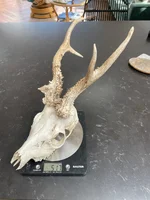
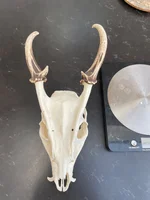
Picked up this boy a couple of weeks back, went off to be cleaned up this week and it was suggested I get it measured.

IMG_8604.jpegIMG_8602.jpeg

What do folk think?

I’ve never had a head measured so went through the better ones in the shed, are any of the others worth measuring? I was surprised at some of the weight!
 
All look good. 450grm is the guide weight for Cic Bronze Roe trophy.
Only one way to find out is to get them measured.
D
 
Forget about the scores - some really nice heads! Interesting shapes, slightly unusual.
Thanks.

The last couple of years there seems to be a prevalent 5 point gene as 80% of the mature bucks shot have had 5 points, I am now trying to see if I can shoot this out over the next couple of years by leaving anything with 6 points (top one is from a different area) and only shooting the 5s. Probably won't work as I have about 1800 acres over 3 farms but there is an estate in the middle that I have vermin, but not deer permission on, so will likely never remove them all, but it will be interesting to see what happens.
 
Thanks.

The last couple of years there seems to be a prevalent 5 point gene as 80% of the mature bucks shot have had 5 points, I am now trying to see if I can shoot this out over the next couple of years by leaving anything with 6 points (top one is from a different area) and only shooting the 5s. Probably won't work as I have about 1800 acres over 3 farms but there is an estate in the middle that I have vermin, but not deer permission on, so will likely never remove them all, but it will be interesting to see what happens.
It will likely be recessive, so hard to purge.

However, by encouraging new males to move into the area, you'll increase heterozygosity, so reduce the expression of it. Easiest way to do that will be shoot hard to create gaps for males to move in from outside. Many of the 6 pointers you see will be carriers, so you may not gain much by leaving them.
 
It will likely be recessive, so hard to purge.

However, by encouraging new males to move into the area, you'll increase heterozygosity, so reduce the expression of it. Easiest way to do that will be shoot hard to create gaps for males to move in from outside. Many of the 6 pointers you see will be carriers, so you may not gain much by leaving them.
Interesting, what makes you think it will be a recessive gene?
 
Likely a regional gene. Chances of bringing in new genes are slim as you can’t expect neighbours to suddenly have different genes because of a boundary line. Shoot hard on the boundary margins and see what comes in from the neighbours. If you start seeing 6 pointers and want to keep them, remove the dominant bucks from the prime areas to give them space.
 
It will likely be recessive, so hard to purge.

However, by encouraging new males to move into the area, you'll increase heterozygosity, so reduce the expression of it. Easiest way to do that will be shoot hard to create gaps for males to move in from outside. Many of the 6 pointers you see will be carriers, so you may not gain much by leaving them.
That won’t do any harm, but remember, every buck came from his mother, and the genes he carries is also a product of her physiology - if say, mum’s great grandpa was a five pointer, she can pass on the genes. A more effective strategy would be to cull as many females as possible, over say five to ten years, as well as removing any five pointers seen, then hope some better genetically composed females turn up in the vacated areas.

But I agree, not an easy thing to achieve.
 
Interesting, what makes you think it will be a recessive gene?
I can’t be certain, but the vast majority of alleles that lead to sub optimal phenotypes are recent mutations, and those are usually recessive.

With something like this, where a very specific trait is consistently affected, chances are it’s a single gene.
 
That won’t do any harm, but remember, every buck came from his mother, and the genes he carries is also a product of her physiology - if say, mum’s great grandpa was a five pointer, she can pass on the genes.
You’re absolutely right, though there’s a small technical error in your wording - genes aren’t a product of physiology. I think you meant ‘product of her genotype’.

The broader point is extremely important and often forgotten by people trying to manage for heads/antlers: the females carry the genes for antler characteristics, but don’t express them. So trying to select for heads by selectively shooting males is missing a major part of the gene pool.

I think @VSS has made this point often, emphasising that if you’re a livestock farmer, you pay much closer attention to your females than your males.
 
You’re absolutely right, though there’s a small technical error in your wording - genes aren’t a product of physiology. I think you meant ‘product of her genotype’.

The broader point is extremely important and often forgotten by people trying to manage for heads/antlers: the females carry the genes for antler characteristics, but don’t express them. So trying to select for heads by selectively shooting males is missing a major part of the gene pool.

I think @VSS has made this point often, emphasising that if you’re a livestock farmer, you pay much closer attention to your females than your males.
That was going to be my next question, so if it is carried on the female gene then managing the males for this, or any, antler characteristic is fairly pointless?

It’s all down to the females and you can’t tell what they are producing unless you see a trend?
 
That won’t do any harm, but remember, every buck came from his mother, and the genes he carries is also a product of her physiology - if say, mum’s great grandpa was a five pointer, she can pass on the genes. A more effective strategy would be to cull as many females as possible, over say five to ten years, as well as removing any five pointers seen, then hope some better genetically composed females turn up in the vacated areas.

But I agree, not an easy thing to achieve.
That’s interesting.

I’ve shot this ground for around 10 years now, nothing massive but plenty of nice representatives, with a few potential medals based on the photos and weights above.
Guy Stainthorp did take a gold medal off of one of the farms a couple of years ago while down shooting with me.

I don’t over shoot the females but it seems I may have shot out the ‘good’ females, or the neighbours have as doe numbers have really dropped. The prevalence of 5 pointers has only happened the last 2/3 years. But they are really prevalent now.

In my ignorance I had put it all down to a really big 5 pointer that was found dead by the farmers sister last year, I thought he may have been spreading the gene about for a year or 2. Evidently it must have been his mum and his sisters!
 
Yep, if in doubt as to how they can turn out, it’s just as good to ‘leave the little boy acorn to grow’ before deciding whether the mature ‘tree’ is the type you want to promote: dead deer don’t improve, and I personally prefer to give young bucks the chance to show what they can do, but take a firm line with the females, especially when it is known that a poorer type of trophy is produced in a certain area.

Conversely, the Germans have been attempting to improve their antler quality in many areas for hundreds of years, with somewhat indifferent results, whilst Peter Zobel in Denmark dominated the top ten trophy list from scratch for over a couple of decades, principally by optimising the nutrition availability for his roe deer during the antler growth period ( - as indeed did Prince Albrecht of Bavaria), so while genetics do indeed have their place, generally speaking a doe in good circumstances conceiving a good healthy male calf has already offered it the greater potential to make the trophy that is the more aesthetically desirable to many.

A general maxim worth bearing in mind is that if you always shoot old bucks, you’ll always have old bucks to shoot, but if you shoot eg all the (easy) three year olds this season, there’ll be an absence of four year olds the next season. The older bucks (6-8yr olds) are those which produce the more interesting and generally heavier/more voluminous trophies, and whilst no guarantee comes as to whether or not they make ‘medal class , they do demonstrate what the area is capable of producing, when given the chance.

At Trolle Ljungby, in Skåne, Sweden, they formerly tagged as many calves as possible every year, and left most bucks until six years of age. They produced great trophies there for more than a century.
 
Back
Top