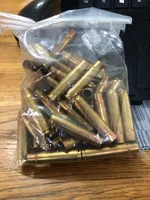
procedure:
Step 1:
I installed an RCBS carbide .44 magnum sizer in my Rockchucker, set down to bump the shell-holder firmly. Run the LUBED .308 cases through this die, which will leave a narrow "belt" at the front of the extractor groove, and also may shear off a microscopically-thin ring of brass. Considerable effort on the handle will be needed. This is why we build our benches SOLIDLY.
Step 2:
Run the swaged-down cases into a .30 carbine mouth-expander die (or a Lee "Universal expander die") to flare the mouth large enough to accept the expander ball in the .35 Remington sizer die. The flared part will be trimmed-off, so don't be shy about putting a good big flare on the mouth.
Step 3:
Size all the cases to the max in the .35 Remington sizer. Again, adjust so that the shell-holder has a good "bump" against the die.
Step 4:
Trim the cases to proper .35 Remington length. My standard Forster trimmer with a Makita 3/8" drill adapted for power drive made VERY short work of this, as little as two or three seconds per case, but I'd HATE to do it with the original hand-crank on the trimmer. Deburr the brass after trimming, and we're ready for the last step.
Step 5:
Using a sharp, clean, fine-cut flat file, and chucking the case in the Unimat (a drill press would work fine, too, or a good 1/2" drill mounted in a vise) I make about 20 file strokes across the case-head and rim areas, removing the "belt" thrown-up by the .44 die in Step 1. Some experimentation will be necessary with YOUR setup to determine how much filing is needed. Once that routine is established, you can also consider polishing the filed area for appearance's sake as a final step. Keep the file CLEAN, with a fine wire brush or other method. The teeth will load-up with brass cuttings, and I find it best to clean the file after using it on each case.
An important quality-control check is accomplished by keeping the rifle itself close by the filing location, and checking each case for fit in the chamber as it 's completed. If it doesn't fit VERY easily, I put it back in the machine for a bit more filing. concentrating on the rim diameter and the web zone ahead of the extractor groove. If the case is still too snug, I toss it. No point in excessive fiddling with a single round.
At no point do I attempt to measure anything, except the trim-to length in the trimmer.
All of the above may seem time-consuming and pointless. Not so. The time involved for each case is less than two minutes total, by my timing. To get usable .35 Remingtons for NOTHING except maybe 40 minutes spent per box of 20 is a great boon, in my eye. .308 cases are everywhere, but .35s....?? I have time; it's a hobby, after all. Ammohead, Buckshot, NVCurmudgeon and 9.3x62AL can all attest to the fact that the former .308s work well in the Marlin 336.