Here is Mikes 2013 obituary.
Legendary firearms engineer Merle "Mike" Walker passed away on March 6, at the age of 101. Walker was one of the most important gun and cartridge designers of the 20th Century, and he also was a leading proponent of benchrest shooting. Mike worked for Remington Arms Company for 37 years, as a lead designer and engineer. While at Remington, Mike created many of Remington's most popular bolt action rifles. For many years, Mike served as Director of Research and head of the Custom Shop at Remington's, Ilion, NY facility.
Mike led the development of many important Remington rifle designs, including the Rem m700, Rem 40X, Rem m721, and Rem m722. Walker held numerous patents, mostly for trigger designs.
"Without a doubt, the Remington Model 700 is the most popular commercial, high-power, bolt-action rifle in the world. The Model 700 is actually a product-improved Model 721 and Model 722 bolt-action rifle, the brain-child of Merle 'Mike' Walker and his Remington design team in the 1940s." - Roy C. Marcot, The History of Remington Firearms
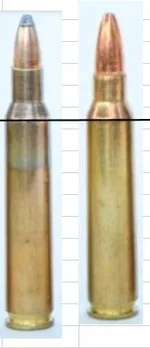
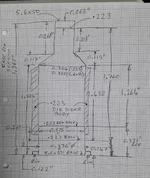
Mike was a major pioneer in modern cartridge design - he was the originator of the .222 Remington and the 6mm Remington Int'l rounds. According to Guns & Ammo: "Long-time Remington employee and benchrest competitor Mike Walker, who headed up the M722 design team, is largely credited with the development of the .222 Rem". The .222 Rem (aka "Triple Deuce") dominated short-range Benchrest competition until the advent of the PPC cartridges.
Walker also worked with Jim Steckl on the .30-cal wildcat that eventually evolved into the 6mm Bench Rest Remington. This cartridge demonstrated the accuracy and efficiency of the "short, fat" case design. When brass was eventually produced for the 6mmBR Rem, Mike convinced Remington to produce a run with a small primer pocket. Thanks to these pioneering efforts by Walker and Steckl, we now have the ultra-accurate 6mmBR Norma (with a small primer pocket), and the 30BR wildcat.
Mike was one of the "founding fathers" of the International Benchest Shooters (IBS), and he was in the early IBS leadership group. He was a talented (and dedicated) benchrest shooter. Remarkably, Mike shot in the 2010 IBS Nationals at age 99. Mike also played a key role in the creation of Precision Shooting Magazine. Still engaged in his passion for gun-building and firearm design, he worked in his shop even at the age of 101. He passed in Elizabeth Hospice on March 6, 2013 after hip replacement surgery.
IBS President Jeff Stover tells us: "The term 'living legend' is used in many sports and endeavors. Rarely, though, is that term used as accurately as when referring to Mr. Merle 'Mike' Walker. He developed the Rem 700, he helped invent the button rifling process and many other firearms innovations. Probably the last time he shot in competition was at the 2010 IBS Group Nationals at Weikert, Pennsylvania. He got around quite well - even at 99 years of age! He shot an older rifle in a beat-up stock, but he was there on the line with the rest of us. During one match Mike was having some problems and it was close to cease fire time. Our range officer could see that everyone else had finished. Mike kept shooting, trying to get five on paper. The range was quiet except for the reports from Mike's rifle. When it was clear that all five were on paper, 'cease fire' was finally called. There were no questions as to what happened - all of us on the line realized it was a tribute to probably the only real Living Legend that any of us would meet, let alone shoot with…."
Mike Walker will be missed. As James Mock has written: "We in the shooting community are truly diminished. Mike was an icon of the innovative spirit of America." Mike Walker was a true pioneer who has left an enormous legacy to all those engaged in the "pursuit of accuracy". He was a lifelong member of the National Rifle Association and the Campfire Club of America and graduated from Iowa State University in 1934 with a degree in Mechanical Engineering. He was also credited in Cambridge Whos Who in December 2012.
Merle Hamilton "Mike" Walker married Olive Marie Frink on July 17, 1935 in Ames, Iowa. Merle and Olive Walker had two daughters, Janet DuBane and Eleanor Walker. Eleanor died in 1999. Olive was a crack benchrest shooter as well who died in 1990. Merle then married Kathryn Horne "Sue" LaFrance on February 8, 1992 in Hendersonville, North Carolina. "Mike" is survived by his daughter Janet Walker DuBane, his wife Sue, her daughter Linda LaFrance and her son Peter LaFrance. If you wish to honor his memory, his favorite charities were Paralyzed Veterans of America or the St. Labre Indian School.
Technical Content from
AccurateShooter.com copyright © 2013, All Rights Reserved, used with permission.
Published in Anchorage Daily News from Mar. 31 to Apr. 1, 2013.