Top Spanish Hunting
Well-Known Member
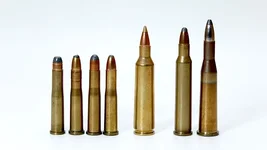
For decades it was ignored by all commercial firms until Remington rescued it from oblivion in 1965 and it became the most appreciated high-power centerfire .22 caliber cartridge for hunting predators at long distances. The first complete cartridge, that is, provided with a case, gunpowder, piston and bullet, was the .22 Short (.22 Short) rimfire. It was marketed in 1857 by Smith & Wesson in the United States for the S&W No. 1 revolver, by adding the powder charge to the French Flobert cartridge, which was (is, because it is still manufactured, like the .22 Short) a incomplete cartridge because it lacked gunpowder: it fired a 6 mm projectile at low speed propelled by the detonation of the primer. The .22 Short was so successful that it was used as the basis for all other .22 rimfire cartridges ever developed, and its caliber was later used to design numerous centerfire cartridges around the world, although the United States It has been the country in which, by far, the most models have been created.
Many more than in all of Europe, because on our continent small game hunting and predator hunting with small caliber rifled weapons has never been as popular as in the US, which does not mean that . 22 ring and, above all, central percussion. A good number of models have also been developed that, due to the small size of the cartridges, have even been used to manufacture a unique Central European weapon: the vierling with four tilting barrels, as well as all types of rifles. In the United States there is a great fondness (tradition) for modifying the caliber, case design, etc., of commercial cartridges to make them more precise, powerful or ensure that the resulting cartridge adapts better than existing ones to a certain modality. hunting or shooting, which is not easy in Europe (and impossible in Spain). Well, all non-commercial cartridges obtained in this way are called “wildcat”. Most are not successful, but some end up being adopted by cartridge manufacturers and very few become famous, which is the case of the protagonist of these notes.
Indeed, the .22-250 Remington was originally a “wildcat” because it was created using the case of the .250 Savage, a cartridge designed in 1915 by Charles Newton that is also known by the name 250-3000 Savage because It could fire an 87 grain (5.64 gr) projectile at the “astonishing” speed for the time of 3,000 ft/s (914 m/s). Well, modifying its case to accept .22 caliber projectiles, Grosvenor Wotkyns, J.E. Hebby and J.E Smith created the .22-250 Varminter in 1937, which Remington would market years later under the name .22-250 Remington. As a curiosity, we would like to mention that the creators of the .22-250 Varminter were ballistic engineers who were experts in .22 caliber cartridges and advised Winchester, but Winchester, instead of adopting the .22-250, marketed the .220 Swift, developed at the same time by Wotkyns, which, although it had some popularity, could not compete with the .22-250.
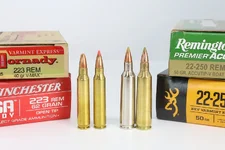
The .22-250 was designed and continues to be a “vermin” cartridge, a word that is rarely used today because today, to refer to these species, it is preferred to use the term predators, which I do not understand very well because vermin, according to the RAE, is the “animal that attacks or harms small game or livestock” and the .22-250 was invented just to kill these animals. It was originally loaded with 50 and 55 grain bullets, although it is currently offered with lighter weight projectiles to enhance the devastating effect on predators and also with heavier weight so that the cartridge is more effective when used on large game species. Thus, for example, Hornady offers it with a 35 gr NTX bullet and Winchester with a 64 gr Power Point. Now the 22-250 is so powerful that with the heavier 50 grain projectiles it can be used to hunt smaller big game animals, such as roe deer, which is the species for which it is most used in our country. As a general rule, bullets that weigh more than 50 grains should be used and, within those of this weight, choose the least aerodynamic ones for hunting at short or medium distances.
At close range, however, varmint ammunition must be used with caution on a roe deer because it can create superficial wounds. There are also European companies that load the caliber with different weights of bullets, but they do not add the letter V nor do the word Varmint appear printed on the boxes. In these cases, also as a precaution, the projectiles that should be used are those with a weight equal to or greater than 55 grains if we find them heavier and taking into account that the heavier 55 grain bullets are not designed for vermin, but for large game, so it is possible that if they are used at great distances they will not expand well in an animal as small as the roe deer. Finally, comment that the .22-250 is also loaded with training and shooting bullets that, logically, should not be used in hunting because they cannot kill a deer cleanly unless they hit a vital organ, which is the same as say by chance.
Many more than in all of Europe, because on our continent small game hunting and predator hunting with small caliber rifled weapons has never been as popular as in the US, which does not mean that . 22 ring and, above all, central percussion. A good number of models have also been developed that, due to the small size of the cartridges, have even been used to manufacture a unique Central European weapon: the vierling with four tilting barrels, as well as all types of rifles. In the United States there is a great fondness (tradition) for modifying the caliber, case design, etc., of commercial cartridges to make them more precise, powerful or ensure that the resulting cartridge adapts better than existing ones to a certain modality. hunting or shooting, which is not easy in Europe (and impossible in Spain). Well, all non-commercial cartridges obtained in this way are called “wildcat”. Most are not successful, but some end up being adopted by cartridge manufacturers and very few become famous, which is the case of the protagonist of these notes.
Indeed, the .22-250 Remington was originally a “wildcat” because it was created using the case of the .250 Savage, a cartridge designed in 1915 by Charles Newton that is also known by the name 250-3000 Savage because It could fire an 87 grain (5.64 gr) projectile at the “astonishing” speed for the time of 3,000 ft/s (914 m/s). Well, modifying its case to accept .22 caliber projectiles, Grosvenor Wotkyns, J.E. Hebby and J.E Smith created the .22-250 Varminter in 1937, which Remington would market years later under the name .22-250 Remington. As a curiosity, we would like to mention that the creators of the .22-250 Varminter were ballistic engineers who were experts in .22 caliber cartridges and advised Winchester, but Winchester, instead of adopting the .22-250, marketed the .220 Swift, developed at the same time by Wotkyns, which, although it had some popularity, could not compete with the .22-250.
The .22-250 was designed and continues to be a “vermin” cartridge, a word that is rarely used today because today, to refer to these species, it is preferred to use the term predators, which I do not understand very well because vermin, according to the RAE, is the “animal that attacks or harms small game or livestock” and the .22-250 was invented just to kill these animals. It was originally loaded with 50 and 55 grain bullets, although it is currently offered with lighter weight projectiles to enhance the devastating effect on predators and also with heavier weight so that the cartridge is more effective when used on large game species. Thus, for example, Hornady offers it with a 35 gr NTX bullet and Winchester with a 64 gr Power Point. Now the 22-250 is so powerful that with the heavier 50 grain projectiles it can be used to hunt smaller big game animals, such as roe deer, which is the species for which it is most used in our country. As a general rule, bullets that weigh more than 50 grains should be used and, within those of this weight, choose the least aerodynamic ones for hunting at short or medium distances.
At close range, however, varmint ammunition must be used with caution on a roe deer because it can create superficial wounds. There are also European companies that load the caliber with different weights of bullets, but they do not add the letter V nor do the word Varmint appear printed on the boxes. In these cases, also as a precaution, the projectiles that should be used are those with a weight equal to or greater than 55 grains if we find them heavier and taking into account that the heavier 55 grain bullets are not designed for vermin, but for large game, so it is possible that if they are used at great distances they will not expand well in an animal as small as the roe deer. Finally, comment that the .22-250 is also loaded with training and shooting bullets that, logically, should not be used in hunting because they cannot kill a deer cleanly unless they hit a vital organ, which is the same as say by chance.