
You are using an out of date browser. It may not display this or other websites correctly.
You should upgrade or use an alternative browser.
You should upgrade or use an alternative browser.
22 subsonic ballistic data
- Thread starter Conan1301
- Start date


nun_hunter
Well-Known Member
billy_boyle_2010
Well-Known Member
I can't believe standard 40gr .22 subsonic would vary that much. Use any other 40gr sub ammo and it will be fine. You can always tweak the speed if you find its way off


Squirrelbasher
Well-Known Member
Same as rws subs but in a different box.

jthyttin
Well-Known Member
You'd want to measure the exact velocity from your gun, if you want exact results.
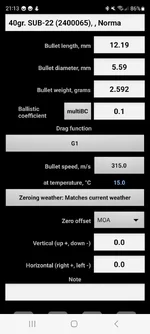
Thermion 2 LRF manual doesn't tell what ballistic models you can use, but at least G1 is shown. RA4 would be better match but it's not in widespread use.
Problem with G1 is, that figures are exaggerated around speed of sound. So when velocity drops, also BC drop. Using the true G1 BC at 1000-1050fps thus gives smaller drop values than in reality. Depending on how far you want to shoot, G1 BC of 0.130 - 0.150 might be a good starting point.
If you did measure the velocity from your gun, fiddle with BC until real world drop at longest range matches the calculator. If not, use the values suggested in this thread. The intermediate distances should be close enough. If you don't get satisfactory results, you can try to adjust speed also (since the G1 model doesn't predict transsonic flight accurately).
If you're shooting past 75m or so, remember to shoot large enough samples. All subsonic HPs I've tried (including Eley and RWS) about 10% of the rounds are slower and drop considerably from main group at 100m. You might get occasional 10rd group with no flyers, but usually there are 1 or 2.
Thermion 2 LRF manual doesn't tell what ballistic models you can use, but at least G1 is shown. RA4 would be better match but it's not in widespread use.
Problem with G1 is, that figures are exaggerated around speed of sound. So when velocity drops, also BC drop. Using the true G1 BC at 1000-1050fps thus gives smaller drop values than in reality. Depending on how far you want to shoot, G1 BC of 0.130 - 0.150 might be a good starting point.
If you did measure the velocity from your gun, fiddle with BC until real world drop at longest range matches the calculator. If not, use the values suggested in this thread. The intermediate distances should be close enough. If you don't get satisfactory results, you can try to adjust speed also (since the G1 model doesn't predict transsonic flight accurately).
If you're shooting past 75m or so, remember to shoot large enough samples. All subsonic HPs I've tried (including Eley and RWS) about 10% of the rounds are slower and drop considerably from main group at 100m. You might get occasional 10rd group with no flyers, but usually there are 1 or 2.
badmolassesaccident
Well-Known Member
Your firing solution depends on the ballistic coefficient. I am not convinced at all that the BC printed on the box of ammo or the manufactures data sheet is accurate at for 22LR. I'd say just pick some 22 subsonic ammo out of the database, chronograph it out of your rifle, measure your elevations at say 50, 100, 200 and generate a BC in the app that matches those elevations. Don't forget you need to account for any headwind or tailwind in your elevations. The bullet is slow slow that headwinds and tailwinds can affect elevations.

I was doing exactly this with some Winchester subs last night. Chronoed, zeroed at 50m, set up the profile, then put the target out to 150m and tweaked the BC to bring the rounds to the centre of the gong. Entering too high a BC will give insufficient hold-over in the scope and cause you to hit low.You'd want to measure the exact velocity from your gun, if you want exact results. [...] If you did measure the velocity from your gun, fiddle with BC until real world drop at longest range matches the calculator.
nun_hunter
Well-Known Member
Genuine question but why are people more trusting of the accuracy of their chronograph (which I'm sure most state a tolerance or variability) rather than that of the manufacturer who has better equipment?

Genuine question but why are people more trusting of the accuracy of their chronograph (which I'm sure most state a tolerance or variability) rather than that of the manufacturer who has better equipment?
MV varies with barrel length. Manufacturer will post values derived from their test rig which may differ from the consumer's rifle in several ways, including barrel length.
But, as has been stated above, there is no substitute for truing your ballistic app with range acquired data at suitable distances.
billy_boyle_2010
Well-Known Member
Genuine question but why are people more trusting of the accuracy of their chronograph (which I'm sure most state a tolerance or variability) rather than that of the manufacturer who has better equipment?
So many things affect it. Some fixed (like your barrel size and length)- others variable like temp and the batch of ammo you're using.
Plus the manufacturers have a tenancy to over estimate their speeds to show a flat trajectory. At least they do in non subsonic ammo where speed is desirable.
The manufacturer states a speed for their ammo knowing that not every round will have that exact same MV and without stating the conditions under which the measurement was made (barrel length, etc)
Their figures would be more trustworthy if they gave the spread of velocities measured and were more forthcoming about the conditions under which the measurements were made
Cheers
Bruce
Their figures would be more trustworthy if they gave the spread of velocities measured and were more forthcoming about the conditions under which the measurements were made
Cheers
Bruce
nun_hunter
Well-Known Member
Yes I would expect speed to vary with barrel length but I would also expect that what the manufacturer tests BC and velocity with is a lot more accurate than most people's chronographs. So why not assume the BC is correct and adjust the velocity off your chronograph when trueing the data in your app?MV varies with barrel length. Manufacturer will post values derived from their test rig which may differ from the consumer's rifle in several ways, including barrel length.
But, as has been stated above, there is no substitute for truing your ballistic app with range acquired data at suitable distances.
Would most of the BC adjustments people would need to make would have about the same impact on poi as the stated tolerance of accuracy of their chronograph?
jthyttin
Well-Known Member
G1 model is not accurate for 22LR when hovering around transsonic region. RA4 would be more appropriate but manufacturers don't publish (or even test) those figures.So why not assume the BC is correct and adjust the velocity off your chronograph when trueing the data in your app?
To get you an idea, if G1 BC is 0.172 for a given bullet (IIRC Lapua likes to use this for RN) at 1050fps, it might be 0.150 at 950fps and 0.130 at 850fps. These are ballpark(ish), not exact figures. Let's say the bullet is traveling 1050fps at muzzle, 950fps at 70 meters, and 850fps at 150 meters. These are quite accurate figures for the BCs given.
Fortunately the changes are quite small if you stay at reasonable ranges, 100m or so. Error of one meter in range measurement / estimation, is worth about same than the difference in BCs above (0.172 vs. 0.150).
nun_hunter
Well-Known Member
Forgive my ignorance but do the better ballistic apps not take this into account? Most apps will tell you the estimated velocity at any distance so would it not take the reduced BC into account for this too in order to calculate the bullet drop?G1 model is not accurate for 22LR when hovering around transsonic region. RA4 would be more appropriate but manufacturers don't publish (or even test) those figures.
To get you an idea, if G1 BC is 0.172 for a given bullet (IIRC Lapua likes to use this for RN) at 1050fps, it might be 0.150 at 950fps and 0.130 at 850fps. These are ballpark(ish), not exact figures. Let's say the bullet is traveling 1050fps at muzzle, 950fps at 70 meters, and 850fps at 150 meters. These are quite accurate figures for the BCs given.
Fortunately the changes are quite small if you stay at reasonable ranges, 100m or so. Error of one meter in range measurement / estimation, is worth about same than the difference in BCs above (0.172 vs. 0.150).

long_range_rob
Well-Known Member
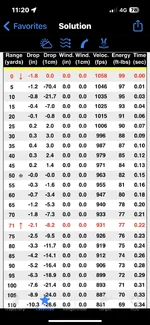
This is what I use for my Eley 40gn Subs

Never mind what an App says , go shoot it at ranges up to max . Zeroed at 50 your usually about 4" low at 100 with subs , CCI velociters can extend your trajectory range while not messing with windages as much as the lighter bullet stuff .
Always field test App data as its got tendencies and remember altitude / pressure matters
Always field test App data as its got tendencies and remember altitude / pressure matters
jthyttin
Well-Known Member
No. If you input single BC they will use it throughout the trajectory. This is definitely not my area of expertise, but I can say with some certainty that you cannot predict the changing BC by using only BC for given velocity, it depends on bullet shape and size (there can be two quite different bullets with same G1 BC).Most apps will tell you the estimated velocity at any distance so would it not take the reduced BC into account for this too in order to calculate the bullet drop?
There are calculators, for G1 at least, that you can input several BC values and define the velocity window for each of them. I think they were more popular for LR shooters, but now calculators based on G7, CD / form factor etc. have taken over. Manufacturers like Sierra still give velocity dependent G1 BCs for their bullets.
This thread has sparked something I've been thinking about for a while.
When a ballistic calculator generates a firing solution does it use the zero distance you have input as the highest point in path of the bullet?
Looking at long range robs chart above, that seems to be the case for this particular situation.
i.e the drop is zero at his zeroing distance and the bullet is below that everywhere else (negative numbers)
However, as we all know, the flight path of a bullet can cross the line of sight at two points - a near zero and far zero
So, I guess my question is, if you happen to zero the scope at the near zero, can the ballistic calculator still give an accurate result at distance farther than the near zero where, for part of its trajectory, the bullet will be above the line of sight (positive values) and then pass through the far zero and then be below the line of sight (negative values)
Cheers
Bruce
When a ballistic calculator generates a firing solution does it use the zero distance you have input as the highest point in path of the bullet?
Looking at long range robs chart above, that seems to be the case for this particular situation.
i.e the drop is zero at his zeroing distance and the bullet is below that everywhere else (negative numbers)
However, as we all know, the flight path of a bullet can cross the line of sight at two points - a near zero and far zero
So, I guess my question is, if you happen to zero the scope at the near zero, can the ballistic calculator still give an accurate result at distance farther than the near zero where, for part of its trajectory, the bullet will be above the line of sight (positive values) and then pass through the far zero and then be below the line of sight (negative values)
Cheers
Bruce
jthyttin
Well-Known Member
Don't know which columns you were looking but to me it seems that there's near zero around 20y and far zero at 50y.
Tweaking the BC in JBM, G1 0.115 gives the same velocity numbers as in the screenshot above. But trajectory is more or less gibberish in that screenshot. Inch wise it looks somewhat OK but centimeter conversions are more or less off.
Regarding the original question, some calculators have options like "Zero at MPBR" but AFAIK they otherwise use the zero you give. Usually there are near zero and far zero, and they are what they are. I.e. for a given gun, all near zero and far zero pairs are matching and unique.
In some cases, like zeroing AR-15 at 100 meters, there's only one zero, the line of sight is tangent to trajectory. And in the case for near and far zero, line of sight is secant. You'd have to change either exterior ballistics (BC, velocity) or sight height over bore to change a secant zero to tangent zero (or vice versa).
Tweaking the BC in JBM, G1 0.115 gives the same velocity numbers as in the screenshot above. But trajectory is more or less gibberish in that screenshot. Inch wise it looks somewhat OK but centimeter conversions are more or less off.
Regarding the original question, some calculators have options like "Zero at MPBR" but AFAIK they otherwise use the zero you give. Usually there are near zero and far zero, and they are what they are. I.e. for a given gun, all near zero and far zero pairs are matching and unique.
In some cases, like zeroing AR-15 at 100 meters, there's only one zero, the line of sight is tangent to trajectory. And in the case for near and far zero, line of sight is secant. You'd have to change either exterior ballistics (BC, velocity) or sight height over bore to change a secant zero to tangent zero (or vice versa).
Similar threads
- Replies
- 0
- Views
- 123

- Replies
- 48
- Views
- 3K

- Replies
- 20
- Views
- 1K


- Replies
- 17
- Views
- 680

