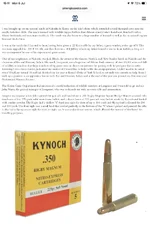
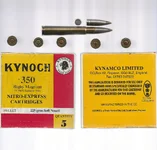
Have you got a picture of the batch number? Looks like a Kynamco box but the batch number will tell us more
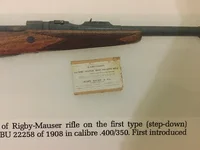
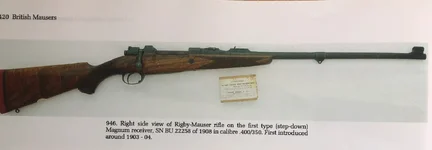
this was published by Rigbys so I see it's the exact same ammunition I have - I don't know the date but the article suggests it was loaded with Cordite - I will pull one and see
Thanks, this is modern Kynamco. Made from Bertram Brass (kangaroo) cases, Woodleigh 225gr RNSP, and probably loaded with Hodgdon (ASI) powder. The batch of this I've got had amongst it a box of vintage .350 Rigby Mag with headstamps from several decades, 2 types of PSP, and the copper-capped bullets which Kynoch custom-loaded for Rigby. The definition of the pic isn't great, but the firm's name should be visible stamped on the base of one. The originals came in a Kynamco packet, as original John Rigby boxes sell for a small fortune.

If you intend reloading for it, Ken Waters 'Pet Loads' book has his results with Norma, Sierra, Nosler, and Hornady bullets & some cautionary advice. A reprint of his writeup can be ordered online as a PDF of a back issue of 'Handloader Magazine'. I'm not certain about the copyright implications of sending out the reloading data, but this is the foreword to it:-
The .350 Rigby Magnum
Introduced in 1908, this big rimless cartridge preceded the .375 H&H Magnum and became popular as a flat-shooting medium caliber in Africa because of its high velocity for that day. It drove a 225-grain semi-pointed soft nose or roundnose solid of same weight at a muzzle velocity of 2,600 fps with a muzzle energy of 3,400 ft-lbs from 24-inch barrels.
This was a delightful general purpose cartridge for lion and the large African antelope but lacked a 250-grain bullet load for taking heavier skinned dangerous game in thick cover. Had not the .375 H&H Magnum with its heavier bullets and 200 fps velocity advantage eclipsed it in 1912, it is likely the .350 Magnum would have gained an even larger following among big game hunters.
Its principal disadvantage is that it requires either a magnum Mauser action or opening up a standard action for a 2.74-inch case and loaded cartridge length of 3.57 inches. The British rifle makers know how to do this by gaining space at the rear of the receiver rather than at the front without sacrificing strength.
As factory loaded, it is only a little superior to our own .35 Whelen, but its large case allows the use of heavier charges of powder while maintaining lower pressures. With maximum loads it is easily superior to the Whelen. My loads to date, however, haven't yet come up to equaling factory rounds because I prefer to work up gradually . . . .