Biomass (wood pellet / chip) boiler

Ronin

Distinguished Member
Random perhaps - anyone experience of using wood pellet or chip biomass boiler in their home

Cost to purchase is high I know

More interested in practical day to day running and cost in relation to “conventional “ gas central heating

Particularly interested in Froling users or similar auto feed high efficiency kit
 
Last edited:
Not used a pellet boiler, but I use the pellets for animal bedding. The price of them has jumped astronomically of late. They used to be around £200 for a pallet of 48x15kg bags. Now well over £400 of you can get them.

Several of the manufacturers have left the uk market and others are facing supply issues.
 
The Interforst show in Munich had quite a few companies showing their wares. Try going to the Munich messe website and get their info as to websites etc.
There seems to be a serious shortage of the equipment here in Germany now as panic buying (toilet rolls?) to get it installed before the promised winter gas shortage here kicks in.
 
My parents have a log boiler which hears their 8 bedroom house for about £1200 a year. They buy in a lorry load of firewood every other year and process it themselves. It works and it’s cheap but it’s heaps of work and heaps of storage required. The pellets will easy the work but you’re at the mercy of limited supply for a process heavy product. I don’t think they’re particularly cheap to run at all nowadays.
 
We have one and it’s fine about 14 bags a month in the summer and 14bags a week in the winter!
About 98 bags to the tonne… prices used to be £300 per tonne now £390
 
Cousin had a new one commissioned last year. Believe he got a grant to have it installed but also gets money back to run it. I think he said it’ll pay for itself in a few years. Though they coppiced and chipped all their own fuel so don’t really know about costs to run. Look into the grants if they’re still doing them!
 
Don't they require a gas to get them going? My sisters son is working in a company manufacturing pellets in Germany, they fear pellet heating will be going out of fashion. Especially because most governments have chosen to go as much electric as possible as they can control that best. Ultimate goal is to forbid any fuel burning in the houses, especially wood as that might be tax free.
edi
 
Large estate i looked after had one to heat the big house and cottage. When it worked it was great but they struggled finding people that really understood the machine. When faults cropped up they had engineers replacing bits hoping it would work. Sometimes it was down for weeks. Apparently on the continent where its used lots the techs understand them better and they work fine.
Sorry to not be much help but you need the back up from a company that know their stuff.
Only ever seemed to break down in winter
 
Ronin
I have worked with a Bio mass /pellet boiler engineer who has been on the go for many years . He fits all over the country. and done a lot of my pals farms etc . If you want his no let me know .He is based just in Brampton so not far from you .
 
Ronin
I have worked with a Bio mass /pellet boiler engineer who has been on the go for many years . He fits all over the country. and done a lot of my pals farms etc . If you want his no let me know .He is based just in Brampton so not far from you .


Cheers - just weighing up pros and cons for a possible project
 
We have one and it’s fine about 14 bags a month in the summer and 14bags a week in the winter!
About 98 bags to the tonne… prices used to be £300 per tonne now £390


Could you expand on house size / room number and insulation that’s fitted for that amount of use

Or message me if that’s better


Many thanks
 
Ronin. My nephew has one in a barn conversion, Austrian make with auto feeder. they blow pellets into a hopper. The barn is 90 ft long, open plan for 2/3rd of length upstairs & full length downstairs. Plus a converted cartshed down the side with 5 rooms. All heated with underfloor heating. Like all new technologies, rely on good insulation & double glazing to get the best. Unbelievable piece of kit, but at a cost when new. Got to admit I'm jealous, in my draft ridden farmhouse with no insulation or double glazing. He does use a medium size wood burner in the coldest evenings, just to keep costs down in a 90ft sitting room. Can provide more details if needed.
 
If you have gas heating already it'll likely be a non starter.
Think woodchip - commercial. pellets -small domestic. The bigger they are the better (scale) A lot of issues for the woodchips stem from the chip supplier not understanding moisture content and chip size. Batch burning logs seems easier for the UK although that needs a lot of space, machinery, time imput as others above have pointed out.
 
Random perhaps - anyone experience of using wood pellet or chip biomass boiler in their home

Cost to purchase is high I know

More interested in practical day to day running and cost in relation to “conventional “ gas central heating

Particularly interested in Froling users or similar auto feed high efficiency kit
Really a replacement for very rural oil fired heating premises. If you have mains gas forget it, even lpg I suspect.

The big issue is how much of an RHI payment you can get. Which is suspect is also the primary attraction.

If you can justify commercial then rates are much better than domestic. Not sure it is worth the effort if you are domestic only, kit is expensive and grants really just cover that. My mate has a commercial chip system and is making some serious money with it. Heating is profitable not a cost. RHI payments have been reduced though and he was pre the ban on using it to dry chip, so payments now are less but still worth a look. Chip can be very cheap if there is a guy nearby who is using his system to dry wood chip as he needs to churn it out to get his full payment. Perverse but true.

Getting a good installer is key. Lots of guys take shortcuts in running pipes (angles particularly) which means a bit more profit for them but reliability issues further down the line. Most of the systems I was aware of a few years back had some big issues. May be better now though as we have a larger installed base.

Use is simple, fill the hopper and forget. Space is an issue as the boiler and feeder is large as is the hopper. Annual service. My mates is monitored remotely so if there is an issue the service guy turns up before my mate is aware there is a problem.
 
Cousin had a new one commissioned last year. Believe he got a grant to have it installed but also gets money back to run it. I think he said it’ll pay for itself in a few years. Though they coppiced and chipped all their own fuel so don’t really know about costs to run. Look into the grants if they’re still doing them!
I don't know about what incentives there might still be for commercial uses, but as far as domestic use, I think this is where we stand, at the moment:

Financial Support for Biomass Boilers
How the Closure of the RHI Scheme Affects You and Your Energy Bills
As of 1 April 2022, energy regulator Ofgem closed the Renewable Heat Incentive Scheme (RHI) to new applicants. As of now, only applications concerning a change of ownership can be submitted.

Domestic Renewable Heat Incentive (Domestic RHI)


The RHI scheme only lasts for seven years from when you successfully registered for it.. That was reckoned to be about the "payback" time to recover the costs of the installation. No savings until then, and once the seven years are up (and they adjust the rates annually, downwards) basically you have a seven year old boiler and pay the going rate for the pellets, same as anyone else. Plus the incentive is based on how much energy you produce, i.e. the more you burn the more they pay you. Which is rather counter intuitive. I understand that it has to be fuel meeting the EN Plus A1 certification.

The replacement "Boiler Upgrade Scheme" seems to make more sense. An up front grant to go towards the initial installation. No other incentive, you have to work out whether it makes economic sense. At best it used to be that the cost of running one was on a par with a gas boiler, of course those economics might be more favourable nowadays, but for how long ? Can be quite efficient for space heating, but less so for hot water etc. This is not an open-ended grant scheme, a budget has been allocated, when that's gone, its gone.

Boiler Upgrade Scheme
Boiler upgrade scheme.On April 1, 2022, the Boiler Upgrade Scheme (formerly known as the Clean Heat Grant) was established to assist households with the initial costs of installing boilers. It replaces the Renewable Heat Incentive (RHI). With the new scheme, you can save £5,000 on starting costs for your biomass boiler!

Am I Eligible for the Boiler Upgrade Scheme?
The scheme operates on a first-come, first-served basis for those who meet the criteria. It is important to consider that this scheme only supports biomass boilers in rural areas.


If you are in a clean air zone check carefully. Not all of these things are compatible, they still can put out smoke. As well as fine invisible particulates known to be bad for health. And NOx

Of course unless they are a big commercial sized thing that does it automatically, they need emptying of ash, probably weekly, the hopper kept topped up by pouring in one bag at a time, and regular scheduled maintenance. Looked into one for my Father's country place, North Northumberland. Underfloor heated by oil, plus a good woodburner (and massive log pile thanks to storm Arwen). The oil boiler is vital to keep the place from freezing up when he is away, cutting in when needed on it's thermostat. Couldn't rely on a pellet system to look after itself. Very soon decided it was a non-starter idea. Superficially tempting, particularly the ones that can be installed with a small flue pipe poked through a hole in a wall.

Besides, he has a good modern log burning stove, no moving parts or reliance on electricity, maintenance, well a visit from the chimney sweep every year or two, and probably several years supply of logs. Just waiting on the contractor with the log splitter to process them for him, he's still very busy doing the same for other people, after the storms.

You may be eligible if you meet the following requirements:

are a homeowner, small landlord, or private landlord in England and Wales.
are not replacing an existing low-carbon heating system. You can only replace fossil fuel heating systems (e.g. oil, gas, direct electric).

have a valid Energy Performance Certificate (EPC) with no unfulfilled loft or cavity wall insulation recommendations
have an installation capacity up to 45kWth (majority of UK properties have this)

See also: 21 Biomass Boiler Pros And Cons

The Interforst show in Munich had quite a few companies showing their wares. Try going to the Munich messe website and get their info as to websites etc.
There seems to be a serious shortage of the equipment here in Germany now as panic buying (toilet rolls?) to get it installed before the promised winter gas shortage here kicks in.
There is not an infinite supply of wood pellets made using wood waste. Plus they vary in quality. Particularly if say there is an upsurge in demand for them from new installations. Even if you have a supplier set up to deliver them, and somewhere to store them keeping them dry. and ventilated (in large quantities they can spontaneously combust, or get set alight by some other accident) If you do, say have an unused barn, you might still need a large amount, tonnes to see you through say a Winter gas crisis.

Let's see, an imaginary conversation with Dad's fuel supplier, if another severe Winter comes: Please could you deliver a couple of tonnes of pellets. Sorry, we are sold out, no timescale when we can get resupplied. Orders have been mad these last few weeks. OK can you top up the oil tank, there's only a third left. Sorry, earliest I could do that is next month, booked solid. If you had ordered it sooner as I suggested when delivering to your neighbour to share the delivery charge, you'd have been OK. Oh. Do you know anyone else who could ? Laughs. No, I'm pretty much the monopoly suppler in this part of the county, as you know, and the only one with a tanker small enough to get up your lane.

Worth learning how they are made, and some of the downsides. Carbon neutral they absolutely are not.

Pellet fuel - Wikipedia

The most optimistic estimates here are that if all of our forestry waste was processed into pellets, there might be enough to heat 1.5 million homes. Maybe supply could be increased to meet demand, but it would take a bold business to consider increasing their pelletisation capacity for that alone.


If you have gas heating already it'll likely be a non starter.
Agreed. Even if it is viable, either purely economically, or simply for green "zero carbon" aspirations, probably best not to rip out the gas system altogether, but keep it for backup. Not allowed to do that for the Domestic Boiler Upgrade Scheme though, it has to be a replacement, I think.

TBH, heat pumps may yet be worth investigating

Really a replacement for very rural oil fired heating premises. If you have mains gas forget it, even lpg I suspect.

The big issue is how much of an RHI payment you can get. Which is suspect is also the primary attraction.
The RHI scheme was scrapped in April this year. It will carry on for up to seven years for those already on it who got in at the last minute, but there is no guarantee as to what the returns are going to be in the future, other than that they will almost certainly be reduced year on year.
 
Last edited:
Perhaps off topic strictly, as using neither pellets nor chips, but here goes:

Pellets - are a machine-made product extruded from wet wood - just saying that it takes energy (£) to both make and dry them out, and a lot of energy (£££) to make them, hence the cost, which is increasing phenomenally with increasing energy and raw material costs right now.

Chips - can be bought dried, but again - ££ costly; if produced from waste wood, they require a very large barn in which to store, plus a means of turning and or ventilating them so they don’t either mould or heat up from the process of drying out, both not cheap solutions. A friend in Denmark used to run this system and converted the unloved, or misshapen and left in the field Christmas trees for fuel, which was chipped by a contractor and blown upstairs into a large outbuilding, from where it could be moved into hopper feeding the burner sited in the lower ground floor, but he also needed an auger system to rotate the drying chips or else mould was an issue and heating a risk.

I use an Austrian ETA log ‘boiler’ (I also looked at the similar models by Fröhling), the economics of which are a bit more viable, and the fuel (naturally seasoned, air-dried logs) a bit more readily justifiable as well as cost-friendly, when when compared to pellets. That said, one needs of course the time (£) to produce the fuel in advance and to store same, and I anticipate an uplift in raw log charges soon also.

The moral? - it’s good to have your own woodland.

700AA348-3351-4164-AA84-78E9076C65FB.webp
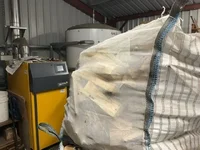
Log burner, 2000 litre HW tank, logs ready for autumn, trucked in to position;

C5D23880-263E-4F3E-862C-ECE77628BBF8.webp
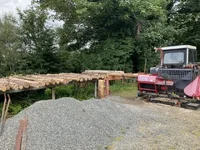
Log table with oversize/overflow table (takes a truckload at a time comfortably), processor and (multi purpose) tractor;

58968463-770E-4B05-96CA-543F49BEA44B.webp
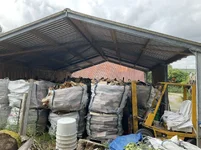
Log drying and storing barn - time, sun and wind are our helpers. Anticipate min 30 weeks per year of heating required, and prepare accordingly! Just finishing logs for use in winter of 2023-24, it’s nice to be ahead.
 
Pellets - are a machine-made product extruded from wet wood - just saying that it takes energy (£) to both make and dry them out, and a lot of energy (£££) to make them, hence the cost, which is increasing phenomenally with increasing energy and raw material costs right now.
Absolutely. Explained in my wiki link. Pellet fuel - Wikipedia

Some extracts from that, which resonate with my own thoughts:

Pellets are produced by compressing the wood material which has first passed through a hammer mill to provide a uniform dough-like mass.[15] This mass is fed to a press, where it is squeezed through a die having holes of the size required (normally 6 mm diameter, sometimes 8 mm or larger). The high pressure of the press causes the temperature of the wood to increase greatly, and the lignin plasticizes slightly, forming a natural "glue" that holds the pellet together as it cools.[9]

If the pellets are made directly from forest material, it takes up to 18% of the energy to dry the wood and additional 8% for transportation and manufacturing energy. An environmental impact assessment of exported wood pellets by the Department of Chemical and Mineral Engineering, University of Bologna, Italy and the Clean Energy Research Centre, at the University of British Columbia, published in 2009, concluded that the energy consumed to ship Canadian wood pellets from Vancouver to Stockholm (15,500 km via the Panama Canal), is about 14% of the total energy content of the wood pellets.[25][26]


Hmm, so that's 26% of the energy gone just making them. Then, why oh why does Sweden need to import from Canada ? A total of 40% of the intrinsic energy consumed in the processing and transport. And I betcha that the machinery and bulk carriers don't run off wood chips. Nope, that would probably be fossil fuel.

Regulatory agencies in Europe and North America are in the process of tightening the emissions standards for all forms of wood heat, including wood pellets and pellet stoves. These standards will become mandatory, with independently certified testing to ensure compliance

Wood pellets can emit large quantities of poisonous carbon monoxide during storage. Fatal accidents have taken place in private storerooms

When handled, wood pellets give off fine dust which can cause serious dust explosions.[39]

Wood pellets are typically stored in bulk in large silos. Pellets may self-heat, ignite and give rise to a deep-seated smoldering fire that is very difficult to extinguish. The smoldering fire produces toxic carbon monoxide and flammable pyrolysis gases that can lead to silo explosions.

Emissions such as NOx, SOx and volatile organic compounds from pellet burning equipment are in general very low in comparison to other forms of combustion heating.[49] A recognized problem is the emission of fine particulate matter to the air, especially in urban areas that have a high concentration of pellet heating systems or coal or oil heating systems in close proximity. This PM2.5 emissions of older pellet stoves and boilers can be problematic in close quarters

A report[9] by the Manomet Center for Conservation Sciences, "Biomass Sustainability and Carbon Policy Study" issued in June 2010 for the Massachusetts Department of Energy Resources, concludes that burning biomass such as wood pellets or wood chips releases a large amount of CO2 into the air, creating a "carbon debt" that is not retired for 20–25 years and after which there is a net benefit.[9] In June 2011 the department was preparing to file its final regulation, expecting to significantly tighten controls on the use of biomass for energy, including wood pellets.[55] Biomass energy proponents have disputed the Manomet report's conclusions,[56][57] and scientists have pointed out oversights in the report, suggesting that climate impacts are worse than reported

On 11 February 2021 five hundred scientists and economists wrote a letter regarding the use of forests for bioenergy to world leaders. It warns that "The burning of wood will increase warming for decades to centuries. That is true even when the wood replaces coal, oil or natural gas". The letter calls for an end to subsidies for the burning of wood and an end to the treatment of the burning of biomass as carbon neutral in renewable energy standards and emissions trading systems.

Per the New Hampshire Office of Energy and Planning release on Fuel Prices updated on 5 Oct 2015, the cost of #2 fuel oil delivered can be compared to the cost of Bulk Delivered Wood Fuel Pellets using their BTU equivalent: 1 ton pellets = 118.97 gallon of #2 Fuel Oil. This assumes that one ton of pellets produces 16,500,000 BTU and one gallon of #2 Fuel Oil produces 138,690 BTU. Thus if #2 Fuel Oil delivered costs $1.90/Gal, the breakeven price for pellets is $238.00/Ton delivered.


OK lets do a quick and dirty approximation. One ton of pellets is equivalent to 99 Imperial gallons of heating oil. Except it isn't, only the best big commercial pellet burners approach the thermal efficiency of a modern oil , or gas, boiler.

But lets take it at face value. Just got a quote from boilerjuice, minimum qty 500 litres (about 110 gallons) for £466.21 delivered.

What are pellets going for, maybe £400/ton. Not a lot in it is there ?

Do your own sums to compare with mains gas, cheaper, which BTW is a much lower carbon fuel CH4. Lots of the energy in that is from the hydrogen content, which BTW burns up basically just turning into water vapour/steam, from which energy can be further recovered in a condensing boiler. A modern gas boiler is a most excellent thing, and not particularly expensive either.

Burn wood, well dry stuff is 10% water anyway, which contributes nothing, having to be boiled into steam. That can then maybe be condensed again in a hi-tech boiler, partially recovering the energy loss from that.

Usage across Europe varies due to government regulations. In the Netherlands, Belgium, and the UK, pellets are used mainly in large-scale power plants. The UK's largest power plant, the Drax power station, converted some of its units to pellet burners starting in 2012; by 2015 Drax had made the UK the largest recipient of exports of wood pellets from the US.[69] In Denmark and Sweden, pellets are used in large-scale power plants, medium-scale district heating systems, and small-scale residential heat. In Germany, Austria, Italy, and France, pellets are used mostly for small-scale residential and industrial heat.[68]

From Spring 2015, any biomass owners—whether domestic or commercial—must buy their fuels from BSL (Biomass Suppliers List) approved suppliers in order to receive RHI payments.[70] The Renewable Heat Incentive scandal also referred to as the "cash for ash scandal", was a political scandal in Northern Ireland that centred on a failed renewable energy (wood pellet burning) incentive scheme.

Pellets are widely used in Sweden, the main pellet producer in Europe,[27] mainly as an alternative to oil-fired central heating. In Austria, the leading market for pellet central heating furnaces (relative to its population), it is estimated that 2/3 of all new domestic heating furnaces are pellet burners. In Italy, a large market for automatically fed pellet stoves has developed. Italy's main usage for pellets is small-scale private residential and industrial boilers for heating.[71]

In 2014 in Germany, the overall wood pellet consumption per year comprised 2,2 million tonnes. These pellets are consumed predominantly by residential small-scale heating sector. The co-firing plants which use pellet sector for energy production are not widespread in the country. The largest amount of wood pellets is certified with DINplus, and these are the pellets of the highest quality.
As a rule, the pellets of lower quality are exported

Why does that not surprise me.

So, what is to be done with e.g. forestry waste trimmings. Which have captured a lot of carbon over their life. Allow them to rot, well sadly no, that often turns into methane, a far worse greenhouse gas than CO2. But at least it isn't implicated in acidifying the oceans.

Carbon credit trading ? Just moving things around for the hedgies to speculate on. No better than Papal Indulgences. And cynical utility companies to sign up the gullible to expensive "zero carbon" deals because they have offset things with such things, or promise to plant some trees somewhere. Which of course in many years time, will never ever be harvested and maybe even turned into wood pellets. Meanwhile largely going bust over recent years because they gambled badly.

Just as the Norwegians are ever so cynical, at home they are ever so clean, all that hydro electricity (we buy a lot of that from them too, via the two interconnectors) Loads of pure EVs, heat pumps, super insulation etc. Meanwhile being a major player in exporting natural gas and oil, but that doesn't count because it gets burned elsewhere.

A sort of reverse hypocrisy here, oh no we mustn't create jobs, and wealth, by creating the first new deep mine for valuable coking coal for steelmaking in Cumbria. Well, if we don't do it somebody else will. It's all the same, the eventual CO2 from that will still happen but it won't be counted against us.

Again, are we determined to destroy what's left of our steelmaking, maybe that can be turned around by going over to electric arc furnaces. To be powered by what exactly. Wind. Solar, or the horror, Nuclear.

Sorry, you have caught me in a dystopian mood and I have no glib easy answers.
 
Back
Top