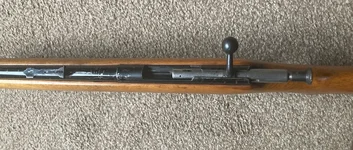
BSA CF2 6.5x55

Can I load hotter 6.5x55 rounds in these actions?

The CF2 actions were all made the same no matter what cartridge it was finally fitted up in so the same action you have will happily digest magnum pressures. Most hand loading data for the 6.5x55 Swedish is kept down in pressure as the companies printing it are worried about folks blowing up antique Mauser 94's. 95's and 96's.

Speer in their #14 manual cautiously list some loads which are a bit warmer than the the norm but they still fall well short of the 3000 fps which is achievable with careful load development. Speer only took the 120's up to 2850 fps.

I have a buddy in the US that loaded Nosler 125 grain partitions to 3000fps in his Ruger M77 using Reloader 22 if I recall correctly with no excessive pressure signs however once you leave the realm of published data your on your own.

In my old Hodgons #26 it gives a load of :-

start = Reloader 22 48.0 Grns = 2898 Fps

max = Reloader 22 51.0 grns = 3025 fps with the 120 grain bullet

That's at std SAAMI industry pressures for the 6.5x55 Swedish.

Hope that helps answer you question.
 
Thanks. I own a Swedish m/38 short rifle as well in 6.5x55.

I heard that the 6.5x55 actually shoots more accurately at moderate pressures (even safe for the 96 mausers).
 
Well Steve, my buddy in the US, is an accuracy nut. He shoots BR and Hi Power in competition at 600 yards.

With that Ruger M77 and load in 2002 he dropped an 11 pt Whitetail from a sitting position at 325 steps with a neck shot. He paced it out to check the distance. The head and neck were the only parts clear of brush. I would not try it but then again I am not used to shooting sub 2" groups with aperture sights at 600 yards. He would not accept anything less than very good grouping. MOA simply does not cut it with him.

I heard that the 6.5x55 actually shoots more accurately at moderate pressures (even safe for the 96 mausers).

Hmm I have never heard that. You will just have to do some load development and see how it goes...................... Oh my that's a hardship :D. Oh yes I found that the Speer 120 grain Hot Cor bullet performed well in my 6.5x55's. If your after larger beasts the 139/140's might be a better idea though. According to that Hodgdons manual you can get 2850 fps with them.
 
Thanks. I own a Swedish m/38 short rifle as well in 6.5x55.

I heard that the 6.5x55 actually shoots more accurately at moderate pressures (even safe for the 96 mausers).

Moderate compared to what? I've got some 53K loads for my FN that shoot half MOA.~Muir
 
My understanding is that most modern powders give most consistant combustion at higher pressures in the 60-65 kPSI range, but that they are very stable over a wide range of pressures. In a sporter-type rifle i would imagine barrel harmonics is going to be far more important to accuracy than chamber pressure.

FWIW, i would be very happy to run a M38 up to 60 000PSI (they were all proof tested to 66 000 PSI), and some folks run them hotter than that. I've seen many rebarreled to more modern high-pressure cartridges and never heard of a problem. The metallurgy was very consistantly high in those M38 (at least the type II/Husqvarna-made - easily recognised by the bent bolt handle) rifles. It is interesting to consider that to my knowledge the Zastava M98 is made exactly as the M98 was made a hundred years ago with essentially the same steel alloys, and they are largely sold in high-intensity cartridges. Now i'm not suggesting everybody go out and start hotrodding their M96 and M98s, and Zastava would be able to get a much more consistant grade of steel today than they could 100 years ago (making the rifles less prone to flaws), but i think it would be safe to say that very many of these actions are very strong and quite safe with high pressure cartridges. It is just that you don't really know what you have - as there were also some very weak and inconsistant M98s made. And the idea that you can just go and hardness test your reciever and be confident in its strength is a fallacy. Sadly, you have to assume you have a dodgey one unless you know a great deal about the origins of your action. I think you can safely say the M38 was one of those actions that was of the greatest consistancy and strength and can be relied on at pressures a little higher than some of their contemporaries including some large ring M98s.
 
Last edited:
My understanding is that most modern powders give most consistant combustion at higher pressures in the 60-65 kPSI range, but that they are very stable over a wide range of pressures. In a sporter-type rifle i would imagine barrel harmonics is going to be far more important to accuracy than chamber pressure.

FWIW, i would be very happy to run a M38 up to 60 000PSI, and some folks run them hotter than that. I've seen many rebarreled to more modern high-pressure cartridges and never heard of a problem. The steel quality and heat hardening was very consistantly high in those M38 rifles. It is interesting to consider that to my knowledge the Zastava M98 is made exactly as the M98 was made a hundred years ago with essentially the same steel alloys, and they are largely sold in high-intensity cartridges. Now i'm not suggesting everybody go out and start hotrodding their M96 and M98s, and Zastava would be able to get a much more consistant grade of steel today than they could 100 years ago (making the rifles less prone to flaws), but i think it would be safe to say that very many of these actions are very strong and quite safe with high pressure cartridges. It is just that you don't really know what you have - as there were also some very weak and inconsistant M98s made. And the idea that you can just go and hardness test your reciever and be confident in its strength is a fallacy. Sadly, you have to assume you have a dodgey one unless you know a great deal about the origins of your action. I think you can safely say the M38 was one of those actions that was of the greatest consistancy and strength and can be relied on at pressures a little higher than some of their contemporaries.

You'd think so but a look at a reloading manual that list pressure data will show you that it's usually not the case. You can easily find cartridges that have a 60K limit yet maximum loads stop at less pressure. This is because for that given component chain the pressures become erratic at top end with that powder and the data supplier wants to supply data that will consistently keep pressures under that 60K limit. It has been my experience that powders begin to behave erratically at top pressures (for the given cartridge and component chain) tho that might not always be a fair statement. Given that pressure begets pressure, and that the pressure curve is steepest at the upper end, it might be said that any exterior influence that raises pressures (a tight neck, a variation in seating depth, etc) may also enhance erratic behavior of a powder charge that is at or approaching maximum load. Outside the use of a pressure gun its hard to tell. An additional note might be that there are many powders that aren't designed to work anywhere near the 60-65K mark yet work well. Obviously, it depends on the powder and the vessel its ignited in.

As to the Swede. Love the Swede rifles. I have many M-96's and a couple of M648 commercials in 8x57. I have been a real fan of them for years and yes, they are stronger than their contemporaries. They are not, however, considered safer. And that is the issue. The traditional complaint is that they lack the third lug of a M-98 but that doesn't fly as Remingtons don't have it either. The best argument for not rebarreling the Swede to a high pressure cartridge is that they, like their contemporaries, lack the ability to handle the gas from a ruptured case or primer... or so the argument goes. There are some modern rifles that don't fit hat bill, either in my opinion. The Swedes were reportedly proofed at 70K PSI but no "proofing" pressure is intended for every day use. It is the margin of safety provided for the one, aberrant round that spikes your pressures far above normal. It takes little to send a 60K round close to 70K so I would, and have, avoided rebarreling 96 actions to any high pressure rounds. When Kimber Firearms went into bankruptcy reorganization in the mid 1980's they bought Swede mausers by the pallet and rebarreled them to hot calibers. I have worked on them.. It was a bad idea that hasn't gotten sweeter with time.

JMHO of course.~Muir
 
Do you gentlemen have groups of your BSA rifles so I can see the potential accuracy? I'm excited to see this rifle!
 
Out of curiosity, how do the BSA CF2 compare to other rifles of the time like the Parker Hale 1200 (look very similar!), Rem 700, Pre-64 Win 70, Ruger M77, Husqvarna 1640 etc.?
 
Last edited:
But surely when you are looking at a M38, you are looking at a rifle that is equivalent to many rifles that we consider entirely appropriate for modern pressure loads. I appreciate that the rear of the bolt is sometimes singled out as a weakness with respect to gas handling, but if you replace that with one of the aftermarket shrouds which i think are only around $40, surely it is as much a 60 000 psi action as most other mauser-type actions. The vents are smaller than on a M98, but with respect to gas handling it is doing a lot better than the much-vaunted pre-64 M70 Winchester! The metallurgy on the M38 is arguably the best of any rifle of its era.
 
Out of curiosity, how do the BSA CF2 compare to other rifles of the time like the Parker Hale 1200 (look very similar!), Rem 700, Pre-64 Win 70, Ruger M77, Husqvarna 1640 etc.?

The BSA is similar to the P-H 1200's M98 action in that:-

1) It's a bolt action with twin forward locking lugs

2) It's proofed to modern standards

There it diverges as the BSA CF2 is machined from a billet of steel. The later P-H's it seems were castings but might be forgings. I have heard both but can confirm neither. The CF2 has a lighter striker/firing pin with a short travel and fast lock time. The gas handling I cannot really comment on as I do not know how it would handle it. I did have a primer pocket blow on my 270 and one piece of unburnt powder hit the tip of my nose but I cannot say it if was a freak or not. The rifle is fine. The problem was caused with a load taken straight from the Nobel Sort Vectan leaflet and is fine in my other 270 BSA's but the CF2 Stutzen has atighter barrel and it seems this was enough to push the pressures over the top.

My other BSA 270's are 1st pattern Monarchs and Majestics which it appears have cut rifled barrels rather than the hammer forged one on the CF2 oh yes and the CF2 was acquired new so it has not had that many rounds down the bore. I have no idea how many rounds the others have shot.

I believe I have some targets stored away from load development in my 7x57 CF2 with teh Hornady 139 Bullets. It shot best with the 139 grn Flat Point but those will not feed from one side of the magazine as the flat tip catches the edge of the chamber and hangs up................................. Pity as they shot into 1/2 MOA or less.

Well right now Photbucket will not upload any photos so I cannot add them targets to it.
 
By any chance do you know the twist rate for the 6.5x55 CF2?

Also, as in my photos, the trigger guard and some of the bottom metal has some wear. Is the trigger guard aluminum alloy and the bottom metal steel?

Also, do these rifles benefit from free floating the barrel? Either by shimming or opening up the barrel channel? Or do they shoot better with a bit of pressure at the tip?
 
Last edited:
Page 178 of Knibbs book states it's 4 groove, one turn in 8.66" right hand for the 6.5x55mm.

Just give the rifle a good clean, check the bedding screws and shoot it. Many of the BSA stocks have been ruined by those followers of the free floating mantra I am sorry to say.

However it's your rifle and your money so it's really down to you.
 
I don't want to alter it, except for cleaning up the stock. I might just give it do a light sanding to clean off the surface grit, and then give it some BLO to moisten the stock.

Do I treat the rosewood fore-end and grip cap different than the rest of the walnut stock?
 
I don't want to alter it, except for cleaning up the stock. I might just give it do a light sanding to clean off the surface grit, and then give it some BLO to moisten the stock.

Do I treat the rosewood fore-end and grip cap different than the rest of the walnut stock?

No not really unless yu really sand quite a bit off the surface. Rosewood I am told has to be sealed as there is a natural oil in it which stops normal stock finishes hardening or drying. So far I have not had a problem with any of mine.

Personally I would not sand but as I said use a paint on jelly type paint stripper. The one I use called Nitromors requires washing off with water to neutralise it. Which of course raises the grain a bit. I then rub theat wooden round profile brush handle briskly over the wood which helps lay down the grain again and gives the surface a slight sheen. Then a a light wipe down with green scotch brite pad. Wipe dust off then start the oil finish applications.

After the old finish is off is the time to use the damp/wet cloth and iron to raise those dents and compressions. So far I have never needed to do more than this to any of my rifles.
 
Sorry I erroneously used the word 'sand'. I meant steel wool in circular motions to just take off the dirt and grime accumulated over the years. I'll have to really see how the dents are in stock. With my Husqvarna, I left them as is as they are part of the rifle's history and character, which I can add my own to. If it's offensive, then I'll try to fix it. Otherwise, I want to spend more time shooting it :)
 
I never use steel wool.. It can leave tiny bits behind that can rust and leave stains. As I said Scotch Brite or 600 Wet and dry. If you wett eh surface of the stock with BLO or stock oil it will float off the grime rather nicely and the very mild abrasive cuts the grime off well.

If the stock is just dirty with dried grime and sweat I have cleaned them off using the P-H 009 Nitro solvent. An old tooth brush dipped into it clean the chequering panels out rather well. I do have some stock finish surface remover paste in a re-finish kit I brought some years ago. I have used one small dab from the tine on the P-H 1200TX as I recall. The stock on that was filthy. So dirty carl at the range who was there when I did the deal for it and saw it after I cleaned it up remarked it looked like a totally different rifle and asked was I sure it was the same one.
 
Brithunter, is it possible to free float the barrel on this rifle if not why not. I was thinking of putting a custom stock on my 270. Your thoughts on this please.

Tusker
 
Back
Top