Brithunter
Well-Known Member
One can free float almost any rifle. However the real reason for free floating seems to have been forgotten. Prone riflemen use tight slings, I believe Whelen gives a pressure applied to the sling of up to 70lbs pull, and such pressure pulling slightly to one side can pull even well seasoned walnut into contact with one side of the barrel of the rifle and when shooting strings/relays as in competition this can effect the shots especially as the barrel heats up. They were not shooting 3 shots as it seems most do today when testing rifle and ammunition. Five shot strings being the minimum and twelve shots being quite normal.
Whelen considered 10 shota a minimum for load comparison and testing grouping ability.
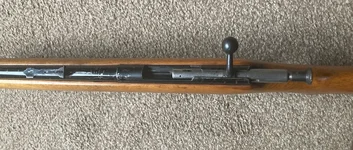
Hence they gouged out the barrel channel to give a large clearance to the barrel this being an example of such floating:-

note the very large gap and the heavy barrel on this prone target rifle.
Sporting/stalking rifles are another matter. Their barrels are thinner in contour, lighter in weight as are the stocks, or should I say were the stocks. The "modern" trend seems to me more towards outfits that seem closer to artillery pieces in size, bulk and weight than a stalking rifle.
It was found that in a properly seasoned stock that a forwards pressure point gave better results as this forward pressure point dampened the barrels whip. If one shoots enough to get the barrel very hot and by that I mean too hot to hold in ones hand the last shot/shots may "walk" a little on the target but in stalking tis a rare occasion to shoot enough to get a barrel that hot is it not?
Free floating also puts more pressure on the bedding area of the stock especially the front part which acts as the fulcrum to support the extended weight of the barrel stretching out in front. In poorer woods and poorly seasoned and often Kiln dried wood this front area compresses over time even if glass bedded hence to development of pillar bedding as we know it today.
With the pressure point out front there is not so much pressure applied to the front bedding area, i.e under the front receiver ring and recoil lug, as the barrel is also supported at this forwards point spreading the load even at rest.
No doubt there are those on these forums which will disagree with me.
For an example I own a commercially sporterised Swedish Mauser made at Carl Gustav around 1905, well the original rifle was, in the sporterisation a new M38 length barrel was fitted and some new bolt parts all forced matched to the action. This means all the serial numbers match and the Swedes numbered just about every part. The rifle was fitted with a new sporting stock. When I acquired it the rifle had not been shot except for proofing so was like new. The stock was covered in some preservative which was a right cow to remove but it did eventually come off and I applied a hand rubbed oiled finish and the rifle shot very well as these Swedes are known to do. Oh yes reading and believing what was written about free floating I regretably floating this rifles barrel
  .
.
Over the years the grouping opened up a bit and after one particularly wet days shooting I stripped the rifle out of its stock to dry and clean before a light oiling and once the stock was totally dry reassemble. It was then i discovered over time the front bedding area had compressed and now if one tightened the rear tang screw the action was being bent to make contact with the Mausers rear stock bush. The stock being a modern kiln dried one of what our American cousins would call utility grade was not of the best quality and was not as hard and resistant to compression as better walnut, if indeed it is walnut, would have been. the only option was to glass bed to reclaim the level of the bedding. Now I also own stalking rifles of 100 years old and their bedding and inletting is as good now as the day it left the makers. Every single one of these has the traditional pressure point bedding just back from the tip of the forestock.
I am also fortunate enough to own a fairly modern bespoke rifle which has a carefully hand crafted stock of fine dense, and heavy walnut, in which the action and barrel fit like a glove. There is no bedding compound used at all on it and if the "nut behind the butt" does their bit right this rifle will place all it's shots in a nice tidy little group. With a handload I found for it it will quite regularly place the shots touching or almost touching at 100 yards. It's been out in the weather now has some marks on the wood and it still performs the same. All this lead me to question the free floating mantra so often chanted and written about and tend me to believe that in modern production was just a cost cutting means of making rifles. Proper bedding and getting the pressure correct in the pressure point type takes skill and time where as anyone can hog out a barrel channel. One could probably train a chimp to do so. Like plastic mouldings they are there to cut costs and not really as improvements.
With your new stock it will easy to rout/gouge/sand out the barrel channel to float it IF the pressure point bedding system does not give the results you seek. However putting a proper pressure point pad back in although feasible is not so neat nor easy.
It's your rifle, your stock and your money so the choice it really down to you at the end of the day. Others such as myself can only present their views for you to consider. I hope this is of use or at least interest.
Whelen considered 10 shota a minimum for load comparison and testing grouping ability.
Hence they gouged out the barrel channel to give a large clearance to the barrel this being an example of such floating:-
note the very large gap and the heavy barrel on this prone target rifle.
Sporting/stalking rifles are another matter. Their barrels are thinner in contour, lighter in weight as are the stocks, or should I say were the stocks. The "modern" trend seems to me more towards outfits that seem closer to artillery pieces in size, bulk and weight than a stalking rifle.
It was found that in a properly seasoned stock that a forwards pressure point gave better results as this forward pressure point dampened the barrels whip. If one shoots enough to get the barrel very hot and by that I mean too hot to hold in ones hand the last shot/shots may "walk" a little on the target but in stalking tis a rare occasion to shoot enough to get a barrel that hot is it not?
Free floating also puts more pressure on the bedding area of the stock especially the front part which acts as the fulcrum to support the extended weight of the barrel stretching out in front. In poorer woods and poorly seasoned and often Kiln dried wood this front area compresses over time even if glass bedded hence to development of pillar bedding as we know it today.
With the pressure point out front there is not so much pressure applied to the front bedding area, i.e under the front receiver ring and recoil lug, as the barrel is also supported at this forwards point spreading the load even at rest.
No doubt there are those on these forums which will disagree with me.
For an example I own a commercially sporterised Swedish Mauser made at Carl Gustav around 1905, well the original rifle was, in the sporterisation a new M38 length barrel was fitted and some new bolt parts all forced matched to the action. This means all the serial numbers match and the Swedes numbered just about every part. The rifle was fitted with a new sporting stock. When I acquired it the rifle had not been shot except for proofing so was like new. The stock was covered in some preservative which was a right cow to remove but it did eventually come off and I applied a hand rubbed oiled finish and the rifle shot very well as these Swedes are known to do. Oh yes reading and believing what was written
about free floating I regretably floating this rifles barrel .Over the years the grouping opened up a bit and after one particularly wet days shooting I stripped the rifle out of its stock to dry and clean before a light oiling and once the stock was totally dry reassemble. It was then i discovered over time the front bedding area had compressed and now if one tightened the rear tang screw the action was being bent to make contact with the Mausers rear stock bush. The stock being a modern kiln dried one of what our American cousins would call utility grade was not of the best quality and was not as hard and resistant to compression as better walnut, if indeed it is walnut, would have been. the only option was to glass bed to reclaim the level of the bedding. Now I also own stalking rifles of 100 years old and their bedding and inletting is as good now as the day it left the makers. Every single one of these has the traditional pressure point bedding just back from the tip of the forestock.
I am also fortunate enough to own a fairly modern bespoke rifle which has a carefully hand crafted stock of fine dense, and heavy walnut, in which the action and barrel fit like a glove. There is no bedding compound used at all on it and if the "nut behind the butt" does their bit right this rifle will place all it's shots in a nice tidy little group. With a handload I found for it it will quite regularly place the shots touching or almost touching at 100 yards. It's been out in the weather now has some marks on the wood and it still performs the same. All this lead me to question the free floating mantra so often chanted and written about and tend me to believe that in modern production was just a cost cutting means of making rifles. Proper bedding and getting the pressure correct in the pressure point type takes skill and time where as anyone can hog out a barrel channel. One could probably train a chimp to do so. Like plastic mouldings they are there to cut costs and not really as improvements.
With your new stock it will easy to rout/gouge/sand out the barrel channel to float it IF the pressure point bedding system does not give the results you seek. However putting a proper pressure point pad back in although feasible is not so neat nor easy.
It's your rifle, your stock and your money so the choice it really down to you at the end of the day. Others such as myself can only present their views for you to consider. I hope this is of use or at least interest.



 .
. .
.


 .
.