Bullet Drop Compensating Reticles?

Tartan_Terrier

Well-Known Member
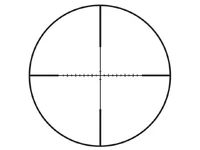
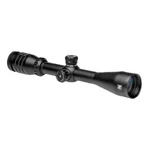
I've seen a few scope manufacturers offering this type of reticle, but I don't know if they're actually any use in practise.

95% of my shots on live quarry are going to be at under 150m, but it would be nice to know exactly where to aim if I'm shooting at longer distance on the range.

Anyone here using a scope with BDC? What do you reckon to it? Any advantage over a mildot type?
 
I have gone down the route of Ballistic Turrets instead. Can be much closer calibrated to your own calibre/load. Don't bother messing with it out to 150/175 yds and beyond that just dial up the distance and put the crosshairs on it. Very effective, quick and accurate.
 
BDC reticles, as you might expect, only come into their own when their is a significant amount of drop to compensate for. That means long range or low MVs.

In my opinion.... :old:


  1. If you shoot an air rifle, or a .22LR with subsonic ammo, then they're useful (but see 5).
  2. Likewise, they're an asset if you do any long-range target or vermin shooting with a centrefire.
  3. With a stalking rifle at normal ranges I find it sufficient to know my POI at 50/100/150/200 m and aim off by rule of thumb.
  4. I prefer BDC/stadia-type reticles to classic mil-dots because I find them easier to read, and particularly like the "Christmas-tree" type which makes it easier to assess and compensate for wind drift.
  5. However, in many second-focal-plane scopes the BDC element in the centre of the reticle is simply too small and ends up cluttering up the image. Thus in most cases it only comes into its own in a first-focal-plane scope, where zooming in also shows you all the reticle detail.
  6. When shooting well beyond point-blank range I use the reticle to aim off when using air rifles and .22LR, whereas with CF I dial in and use the reticle to measure the necessary correction if the first round misses the target. The difference in approach is due (i) to the greater precision of the second method -which matters more at long range- and (ii) to the fact that I generally have less time to engage a closer target and aiming off is quicker.

On my stalking rifles I like a nice, simple Duplex or No.4 reticle, preferably with an illuminable floating central dot with plenty of top-end brilliance and bottom-end fade (and as few wasted settings in the middle as possible).
 
I've seen a few scope manufacturers offering this type of reticle, but I don't know if they're actually any use in practise.

95% of my shots on live quarry are going to be at under 150m, but it would be nice to know exactly where to aim if I'm shooting at longer distance on the range.

Anyone here using a scope with BDC? What do you reckon to it? Any advantage over a mildot type?

I like my Swarovski Z6 with the BR reticle. I don't often use the first dot down, but it's handy to know it's available. I work in MOA, so I've not used and don't plan to use a scope with mil dots. I do use a set of Leica range finder binoculars and I try to practice at ranges longer than I plan to shoot.

I did practice the other day in a strong cross wind and couldn't hit the gong for toffee.

Regards

JCS
 
I have used several kinds. The Burris Ballistic Plex, which the others have sort of copied, works well, Vortex has one like it, and Swarovski and Zeiss have theirs with windage offsets. The Zeiss is very good, too. But, as noted, they are really not needed at most hunting ranges.

On the other hand, since so many of you UK hunters zero at 100 yards, rather than at 200 like I do, you would get a lot more use out of the Burris, or its clones.

And on a .22 LR, .22 WMR, Hornet or .17 HMR, or something loopy, like a .30-30, you can really use these things.

How well do they work? The Burris is might close on to its published ranges for different ammunition, but you have to tune it exactly for long ranges. But I have shot my .270 with it at 200, 300, 400, 500, and 600 on small targets, going up to a gallon paint can at 600, and hit each one first shot with the Burris markings set on 9x.

centerfire
100 yds /200 E1 Reticle Muzzleloader Rimfire drops and yardages

burris-bplex-2-7x35.webpballplexe1-reticle.webpburris-bplex-muzzleloader.webpburrise1plex-22lr-17hmr.gif
 
Last edited:
I use a burris on my 270 and it works really well it has been all over the world for different types of hunting, jacks mine is set up on 9x for it to work,atb wayne
 
Am I right in thinking that these rectifies only work on fixed mag scopes?

Good question, and I should have explained that.
All these reticles are calibrated for a certain power, usually the highest power, which makes sense, as they are for long range and lots of bullet drop.

But they work at other powers.

All the Burris scopes have the same MOA drops for the same reticle, at the highest setting. But they also publish a set of drops for each power range, for the other powers.

The same is true of Mil Dot, and half Mil Dot or G2 reticles. These are normally used for range finding with a 10X scope, then using the turrets to adjust for range. But It works well at 9X, because that makes the dot spacing an even 4 MOA. I use a 4X Mil Dot on a .22, which is kind of coarse at that low power, to hit a rat or crow at 150 yards.

There are also mixes of offset reticles and turrets. Burris makes a scope, the C4 Plus, which has turrets for .223, 308, .270, and .30-06, with a G2 type horizontal reticle for windage standoff. So you range with the horizontal reticle, dial in the yardage rather than MOA, and hold off into the wind using the horizontal marks.
burris-c4-moa.webpburris-c4-plus-30mm.webpballistic-plex-sub.webp
 
Am I right in thinking that these rectifies only work on fixed mag scopes?

it depends if the reticle is in the first or second focal plane. If in the first focal plane the reticle will become larger in proportion to the image. In this situation a BDC will work irrespective of what power the scope is at. If the reticle is in the second focal plane then the reticle will remain the same size as the image zooms in. Second focal plane BDC reticle will only be calibrated at a given power (usually max power for the scope)
 
You can figure the calibrations for scope power settings below the maximum. Burris actually publishes many of those, at each power setting. You are safer shooting at the highest or lowest setting, because you know you have it right on that power. See the reticle and chart I posted above for those subtensions.

Burris also has a detailed article on how to calibrate your BDC on your rifle with your ammunition. It works for all the others like their Ballistic Plex ( Vortex, Nikon, Bushnell, Swaro, Zeiss , Minox). Once you get it sighted in for 100 or 200 yards, you then shoot it at 300, 400, 500, ( and 600), and note the actual drops. Then you can plot out the exact yardage for each of the marks ( or use a ballistics calculator).
 
You can muck about calculating drops at specific magnifications with SFP scopes to your heart's content, but you need to make very sure your magnification ring is exactly where it should be before you shoot.

This is, I believe, why most BDC reticles are designed to be correctly scaled at maximum -though the appropriateness of high magnification for the compensation needed at range is undeniable-, because it gives you a constant stop. Mil-Dot scopes, however, typically scale correctly at 10x, and sometimes feature a detent on the zoom ring to confirm they are at precisely this point.

I wouldn't choose to use a BDC system that didn't have some kind of tactile reference point for the magnification ring.
 
A couple of us got the Zeiss Rapid Z Varmint Reticle in our long range scopes so I worked out a way to range and use the BDC at the same time.
Unless you can find the range a BDC is useless to you.
My rifle caliber and load works best at 13x (calculated using the Zeiss online calculator) so it is only a tweak away from the ranging power which is 12x.
It works well, landing the round within an inch or 2 of the target out to 400m.
Not perfect but I also have the option of ranging then using Strelok to get the correct number of clicks for elevation.
This is assuming that I can remember the average measurements of the game I'm after, as I don't yet have a laser ranging device. I usually use the animals head as a reference. For example a roos head (where I shoot) is approx 180mm from the chin to the tip of the ears. If at 12x it is bracketed between the 1 mil hash lines then it is approx 180m away. Wind to 13x and put the roos head in the correct lines and shoot. It works. This is why I find one load and projectile that works then stick to it.
zeiss_rapidz800.gif
 
Last edited:
Yes if a reticle is 2nd focal plane then the BDC can be used for a variety of calibers and loads but only at a set power. My rifle is 13x for the best fit with the Zeiss BDC.
If it is a 1st focal plane scope it will work for one and one only load or caliber at ANY zoom setting. Also ranging (mildots or milrad lines) in a 1st focal scope will be correct at ALL zoom settings. This is because the reticle does NOT change size in relation to the sighted object, appearing to grow bigger as the object is brought closer using the zoom function.
My 2nd focal plane Zeiss is ONLY correct for ranging in Milrads at 12x.
Swings and roundabouts.
 
Another rangefinding reticle which can also be used for hold over and hold off for wind, with major marks ever 2 MOA and a small mark in between. The scope, a Redfield Battlezone 3-9x42, has turrets with 1/4 MOA clicks and markings calibrated to the .223 Rem 55-gr at 3,100 FPS and the .308 168-gr at 2,650 FPS.
redfield-battlezone-4-12x40.webpredfield-tac-moa-reticle.webp

And the Leupold Mark AR with Mil Dot reticle and exposed turrets in 1/10 Mil clicks.
Leupold-mark-ar-3-9x40.webp
 
Back
Top