Copper bullets - the limitations

NigelM

Well-Known Member
I have been doing a lot of thinking about copper bullets recently. I’m putting a new rifle together and want to make sure it’s future proof come the lead ban which whether we like it or not is probably inevitable within the next 5 years. I’ve also read a few threads where people are obviously confused about the switch and how to do it most effectively.

Here is my take on it all. I’m sure some will disagree but this is the logic I’m happy with.

I started by running some numbers. I know through my own experience with GMX, TSX, TTSX and LRX bullets that I need to achieve a TV of 2400 fps if they are going to expand reliably and kill deer quickly and humanely. The bullet manufacturers bang in about 2000 fps expansion but in my experience this is not true. Plenty of others have corroborated this, some even feel 2400 is a bit low. I don’t believe it matters whether you are talking about Barnes, Hornady or Noser, all their copper bullets behave in a very similar way.

So if you’re going to maximise the effective range of your rifle with a copper bullet you need to reduce the weight of the bullet you’re using, probably to the smallest available in your calibre, to launch it as fast as possible and maximise the range at which it drops below 2400 fps.

My humble 7mm08 currently launches a 150gr ABLR at 2740 fps. It’s still carrying 1000ftlb of energy at 700m and doing 1750 fps which I trust an ABLR to expand at. Now I’m not one to shoot deer at 700m, but I have shot injured deer at over 500m and like to have the option to do it reliably. I also enjoy whacking the odd steel plate at range.

Switch to the 110gr TTSX, the fastest bullet I can get in 7mm, and I can launch it at 3150 fps. It hits the 2400 fps threshold beyond which I don’t trust it to expand properly at just 250m. So my effective killing range has dropped from 700m to 250m through the change to copper bullets. It’s also got the aerodynamics of a brick.

I ran the numbers on my 280ai. That usually shoots a 160 ABLR. It’s still carrying 1000 ftlb’s and 1700 fps at 950m - way beyond the range at which you would shoot deer, but they are the numbers. Switch to a 120 TTSX launched at 3400 fps and it hits the 2400 fps barrier at just 400m. Scary stuff. Our effective ranges are going to take a hammering come the change.

The real danger is that someone who doesn’t understand the difference between copper and lead, of which there will be plenty, will just switch the 165gr lead bullet in their 308Win for a 165gr copper one. They will launch it at around the same velocity, call it 2600 fps. The bullet will perform badly and the deer will run at ranges over 100m. That’s if it get’s to the deer at all as the additional length of the 165gr copper over the usual lead bullet means his standard 12 twist barrel fails to stabilise it and it’s going sideways.

There are two major issues with copper currently.
  • As BC is a factor of mass, as well as cross sectional area and form, copper bullets of the same length and design as lead bullets will always have a lower BC due to the lower density of copper. You could design a copper bullet to have the same BC as a lead bullet of the same mass, but it would be significantly longer and as a result be unlikely to stabilise in most peoples standard twist barrels. The lower BC of todays copper bullets compared to their lead equivalents means they scrub off speed and energy much more quickly, reducing the effective range.

  • Reliable expansion below 2400 fps is a major design issue. If we could trust them to expand down to the 1600 fps that we trust our lead bullets to (lower in some cases) then their effective range would be extended significantly. This is going to take a major redesign of how they work. At the moment Nosler, Hornady and Barnes all have almost identical designs and all perform equally badly. GS Custom in SA have taken a different approach and reports are that they do expand much more effectively and reliably than the other manufacturers, but I have no experience of them. I will try some before long as a limited selection of designs is available through the Dutch importer.
So for copper to really replace our lead bullets like for like the manufacturers need to get their **** together and design bullets that expand reliably at 1600 fps, design longer bullets that give us an equivalent BC to our lead ones and work with the rifle manufacturers to deliver us faster twist barrels in their rifles to stabilise them.

When they achieve that none of us will have any reason to complain about a lead ban, because copper will perform as well as our old bullets. Until then there is going to be a lot of resetting of range limits and a significant change of bullet weight used if we are to continue to cull our deer humanely.

For normal stalking ranges of sub 200m, providing we are changing our bullet weights down to the smallest available in our calibre (243 to 80gr, 270 to 110gr, 30cal to 130 gr) we should all be alright. But if you want to extend those ranges you’re going to have to know what the TV is for your rifle with your bullet of choice and make yourself happy that your bullet will expand sufficiently at that speed.
 
.243 80 grain 3150 fps Fox 150 yards on red hind, first one that didn't go straight through, hit bone on both shoulders, @Edinburgh Rifles thought you might be interested in this.
I had already come to the same conclusion, I would not be happy shooting much beyond 200 with this bullet, but I guess that might not be a bad thing.
Cheers
Richard

IMG-20210303-WA0003.jpeg
 
Last edited:
Look at the Nielsen Sonic bullets. They are designed to open at lower speeds so driving them at high velocity is not as important as with other lead free options.
See Ben Heath's thread here on SD.
They are a fragmenting design so provide a wider damage path too and avoid the likely hood of runners from alleged "pinholing" through.
Ian
 
.243 80 grain 3150 fps Fox 150 yards on red hind, first one that didn't go straight through, hit bone on both shoulders, @Edinburgh Rifles thought you might be interested in this.
I had already come to the same conclusion, I would not be happy shooting much beyond 200 with this bullet, but I guess that might not be a bad thing.
Cheers
Richard

View attachment 196690
Looks like pretty good performance to me - expansion seems pretty good at that range, and would it surely be capable a bit further out. Would you expect more of a jacketed bullet at that range?

Have you had other experiences over 200m that haven't been good?
 
Looks like pretty good performance to me - expansion seems pretty good at that range, and would it surely be capable a bit further out. Would you expect more of a jacketed bullet at that range?

Have you had other experiences over 200m that haven't been good?
Very good performance, I weighed it and it was 79grains, I can only assume the 'tip' weighed 1 grain!
To date 150 is the furthest I have shot with them, prior to this I was using Speer 100grain lead, and out to 275 yards they always killed.

An opportunity might present itself soon and I will try at 200 yards, but of course I don't want to experiment too much at the expense of a deer suffering.
To date I have shot roe up to big red stags, the only issue is there is very little blood trail, it was only a fallow that gave a good blood trail at around 100 yards chest shot.

Cheers

Richard
 
Look at the Nielsen Sonic bullets. They are designed to open at lower speeds so driving them at high velocity is not as important as with other lead free options.
See Ben Heath's thread here on SD.
They are a fragmenting design so provide a wider damage path too and avoid the likely hood of runners from alleged "pinholing" through.
Ian
Ian, just spent some time reading that Danish test and looking at the Gelatin results at 300m. Very comprehensive and really shows up the problems of a 300m shot with a Barnes bullet.

Have you tried the Hunt bullets yet? I read the thread by Ben Heath which was good, but I would rather hear the results from those who have used them rather than the guy who's selling them. I'm sure he's a great chap, but he has got a vested interest.
 
Hi Nigel, My main interest at the moment is the development of a 100grain 243 bullet to meet the large deer criteria here in Scotland.
So far I've side by side tested the 100grn Peregrine against some initial development samples from Nielsen and some conventional Hornady soft points.
I'm now awaiting delivery of the next Nielsen samples so I can do more tests.
Initial redults have shown the bullets to be easy to load, they fly dead straight and group fine with no stability issues when shot through my 1_8 twist 243. They don't exhibit pressure signs even when driven at 3150ft/sec.
Next tests will include shooting through slower twist barrels and on deer.
Ian
 
I have been doing a lot of thinking about copper bullets recently. I’m putting a new rifle together and want to make sure it’s future proof come the lead ban which whether we like it or not is probably inevitable within the next 5 years. I’ve also read a few threads where people are obviously confused about the switch and how to do it most effectively.

Here is my take on it all. I’m sure some will disagree but this is the logic I’m happy with.

I started by running some numbers. I know through my own experience with GMX, TSX, TTSX and LRX bullets that I need to achieve a TV of 2400 fps if they are going to expand reliably and kill deer quickly and humanely. The bullet manufacturers bang in about 2000 fps expansion but in my experience this is not true. Plenty of others have corroborated this, some even feel 2400 is a bit low. I don’t believe it matters whether you are talking about Barnes, Hornady or Noser, all their copper bullets behave in a very similar way.

So if you’re going to maximise the effective range of your rifle with a copper bullet you need to reduce the weight of the bullet you’re using, probably to the smallest available in your calibre, to launch it as fast as possible and maximise the range at which it drops below 2400 fps.

My humble 7mm08 currently launches a 150gr ABLR at 2740 fps. It’s still carrying 1000ftlb of energy at 700m and doing 1750 fps which I trust an ABLR to expand at. Now I’m not one to shoot deer at 700m, but I have shot injured deer at over 500m and like to have the option to do it reliably. I also enjoy whacking the odd steel plate at range.

Switch to the 110gr TTSX, the fastest bullet I can get in 7mm, and I can launch it at 3150 fps. It hits the 2400 fps threshold beyond which I don’t trust it to expand properly at just 250m. So my effective killing range has dropped from 700m to 250m through the change to copper bullets. It’s also got the aerodynamics of a brick.

I ran the numbers on my 280ai. That usually shoots a 160 ABLR. It’s still carrying 1000 ftlb’s and 1700 fps at 950m - way beyond the range at which you would shoot deer, but they are the numbers. Switch to a 120 TTSX launched at 3400 fps and it hits the 2400 fps barrier at just 400m. Scary stuff. Our effective ranges are going to take a hammering come the change.

The real danger is that someone who doesn’t understand the difference between copper and lead, of which there will be plenty, will just switch the 165gr lead bullet in their 308Win for a 165gr copper one. They will launch it at around the same velocity, call it 2600 fps. The bullet will perform badly and the deer will run at ranges over 100m. That’s if it get’s to the deer at all as the additional length of the 165gr copper over the usual lead bullet means his standard 12 twist barrel fails to stabilise it and it’s going sideways.

There are two major issues with copper currently.
  • As BC is a factor of mass, as well as cross sectional area and form, copper bullets of the same length and design as lead bullets will always have a lower BC due to the lower density of copper. You could design a copper bullet to have the same BC as a lead bullet of the same mass, but it would be significantly longer and as a result be unlikely to stabilise in most peoples standard twist barrels. The lower BC of todays copper bullets compared to their lead equivalents means they scrub off speed and energy much more quickly, reducing the effective range.

  • Reliable expansion below 2400 fps is a major design issue. If we could trust them to expand down to the 1600 fps that we trust our lead bullets to (lower in some cases) then their effective range would be extended significantly. This is going to take a major redesign of how they work. At the moment Nosler, Hornady and Barnes all have almost identical designs and all perform equally badly. GS Custom in SA have taken a different approach and reports are that they do expand much more effectively and reliably than the other manufacturers, but I have no experience of them. I will try some before long as a limited selection of designs is available through the Dutch importer.
So for copper to really replace our lead bullets like for like the manufacturers need to get their **** together and design bullets that expand reliably at 1600 fps, design longer bullets that give us an equivalent BC to our lead ones and work with the rifle manufacturers to deliver us faster twist barrels in their rifles to stabilise them.

When they achieve that none of us will have any reason to complain about a lead ban, because copper will perform as well as our old bullets. Until then there is going to be a lot of resetting of range limits and a significant change of bullet weight used if we are to continue to cull our deer humanely.

For normal stalking ranges of sub 200m, providing we are changing our bullet weights down to the smallest available in our calibre (243 to 80gr, 270 to 110gr, 30cal to 130 gr) we should all be alright. But if you want to extend those ranges you’re going to have to know what the TV is for your rifle with your bullet of choice and make yourself happy that your bullet will expand sufficiently at that speed.

Sounds like you’ve just talked yourself in to getting a magnum cartridge ;):lol:

I wonder if WSMs will become more popular when the lead ban kicks in for launching lead free bullets at higher velocities
 
Does anyone know why Nosler don't make a 130gn e-tip for .30cal? 150gn seems to be their lightest. I was tempted to play with this latter (for fun; not deer) but now Nigel has put me off again.
 
Hi Nigel, My main interest at the moment is the development of a 100grain 243 bullet to meet the large deer criteria here in Scotland.
So far I've side by side tested the 100grn Peregrine against some initial development samples from Nielsen and some conventional Hornady soft points.
I'm now awaiting delivery of the next Nielsen samples so I can do more tests.
Initial redults have shown the bullets to be easy to load, they fly dead straight and group fine with no stability issues when shot through my 1_8 twist 243. They don't exhibit pressure signs even when driven at 3150ft/sec.
Next tests will include shooting through slower twist barrels and on deer.
Ian
You've got me interested now. I have emailed Ben Heath and Neilson with questions. I can't find any sensible information anywhere on BC's or load data. Spud stated BC of the 6mm 85gr as G1 0.180 and the 75gr as the same G1 0.180. That's a flying brick and I can't believe it's right but nothing on the Neilson website. On load data these bullets use a very (very) similar shank design to the GS Custom bullets from SA which interest me. GSC have a very specific load development system which has velocity data for most common rounds and then says to play with seating depth in 20 thou increments when the velocity recommendation has been achieved. I'm not sure QL/Gordons really work with these drive band bullets which work on lower than normal pressures as the bearing surfaces are so small.

When I have the BC information I can model them and then need to work out what the true effective expansion/killing velocity is. They might be the answer to the design questions I posed above and get a bit closer at least to the effective range of lead bullets.
 
Sounds like you’ve just talked yourself in to getting a magnum cartridge ;):lol:

I wonder if WSMs will become more popular when the lead ban kicks in for launching lead free bullets at higher velocities
Quite the opposite. I'm trying to avoid going to a magnum cartridge like the plague. Hate the bloody things, although I do have a 338WM which is quite fun providing you're standing up. There is a design solution somewhere to this problem, we shouldn't have to up the HP of our guns to compensate for badly designed bullets.
 
Interesting

Have a look at a little comparison I thought of:

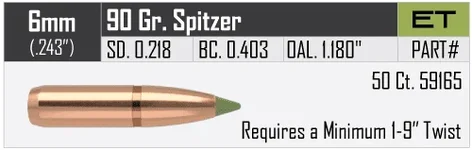
So, non-lead E-Tip bullet. Plastic tip with a boat tail

1614951828256.webp

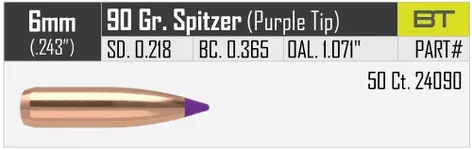
vs lead bullet of same mass and with ballistic tip and boat tail

1614951879704.webp

E-Tip has the better BC so I'd have thought would have shot in a similar way and arrived with decent impact speeds.

The non-lead bullets are getting better. Funnily enough you do read though that Barnes is troubles at the moment with expansion and QA / QC issues.

Scrummy
 
You've got me interested now. I have emailed Ben Heath and Neilson with questions. I can't find any sensible information anywhere on BC's or load data. Spud stated BC of the 6mm 85gr as G1 0.180 and the 75gr as the same G1 0.180. That's a flying brick and I can't believe it's right but nothing on the Neilson website. On load data these bullets use a very (very) similar shank design to the GS Custom bullets from SA which interest me. GSC have a very specific load development system which has velocity data for most common rounds and then says to play with seating depth in 20 thou increments when the velocity recommendation has been achieved. I'm not sure QL/Gordons really work with these drive band bullets which work on lower than normal pressures as the bearing surfaces are so small.

When I have the BC information I can model them and then need to work out what the true effective expansion/killing velocity is. They might be the answer to the design questions I posed above and get a bit closer at least to the effective range of lead bullets.
THE BC FIGURES WERE PRODUCED BY BEN AFTER TESTING
 
  • Reliable expansion below 2400 fps is a major design issue. If we could trust them to expand down to the 1600 fps that we trust our lead bullets to (lower in some cases) then their effective range would be extended significantly. This is going to take a major redesign of how they work. At the moment Nosler, Hornady and Barnes all have almost identical designs and all perform equally badly. GS Custom in SA have taken a different approach and reports are that they do expand much more effectively and reliably than the other manufacturers, but I have no experience of them. I will try some before long as a limited selection of designs is available through the Dutch importer.
So for copper to really replace our lead bullets like for like the manufacturers need to get their **** together and design bullets that expand reliably at 1600 fps, design longer bullets that give us an equivalent BC to our lead ones and work with the rifle manufacturers to deliver us faster twist barrels in their rifles to stabilise them.

I am surprised by your findings of failure below 2400fps. The same gel tests used for lead core bullets indicate sufficient expansion and energy delivered well below that. Peregrine claim 1600fps for instance...but the consensus of anecdotal reports on the internet that I have seen put the Barnes at around 2,000. Could you expand on your 2,400fps findings a bit?

I understood that the main advantage and the reasoning behind the relatively light for calibre lead free bullets is the terminal energy derived from being able to accelerate/propel them at higher velocity...it is more efficient to deliver energy by velocity than mass?

"The kinetic energy of a moving object is directly proportional to its mass and directly proportional to the square of its velocity. This means that an object with twice the mass and equal speed will have twice the kinetic energy, while an object with equal mass and twice the speed will have quadruple the kinetic energy"

The design of the bullet...the size of the hollow point and / or dum dum style splitting of the Nielsen type will have more of an effect on the minimum velocity required for expansion, but the energy will obviously be delivered in different ways...over a wider area...if the bullets are designed to fragment.

Alan
 
Last edited:
Get over BC problems by choosing the appropriate chambering, barrel length and twist to allow you to drive your choice of bullet as fast as possible.
Ian
 
Get over BC problems by choosing the appropriate chambering, barrel length and twist to allow you to drive your choice of bullet as fast as possible.
Ian
You are relying on the "Roy" effect. Professional Hunters I knew out in Africa hated clients who worshipped at the shrine of Roy Weatherby as the recoil accelerating the bullet up to the very high muzzle velocity was brutal and so accuracy suffered, at close ranges also at very high velocities close in the bullet behaved badly. We all know that energy is proportional to velocity squared but then so is drag so the fast bullet slows down pretty quickly which is why the very long range shooters use heavy streamlined bullets which may start out slower but hold their velocity well downrange.

David.
 
You are relying on the "Roy" effect. Professional Hunters I knew out in Africa hated clients who worshipped at the shrine of Roy Weatherby as the recoil accelerating the bullet up to the very high muzzle velocity was brutal and so accuracy suffered, at close ranges also at very high velocities close in the bullet behaved badly. We all know that energy is proportional to velocity squared but then so is drag so the fast bullet slows down pretty quickly which is why the very long range shooters use heavy streamlined bullets which may start out slower but hold their velocity well downrange.

David.
I think there is an interesting point to this.

Something like a 6mm 95 gr Hornady SST shot with muzzle velocity at 3,000fps (2,000 ftlbs ME) impacts at 400yds (Long shot for deer stalking) with a speed of 1,990 fps and 837 ftlbs of Energy

If we look at the same bullet type, 140gr 6.5mm SST shot at 2550 fps MV (again 2,000 ftlbs ME and slow for quite a few standard chamberings) impacts at 400yds with a speed of 1900 fps and carries energy of 1,127 ftlbs.

Muzzle velocity is not always the answer. I fear that 6mm bullets for hunting in non-lead will not be good friends.

I'd be interested to see some independent data on how the various non-lead bullets open up at different speeds.

Scrummy
 
You are relying on the "Roy" effect. Professional Hunters I knew out in Africa hated clients who worshipped at the shrine of Roy Weatherby as the recoil accelerating the bullet up to the very high muzzle velocity was brutal and so accuracy suffered, at close ranges also at very high velocities close in the bullet behaved badly. We all know that energy is proportional to velocity squared but then so is drag so the fast bullet slows down pretty quickly which is why the very long range shooters use heavy streamlined bullets which may start out slower but hold their velocity well downrange.

David.
All true, but the disadvantages of those dynamics for long range shooters are the advantages to us deer stalkers.....and is exactly why I concluded for my close stalking shooting ranges the light, fast, straight line deep penetration, low hazard of surface blow up and low residual energy properties of the 110gr .308 mono metal lead-free were ideal.

The problem with lead free is trying to make them do something they are not good at...for most UK deer and stalking ranges they tick more boxes than lead.

Alan
 
Last edited:
THE BC FIGURES WERE PRODUCED BY BEN AFTER TESTING
Spud, I suspect you just have a typo on your site. The G1 BC of 0.180 is in fact a G7 BC which would make much more sense, but Ben needs to confirm that. I still can't understand why the 85gr and the 75gr have the same BC though.
 
Hmmmm. Fascinating thread, for deer stalking applications in the UK rather than crunch numbers etc maybe just have a look at Ron Spomer’s interesting video on youtube

🦊🦊
 
Back
Top