Do you shoot a Rigby cartridge? Then your country needs YOU! - also, another woodworking blog

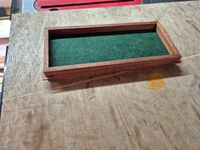
Began sorting out the glue squeeze-out, knocking back the corner edges, and did a test fit to double-check that the tray sits cleanly on top of the sheath. At first I thought it didn’t and that I’d still managed to get the measurement wrong — nightmare. It was rocking around and not sitting flush on its supports.

I then discovered it does exactly the same even when I remove the sheath. The mistake, in a way, is even worse: it goes back to not planing the tops of those supports before cutting them and making the liner. I can’t quite work out why it’s become such an issue, as they look flat and the bottom of the tray looks flat too (I’ve flattened the tray bottom with a plane and my glued-down sandpaper). But there’s still enough movement to bother me, and it makes the feel of the box a lot less professional.

Alas, I don’t think there’s much I can do about it now. Ideas welcome.

20251201_184630.jpg
 

Attachments

  • 20251201_184041.webp
    20251201_184041.webp
    270.8 KB · Views: 5
Last edited:
Began sorting out the glue squeeze-out, knocking back the corner edges, and did a test fit to double-check that the tray sits cleanly on top of the sheath. At first I thought it didn’t and that I’d still managed to get the measurement wrong — nightmare. It was rocking around and not sitting flush on its supports.

I then discovered it does exactly the same even when I remove the sheath. The mistake, in a way, is even worse: it goes back to not planing the tops of those supports before cutting them and making the liner. I can’t quite work out why it’s become such an issue, as they look flat and the bottom of the tray looks flat too (I’ve flattened the tray bottom with a plane and my glued-down sandpaper). But there’s still enough movement to bother me, and it makes the feel of the box a lot less professional.

Alas, I don’t think there’s much I can do about it now. Ideas welcome.

View attachment 449495
Assuming the bottom of the tray really is flat, can you use a scraper to remove any high areas on the support rim/frame in the base?

Via trial & error use thin paper packing to find the low area & scrape the high.

Lovely corner jointing!
 
Assuming the bottom of the tray really is flat, can you use a scraper to remove any high areas on the support rim/frame in the base?

Via trial & error use thin paper packing to find the low area & scrape the high.

Lovely corner jointing!

Thanks - I have some scrapers but never really used them as prepping the edge looked like such a faff. I will get stuck into a Youtube video and remedy this. Can you just explain what you mean by paper packing?
 
Looking fabulous mate great job. I’m glad you chose the green, that was the correct colour IMO!

Regarding your tray fit - how much room between it and the lid, could you add four small rubber feet to the bottom? Then cut down the feet to make it sit flat? Or even only three feet - and not worry about having to level anything? Three would mean when you sit the tray on a flat bench top it wouldn’t wobble either.

I’d say webley701 means keep adding paper layers until the rock is gone then you have the exact amount to remove
 
Looking fabulous mate great job. I’m glad you chose the green, that was the correct colour IMO!

Regarding your tray fit - how much room between it and the lid, could you add four small rubber feet to the bottom? Then cut down the feet to make it sit flat? Or even only three feet - and not worry about having to level anything? Three would mean when you sit the tray on a flat bench top it wouldn’t wobble either

Thanks, also an interesting idea! - I do have mixed weight/size sticky back felt somewhere that I have used for the base of boxes, side tables etc in the past. Where it has got to is another question though. I am not sure how much clearance there is tbh but it is tight. I think I will try a bit more to tidy up the support and box, plus look for these stickers.

I am just polishing up another cartridge a friend kindly sent, and the hinges! Unfortunately those neat elite ones were out of stock so I got these from some other site. Along with some little brass magnets to put at the front as a simple hidden latch.

20251201_191120.webp
 
Looking fabulous mate great job. I’m glad you chose the green, that was the correct colour IMO!

Regarding your tray fit - how much room between it and the lid, could you add four small rubber feet to the bottom? Then cut down the feet to make it sit flat? Or even only three feet - and not worry about having to level anything? Three would mean when you sit the tray on a flat bench top it wouldn’t wobble either.

I’d say webley701 means keep adding paper layers until the rock is gone then you have the exact amount to remove
Yes, as you said Harry regarding the paper.

My thought was to find the low areas/corners by trial & error using small squares of very thin paper packing (until the rocking stops) - it could for example be the top left & bottom right corners which need packing - you then know that the two other corners are high & can be gently scraped down (checking for reducing rock as you go). It may only be a matter of a thou or two.
 
Ticked a couple of things off the list this evening. I cut and fit mitre splines to the tray, trimmed them flush, filled one hole, and then sanded. I didn’t take photos of the finish, but I then bevelled the top edge to allow the lid to close and applied a second coat of oil to the outside edges. I also fitted the Rigby case to the base of the box.


I did some work on the tray support with a card scraper to try and get it perfectly level so the tray doesn’t rock. It’s improved, but it’s still not perfect. I may have reached the limit of my enthusiasm here — it’s probably at the stage where it’s only ever going to bother me.


20251214_182528.webp
20251214_103855.webp
 
t’s been a while since the last update, partly because I’ve been putting off the final stage: fitting the hinges. I eventually decided to buy the Neat Elite Smart Hinge, as the others I’d bought just didn’t look up to the quality I wanted.


So, a few days ago, I took the plunge and dragged out my cheap router table. This was the part I’d been dreading. I’ve never used hardware in a box build before, and to be honest I generally try to avoid power tools altogether when working at this scale.

As it turned out, all my worst fears were realised, and it went wrong in just about every way imaginable.

To summarise the various cock-ups (some my fault, some the kit’s, which I must say I’m not very satisfied with): I followed the video link recommended on the manufacturer’s website. The first problem was that the video showed undercutting a second, very small mortice for the hinge to function. After cutting the first mortice and doing a test fit, I realised this wasn’t required at all. It turns out the video shows an older version of the hinge, so I now have an entirely unnecessary hole at the back of one side of the box.

Next, I discovered that cutting the mortices had blown out the thinnest edge of the mitre joint. This was despite the box being over the manufacturer’s recommended wall thickness and using a brand-new, razor-sharp, high-end router bit. By this point, my happy face had completely disappeared.

Then, during final fitting, the very last brass screw head sheared off, leaving the shank stuck in the box. This happened even though I had drilled pilot holes. To add insult to injury, the instructions mention using a drill bit “provided”, despite there being no such thing in the kit. At that point, I was properly annoyed.

The final nail in the coffin was realising that the screws had actually pierced through the top of the box. That one is really on me — I should have checked the screw length more carefully, but it simply didn’t occur to me at the time.

At this stage, I genuinely wanted to throw the box away. I hate the idea of giving something as a gift that’s so far from my best work — but the lad’s birthday is only a few days away.

20260126_200658.webp

20260126_200811.webp
 

Attachments

  • 20260126_181225.webp
    20260126_181225.webp
    234.2 KB · Views: 3
The alignment was also off. I’m going to blame my tools on that one. The fence on that router table is awful: cheap plastic, and the right-hand locking screw can’t even be fitted when the fence is as close to the bit as I needed it. I’ve already ordered a lift kit so I can build a proper router table at some point, as I won’t be using this one again.

The screws coming through the lid and the edge of the mitre joint breaking off also pushed one of the joints apart, and it now looks a bit naff.

So, I was forced to crack on and try to fix it. By way of repairs:

I scraped the sides of the box to bring them back close to flush, then did a lot of hand sanding. I didn’t trust the random orbital sander at this point, and had a strong desire not to use another power tool.

I used epoxy to glue the broken screw head back in place, purely for aesthetic reasons.

Oh, and I should mention that I’d inset two small magnets to give a pleasing closure feel. The epoxy holding those didn’t set even after 24 hours and a few warming cycles with a hair dryer, so I was forced to carefully remove them, clean everything with meths, and refit them using gel CA glue.

20260127_142648.webp
20260127_165731.webp
20260127_165734.webp
 
Here it is finished with a couple of coats of my finest gunstock oil mix. I am sure he will like it, however, I would be lying if I said I was happy with it.

20260127_175939.webp

20260127_175925.webp
 
I must admit I am very very wary of modern machine tools especially routers when it comes to one off jobs etc.

You are much better off using tools that you know and love and have confidence in. Smoke and inletting by hand may take a bit longer, but you have full control, and you can correct as you go along.

Don’t get me wrong - there is a place for machine tools, but you need to learn how to make jigs and tools. They are fantastic if doing the same job time and again, but if you don’t have the jigs etc you end up with sawdust.

When making something like a lid it’s often worth fitting them early in the process, indeed pre-veneering etc. if the wood is still a bit oversized it is then easy to trim things up true. And if you feck it up then not much time invested. You can always then remove the hardware, and do all the rest of the work.

Beautiful work though.
 
Back
Top