Glaser style projectiles

Bavarianbrit

Well-Known Member
I was at a bit of a loose end today and I saw my box of .44 Special jackets, hm thinks I, lets try building up some Glaser type projectiles. I dropped the jackets into an upside down 30-06 sizing die in the press and tapped them with light blows with a .40 S&W case inserted primer side down on top of the jacket with a 1/4 inch bolt inside it to protect the die this belled in the front of the jackets on the dies shoulder angle a little. Then I filled 10x to the rim with #7 1/2 shot and they came out weighing between 131.5 & 133 grains, now I need to top them off with epoxy to seal them. Then later I will load them with 6.5 grains of N320 that is lying around unused. Then I will try them out on the next dead boars head for penetration performance, I do have a Rossi .44 Special 720 model held here in Germany.
I did load some .357s this way back in 1996 while in Argentina to relieve the boredom of the job and they were amazingly accurate out of a 10 inch Contender barrel at 50 metres.
 
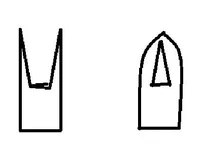
The Glaser Safety Slug made at home! My only concern would be the jacket getting stuck in the barrel. If you had a swaging die for a long nosed .38 you can take a standard .38 HBWC (hollow base wadcutter) profile die and a longer core than usual for rifle use, say 225 grains, and swage it in a jacket for rifle use of just plain lead alloy of standard weight, say 150 grains, for pistol use.

To give a profile with the hollow base forward. Then change dies and run through a round nose profile die. What the die does is close the hollow base onto itself so you now have a round nose bullet with a cavity beneath that seemingly solid round nose. At pistol velocities it probably offers no advantage anyway (especially not in a revolver) but in a, say, .35 Whelen it will give good feeding but with impressive expansion. I used to do this when I swaged commercially in the 1990s with a Corbin set up. The hidden cavity does indeed retain its flat botton as the skirt folds over to the round point shown.HBWC.webp
 
The Glaser Safety Slug made at home! My only concern would be the jacket getting stuck in the barrel. If you had a swaging die for a long nosed .38 you can take a standard .38 HBWC (hollow base wadcutter) profile die and a longer core than usual for rifle use, say 225 grains, and swage it in a jacket for rifle use of just plain lead alloy of standard weight, say 150 grains, for pistol use.

To give a profile with the hollow base forward. Then change dies and run through a round nose profile die. What the die does is close the hollow base onto itself so you now have a round nose bullet with a cavity beneath that seemingly solid round nose. At pistol velocities it probably offers no advantage anyway (especially not in a revolver) but in a, say, .35 Whelen it will give good feeding but with impressive expansion. I used to do this when I swaged commercially in the 1990s with a Corbin set up. The hidden cavity does indeed retain its flat botton as the skirt folds over to the round point shown.View attachment 292659
Would it not strip in the rifling at .35 Whelen velocities?
I am just thinking of using them for fangschuss/coup de grâce loads for my revolver with less Rick O Shea risks to me. Then again I do love to tinker.
 
Take a standard .38 HBWC? Then this will not accept a jacket and still fit in a .35 Whelen barrel. Or are you using the reversed .38 HBWCs inserted into a jacket to make up a larger diameter projectile?
 
I loaded some and fired one off in the woods with no adverse effects, the primer sits normally in the fired case.
I have just noticed that a S&W .40 case is the perfect diameter to fit into the .44 Special case and when filled with #7.5 shot = 180.5 grains, the quest goes on.
 
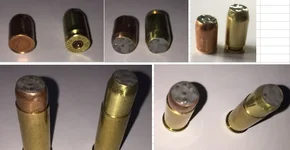
Just some pics of the finished projectiles one is a jacket & the other longer is the S&W .40 with a reversed used primer inserted.
 

Attachments

  • GlaserTypeFor .44Spl .webp
    GlaserTypeFor .44Spl .webp
    20.1 KB · Views: 43
Go on then, this concept is completely new to me.

What is the purpose of a Glaser projectile. Looks like a lot of effort when a cast boolet would work.
 
HMMM Plastic balltip and shot packed inside a hollow point jacket they were perfect when accompanied with hydro shock .45acp for and thing that needed ending ! next best thing to black talon sxt :norty:
 
They certainly don’t seem to expand much better than conventional bullets to my untrained eye and don’t think I could term them “safety” 🤣
 
These were with solid pure lead inside but they were made up using the same .40 S&W cases that I made up. I will need to source more of these once fireds to make up more prototypes for testing into water jugs etc. Retirees have too much time on their hands, what with getting a CAD model made up of my invention for reloading and then 3D printing up a few to test.
 
They certainly don’t seem to expand much better than conventional bullets to my untrained eye and don’t think I could term them “safety” 🤣
They were termed safety as they would theoretically not pass through the drywall into another room as used in American house building in motels etc.
To protect the innocent bystanders.
 
They certainly don’t seem to expand much better than conventional bullets to my untrained eye and don’t think I could term them “safety” 🤣
Yes they were designed for home defence - the safety label came from the fact they were specifically designed to stay in the assailant you shot and not to over penetrate and go through a stud wall into another bedroom etc .
 
Back
Top