Actually, the law is here:
Thank you.
Shooters’ powder
- 2 Shooters’ powder includes both black powder and smokeless powder.
- 3 The powder should be kept in containers with no more than 1 kg of powder
per container. The containers should be constructed in such a way that, in the event of a fire they do not provide additional containment that will either increase the explosive force of any deflagration or cause smokeless powder to detonate. Normally plastic/polythene or paper/cloth containers should be used. Metal containers with a screw cap or a push-in lid must not be used.
4 Although shooters’ powders are generally not very sensitive to ignition by electrostatic discharge, homeloaders or others who decant the contents of plastic containers should take care to reduce the risk of static electricity build-up. Advice on precautions may be sought from the manufacturer.
5 The containers of powder should be kept in a box constructed of plywood with a minimum thickness of 18 mm and a maximum thickness of 24 mm.
6 Where the box holds more than one container, each individual container should be separated by a 6 mm wooden partition that is securely fixed to the outer walls of the box. Each compartment should allow 30% additional height between the top of the container and the inside of the lid.
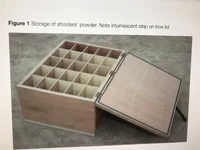
7 There should be a good seal to prevent a flame path between the lid of the box and the interior. An intumescent strip should be fitted around the edges of the lid to give a good seal or alternatively, a stepped lid or internal second lid should be fitted.
8 The box should be constructed so that there is no exposed metal on the inside. Internal nuts should be covered by a glued wooden liner not less than 6 mm.
9 Figure 1 shows a box that would meet the requirements set out in the previous paragraphs.
Page 100 of 114
Health and Safety Executive
Explosives Regulations 2014: Safety provisions
Figure 1 Storage of shooters’ powder. Note intumescent strip on box lid
10 Boxes constructed in line with the findings presented in HSE research report RR9916 can be used for the storage of between 1 and 25 (5 x 5) containers without being type tested. They are expected to provide at least eight minutes of fire protection to a box that is involved in a major conflagration.
11 The box should not be located:
- ■■ under or near any means of access or escape, for example under stairs;
- ■■ in the same room as flammable liquids; or
- ■■ in areas where there are risks of fire.
12 Metal boxes, including ammunition boxes, are not suitable and must not be used. This is because while metal is fire resistant it also transmits heat very well, and because the metal container adds additional containment that significantly increases the explosive power of the powder.
13 Similarly a box constructed from plywood must not be kept in any form of metal box, drawer or cupboard.