Headspace or Headmess

User00044

Well-Known Member
Okay following on from another thread that was derailed, in a not uncommon manner for the SD and apologies to the OP of that thread.

So let's get into this and pick the bones out of it 🤔.

I already hate myself for starting this .🤦‍♂️🤦‍♂️🤦‍♂️

Let's begin with the "book definition " of headspace.
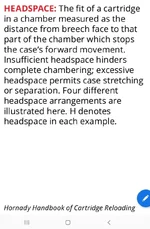
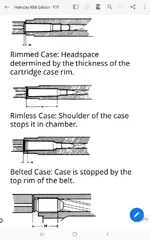
Screenshot_20230124-080356_Adobe Acrobat.webpScreenshot_20230125-071608_Adobe Acrobat.webp

Taken from the Hornady 10th Edition.

Have we all read that ?

From the description , I think it fair to assume that headspace is measured using a fireformed case and in the case of a rimless or rebated rim style case would be a close approximation of the chamber . Since headspace is a reference to case in chamber fit . By that definition, that would mean if the head to datum point measurement was shorter we'd have reduced headspace and vice - versa . Mmm !

Okay , let's go with something we all agree on . Case separation is often a symtom of "excessive headspace " ,caused by sizing cases too aggressively creating too greater gap . But wouldn't that be reducing headspace if we use the book definition . Again the reverse being true if a cartridge won't chamber.

But what about rimmed cases , where the case is stopped by the rim and not the shoulder during the firing cycle . The stretch forwards , case separation is usually forwards of the rim if sized too aggressively , still at the web but stretching into a void forward of the case shoulder.

Dear God , I wish I hadn't started this 🙏.

My understanding of headspace was it was the space between the boltface and case head. Hence we push the shoulder back to increase headspace . If this isnt headspace then what do we call that void and is case separation in rimmed cases caused by excessive shoulderspace ?

Perhaps the "book definition " would be better served ( in the case of rimless or rebated ) if a fireformed case was used and measured from base to datum point and that measurement referred to as " zero or reference headspace" . Especially since we never actually measure a space . Perhaps the void created by sizing during the sizing process should be referred to as "relative headspace ". When rimmed cases are sized we only size the body from the shoulder to the rim , what shall we call that measurement ?

I love contradiction. ❤

I've just reread this and it's absolute nonsense , I get why @Laurie didn't want to pick up the gauntlet!

Okay , please keep it light , humour at my expense is allowed but be aware I'm now trans' , I identify as a bat (the diet is awful), as such have no measurable sense of humour and am entitled to say and do whatever I f'in want 😉. Self deprecating-humour is also allowed and thank you for reading.

Let the discord begin....
 
Headspace as a dimension is only attributable to the weapon chamber, not the ammunition. This is generally measured using Go NoGo gauges, or the standout out a gauge with a known length to shoulder intersection against the chamber breech face in conjunction with an engineering drawing (more so a mass production environment when you’re not matching barrels, actions and bolts on an ad-hoc basis).

There are of course interface case dimensions to align to the weapon chamber, however these are generally referred to under a different nomenclature, such as length to shoulder or junction cone (CIP) for rimless cartridges.

Have a look at the CIP standards for 223 for example;

 
Headspace as a dimension is only attributable to the weapon chamber, not the ammunition. This is generally measured using Go NoGo gauges, or the standout out a gauge with a known length to shoulder intersection against the chamber breech face in conjunction with an engineering drawing (more so a mass production environment when you’re not matching barrels, actions and bolts on an ad-hoc basis).

There are of course interface case dimensions to align to the weapon chamber, however these are generally referred to under a different nomenclature, such as length to shoulder or junction cone (CIP) for rimless cartridges.

Have a look at the CIP standards for 223 for example;


I think you may have missed the point of my post . From a reloaders perspective , we all understand what is meant when we discuss headspace . We knock the shoulder back during resizing to increase the gap between the breechface or boltface and casehead and refer to that gap as headspace which we have calculated to be x thousandth of an inch , so on and so forth . But in general our understanding and use of the word is incorrect or so it seems.

Reading Hornadys' description is a contradiction in itself . If a headspace measurement as described decreases how can it then be an increase ? It's absolute nonsense .

You'd like to think Hornady knows a thing or two in regards to ammo .

As I pointed out , calling that measurement headspace is flawed we aren't measuring a space, we are essentially measuring a close approximation of the chamber length . Close , because of springback .

Essentially , the single measurement of "headspace" is useful only if used as part of a calculation , for example when sizing brass .

The term headspace is , as was pointed out to me by a gunsmith friend of a friend , a misnomer when it comes to reloading . He's quite possibly correct .

In my opinion , the head to datum point needs a rebrand , a change of nomenclature to reflect what it actually is and in my mind it is a base reference measurement . A bit off a mouthful but more accurate . The gap between the boltface and case head would be better described as the "relative headspace " .

From an engineering perspective , I 100% believe and understand what you've written , though I'm quite clearly not an engineer .

Cheers
 
Headspace as a dimension is only attributable to the weapon chamber, not the ammunition. This is generally measured using Go NoGo gauges, or the standout out a gauge with a known length to shoulder intersection against the chamber breech face in conjunction with an engineering drawing (more so a mass production environment when you’re not matching barrels, actions and bolts on an ad-hoc basis).

There are of course interface case dimensions to align to the weapon chamber, however these are generally referred to under a different nomenclature, such as length to shoulder or junction cone (CIP) for rimless cartridges.

Have a look at the CIP standards for 223 for example;

“Weapon” - Sssstttrrrrikkkke 1;
”Weapon” - Sssstttrrrrikkkke 2!
It is a gun, maybe even a firearm - defo not a weapon until you do something rather naughty with it then according to our wonderful press it becomes an assault something or other!
🦊🦊
 
I don't quite understand your point. A rifle barrel is mated to the action and bolt to a tight tolerance based on industry standards that guarantee ease of chambering and a reasonable expectation of case life and safety.

If someone wants to frig about with shoulders that's up to them.
In rimmed cartridge and actually any bottle neck cartridges brass does flow forward as well as backwards.
 
And, actually, the drawing above is incorrect with regard to headspace of rimless bottle neck. Headspace is the distance from a pre-determined datum point on the shoulder slope to the head of the cartridge. See 224 Valkyrie SAAMI drawing below. Note marker on lower right hand corner and it's appearance in the drawings.~Muir
 

Attachments

Not only have I missed your point, I’m not sure what your attempting to achieve.
Headspace is what headspace is, a dimension described as a specification given by SAMMI and or CIP for any given chambering ( note chamber, not cartridge ) usually described as a measurement from the boltface when closed to what ever part/ feature of the chamber stops the case from going forward.
From your comment :-
“I think it fair to assume that headspace is measured using a fireformed case and in the case of a rimless or rebated rim style case would be a close approximation of the chamber”
I think It’s fair to say that, perhaps you aught to get a better understanding of the subject before trying to lecture on it.
Headspace is most definitely NOT measured using a fireformed case. It is, other than through mechanical wear, a fixed dimension of the fit between the bolt face and the chamber.
EXCESS HEADSPACE and INSUFFICIENT HEADSPACE can be measured using a standard headspace gauge of known and standardised dimensions for the given chambering.
If you then manufacture your reloaded cartridges with insufficient or excess clearance for the chamber, is up to you ! It’s got nothing to do with the rifle.
 
Not only have I missed your point, I’m not sure what your attempting to achieve.
Headspace is what headspace is, a dimension described as a specification given by SAMMI and or CIP for any given chambering ( note chamber, not cartridge ) usually described as a measurement from the boltface when closed to what ever part/ feature of the chamber stops the case from going forward.
From your comment :-
“I think it fair to assume that headspace is measured using a fireformed case and in the case of a rimless or rebated rim style case would be a close approximation of the chamber”
I think It’s fair to say that, perhaps you aught to get a better understanding of the subject before trying to lecture on it.
Headspace is most definitely NOT measured using a fireformed case. It is, other than through mechanical wear, a fixed dimension of the fit between the bolt face and the chamber.
EXCESS HEADSPACE and INSUFFICIENT HEADSPACE can be measured using a standard headspace gauge of known and standardised dimensions for the given chambering.
If you then manufacture your reloaded cartridges with insufficient or excess clearance for the chamber, is up to you ! It’s got nothing to do with the rifle.
True, IF you are 'rolling your own' ammo.
BUT
If you are using factory ammo then it has everything to do with the rifle.
 
And, actually, the drawing above is incorrect with regard to headspace of rimless bottle neck. Headspace is the distance from a pre-determined datum point on the shoulder slope to the head of the cartridge. See 224 Valkyrie SAAMI drawing below. Note marker on lower right hand corner and it's appearance in the drawings.~Muir

It is not incorrect, that is CIP’s dimensioning method (the European version of SAAMI)).

As you say SAAMI (& NATO) measure headspace to an intersection on the shoulder taper, a different method however both are correct. In my opinion the SAAMI method is better as you’re not trying to locate an intersection hidden with a blend radius. Not that it matters to the average gunsmith using go no-go gauges.
 
And, actually, the drawing above is incorrect with regard to headspace of rimless bottle neck. Headspace is the distance from a pre-determined datum point on the shoulder slope to the head of the cartridge. See 224 Valkyrie SAAMI drawing below. Note marker on lower right hand corner and it's appearance in the drawings.~Muir


This is how I interpret headspace

This is one should remember a variable

What should be understood from headspace is your cartridge - if you reload, should not be over sized in the full length die causing the case to be significantly undersize - a dangerous condition
 
It is not incorrect, that is CIP’s dimensioning method (the European version of SAAMI)).

As you say SAAMI (& NATO) measure headspace to an intersection on the shoulder taper, a different method however both are correct. In my opinion the SAAMI method is better as you’re not trying to locate an intersection hidden with a blend radius. Not that it matters to the average gunsmith using go no-go gauges.


You don’t have to measure anything

Both Saami and CIP are correct

When re sizing the safest method to determine correct sizing (therefore correct headspace ) with a FULL Length die is to remove firing pin assembly and gradually resize the brass until the bolt will close using light single finger pressure

If the bolt drops under gravity - the case has been oversized (therefore too small)

It needs to “just fit” in the chamber touching both the bolt face and shoulder without crushing and without rattling,,,,
 
This is how I interpret headspace

This is one should remember a variable

What should be understood from headspace is your cartridge - if you reload, should not be over sized in the full length die causing the case to be significantly undersize - a dangerous condition
Fascinating thread and so unusual on SD to see differing opinions!
As a daft laddie question (moi?) does that inevitably mean that full-length resizing runs a higher risk of creating headspace issues than neck-sizing (assuming that your neck-sized case is within spec) ?
🦊🦊
 
Before we go any further , I'm not lecturing anyone , possibly a you problem, just trying to make sense of this . I've probably used more words than I speak in a year .

Here's my understanding of how we use the term headspace,

Headspace - a chamber dimension, breach to datum point.

Headspace- as defined by some manuals , head to datum point case measurement.

Headspace - the space or lack of it between bolt/breach face and case head .

My conclusion is that only the chamber dimension definition is true and that as reloaders we have no influence on that . What we are describing is case in chamber fit and our use of the term headspace has become synonymous as a result of common use . Our use of the word has become accepted but not strictly correct.
 
Last edited:
Yes, to a certain extent reloaders can lose or possibly increase the built in headspace of the rifle....but not always.
An open bolt mechanism probably does not have to be considered for head space.
 
Aye in the same way a golf club or chair leg becomes one when you use it to cause injury. Is it still a weapon at the range then?
Just asking….
🦊🦊
Anything designed specifically to cause physical injury is a weapon . . . . .

WTF is a hunting rifle if its not something designed specifically to cause physical injury
 
Back
Top