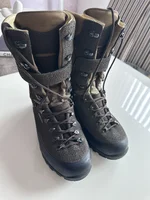
Lacing Boots

I heard the same Ghurka tale from my father. His embellishment was the terror of waking up in the night feeling somebody's hand on your boots, realising what it meant ,and praying you had laced them up correctly!

The other part of his tale was the hygiene and smell problems caused by the little pouch of ear trophies, worn around the neck, when he was tending them in Hospital!

Alan
 
I do not quite get the idea that it is easier to cut ladder pattern rather than criss cross. I would have almost thought that criss cross would help to keep the blade running down the centre..... but I guess at 90 degrees to the lace it is slightly less fabric to cut through...
 
I was always taught to tie the lace at the bottom of the boot, then run a single line up the boot, wrapping the single lace around the top and tying off. Not a very good description I know. The reason I was given was the speed of release if the boot was trapped. The single lace at the bottom could be cut, and the boot would come unlaced almost of its own accord. It's not quite the same as ladder lacing though.
 
I was under the impression that the forces "ladder" method was to do with lacing the boot so the horizontal laces were directly against the tongue of the boot and not pulling the eyelets into the tongue with "crossed" laces.
I makes for a more flexible boot and allowed new recruits to break in famously crap army boots without too much trouble.

not sure how lacing the ladder method makes it easier to take the boot off. if anything it makes the laces harder to unravel and places them directly and flush against the tongue with no space for a blade.

that said if you have trouble cutting laces of any lace format with a bloody great knife then I wouldn't want you anywhere near MY injured foot.
It is also the owrst thing you can do to remove the boot from an injured foot until you are at your final destination. it contains the swelling.
having torn an ankle ligament when going over pulling someone elses hind off the hill I can vouch for how painful it can be to walk the three miles home.
Only thing that helped was the immobilisation of the ankle by tightening up the boot before it swelled up to much.
(makes me wince just thinking about that walk!)
 
Apologies if you know this but it's one of those simple things that often pass one by.

If you get heel lift on your boot (which can cause blisters or hot spots) you can help reduce it with your lacing. When you reach the 'bend' in your boots rather than just carry on criss-crossing the laces do an overhand knot (like the first part of a bow) and then again for the next set of hooks up. This will help hold the boot steady around your ankle.

When you get to the top and are ready to tie the bow put an extra trun into your overhand knot. This will help hold the laces in place while you get tied, keeping the tension on the laces and holding your boot firm.

Very true Frax, I find it on my x/c ski boots , if you don't do this you'll suffer later.
I think I'll be wearing them a fair bit this year
 
I was always taught to tie the lace at the bottom of the boot, then run a single line up the boot, wrapping the single lace around the top and tying off. Not a very good description I know. The reason I was given was the speed of release if the boot was trapped. The single lace at the bottom could be cut, and the boot would come unlaced almost of its own accord. It's not quite the same as ladder lacing though.


This is how I understand the army laces its boots and is what I understood to be ladder lacing. (I don't think there is mention of this lacing method in Muir's link.) I, too, have heard the Gurkha story and medic reason, but I think the real advantages of this approach are that there are no loops to catch, and there is little risk of the laces coming undone, both of which are important when carrying a rifle. (I lace my boots this way for stalking.)
 
Back
Top