

There’s a spot I go to every few months or so, for a ‘lazy man’s hunt’. Otherwise known as an ambush. It’s on the bush edge, up the back of a hill country sheep farm, where well used game trails are used by reds, fallow, pigs and goats to access some sheep food.
I’ve hunted up the main game trail into the native twice before – once you’re through the scrub and under the native canopy, it’s surprisingly open. But the gradients are very steep, and it’s usually wet and damn slippery and hard to get around. Right now though, the leaf litter is as dry as a new packet of cornflakes, and unless the cicadas are going full bore, every step will advertise your presence to anything within 200m. On both the hunts into the native, I shot massive old billy goats, they were probably deaf and blind due to old age, as everything else had seen or heard me coming 10 minutes ago… I think I could actually hear them laughing at me.
This spot was the scene of the best deer interaction I’ve ever had, in April last year. Me and the wife walked up the track one evening after supper in our PJs, just to stretch the legs and enjoy the birdsong; it was such a beautiful evening we kept walking further uphill than we intended, and we found ourselves near the end of the track. The wife spied some deer behind the old macrocarpas, and we crept in with the wind in our favour, which is rare in that spot, more on the wind in a bit.
Long story short, we ended up commando crawling (in our PJs) within 20 yards of the animals, and watching the hinds browse while a magnificent 14 pointer stag sniffed their bottoms. The oldest hind spotted some movement and came around to see what we were; the stag was completely oblivious as he closely followed her tushy. That old hind came right up to the scrub where we were hiding, to almost within touching distance, before she caught a whiff and legged it up the spur opposite, honking like mad. The stag, he just stood there staring. He was a bow hunters dream.
Anyway, in all I had shot three deer in that spot, all using the same method… ambush. So I thought I’d give it another go. Normally I will bike up on the quad to within about 300m, well out of sight and largely screened noise-wise by a steep spur. I’ll park up and walk in about two hours before last light. Sometimes, animals will be out there all day, especially fallow, so first up I climb a spur that gives me a good field of view to glass the area before I move in. This time there was nothing doing, so I advanced to one of my normal ambush spots, under the first macrocarpas.
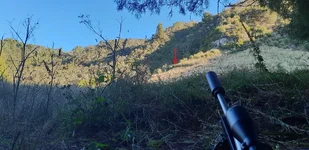
These photos were taken on previous hunts. I would expect to see deer emerge from the native a bit to the right of the red arrow, behind the suppressor, about 150m away.

Here’s the same deer hotspot seen from my other shooting position under a stand of macrocarpa.
In the next photo, you’re looking back to the shooting positions, either under the first tree with the red arrow, or as on the occasion when this photo was taken, from the second position marked by the blue arrow. It all depends on what the wind is doing.

This time round the wind was being a complete arse. From the red arrow macrocarpa, I kept getting across me, but I wasn’t happy that it wasn’t then turning back towards the bushline. It was really fickle, so I moved down to the blue arrow position, but this was even worse, it was steadily blowing from behind me. So I abandoned that position too and stealthily snuck back to open ground, and up a spur to gain some height to where I had reasonably consistent wind blowing across me from about 10:00 so to speak. This was completely at odds with what the clouds were doing, which was blowing straight across me from 03:00.
This photo from the final shooting position shows what the wind was actually doing, and how hard gully winds can be to get right. My worry is that once the gully wind turns around against the face and blows back across me, that it then blows up the windup wind face of the spur and around back to the bushline.

D’ya like the stag in the photo? Cool, eh. Took me ages to get him to pose like that.
So I sat and waited. And waited. I scanned the bush edge and slowly counted 1 to 10 as my eyes moved from point to point, left to right. The position was uncomfortable as hell, falling sharply away from under me to the left, thistles everywhere. I knew I was exposed and movement would give me away, but I had to stop various bits of me from going completely numb.
Here’s a sequence of frames from the GoPro to show the progression in the light. I knew I had to wait until the last of the light, and patience was the key. But I also knew that in the past I’d shot animals here well before the last of the light, and to be honest I wasn’t expecting to have to wait that long.

As the dusk darkened, I started to struggle to see, I was painfully aware how much my previously excellent eyesight has deteriorated since I turned 50. But there was nothing doing, and at the point at which the skyline started to merge with the bush, I gave up. That was the first time I’d drawn a blank here and I was properly disappointed. So I cleared the rifle, packed up my gear and put the torch in my pocket, stood, put on my.
Before I walked off down the spur, I wondered how much light the Zeiss Duralyt could acquire, so I wound out the mag to 3x and pointed it at the hives. Gotta say, the Zeiss does a damn good job, the hives below me were way more visible through the scope than they were with the naked eye. I shouldered the rifle and clipped the 3 point sling, and reached into my pocket for the torch.
As I took a step forward, I pulled out the torch and my finger found the switch. I glanced up to the bush line one last time, glancing left to right, and… I froze. Right on the main game trailhead there was a stationary rufous coloured object that hadn’t been there before. It could only be one thing... A deer. I unclipped the sling, grabbed the rifle and dropped the bipod legs, and hit the deck like a sack of spuds. Fortunately, I was on quite an easy lie, and I was able to find a good position with the bipod within a few seconds – the tilting function of the Harris is worth every penny. As I pulled my right eye into the ocular lens, the Zeiss lit up the clear outline of a fat red spiker facing directly towards, dead still and staring right at me; I could just make out the two straight ~30-40cm antlers. I took deep breath, quickly chambered a round, wound in the mag to about 6x, reacquired the target, aimed for the top of the brisket, exhaled, and let one fly. From spotting the deer to pulling the trigger, it would’ve been more than 10-12 seconds at a guess.
Milliseconds after the suppressed muzzle blast, the sound of the 165gr Speer striking the animal came back as the loudest, most satisfying THWOP I have ever heard. With the naked eye I could just make out the rufus colour slowly tip over to the left and disappear. No more movement, no thrashing around, just utter stillness… Complete silence for a few seconds, before suddenly the roosting magpies started madly squawking.
I’ve hunted up the main game trail into the native twice before – once you’re through the scrub and under the native canopy, it’s surprisingly open. But the gradients are very steep, and it’s usually wet and damn slippery and hard to get around. Right now though, the leaf litter is as dry as a new packet of cornflakes, and unless the cicadas are going full bore, every step will advertise your presence to anything within 200m. On both the hunts into the native, I shot massive old billy goats, they were probably deaf and blind due to old age, as everything else had seen or heard me coming 10 minutes ago… I think I could actually hear them laughing at me.
This spot was the scene of the best deer interaction I’ve ever had, in April last year. Me and the wife walked up the track one evening after supper in our PJs, just to stretch the legs and enjoy the birdsong; it was such a beautiful evening we kept walking further uphill than we intended, and we found ourselves near the end of the track. The wife spied some deer behind the old macrocarpas, and we crept in with the wind in our favour, which is rare in that spot, more on the wind in a bit.
Long story short, we ended up commando crawling (in our PJs) within 20 yards of the animals, and watching the hinds browse while a magnificent 14 pointer stag sniffed their bottoms. The oldest hind spotted some movement and came around to see what we were; the stag was completely oblivious as he closely followed her tushy. That old hind came right up to the scrub where we were hiding, to almost within touching distance, before she caught a whiff and legged it up the spur opposite, honking like mad. The stag, he just stood there staring. He was a bow hunters dream.
Anyway, in all I had shot three deer in that spot, all using the same method… ambush. So I thought I’d give it another go. Normally I will bike up on the quad to within about 300m, well out of sight and largely screened noise-wise by a steep spur. I’ll park up and walk in about two hours before last light. Sometimes, animals will be out there all day, especially fallow, so first up I climb a spur that gives me a good field of view to glass the area before I move in. This time there was nothing doing, so I advanced to one of my normal ambush spots, under the first macrocarpas.
These photos were taken on previous hunts. I would expect to see deer emerge from the native a bit to the right of the red arrow, behind the suppressor, about 150m away.
Here’s the same deer hotspot seen from my other shooting position under a stand of macrocarpa.
In the next photo, you’re looking back to the shooting positions, either under the first tree with the red arrow, or as on the occasion when this photo was taken, from the second position marked by the blue arrow. It all depends on what the wind is doing.
This time round the wind was being a complete arse. From the red arrow macrocarpa, I kept getting across me, but I wasn’t happy that it wasn’t then turning back towards the bushline. It was really fickle, so I moved down to the blue arrow position, but this was even worse, it was steadily blowing from behind me. So I abandoned that position too and stealthily snuck back to open ground, and up a spur to gain some height to where I had reasonably consistent wind blowing across me from about 10:00 so to speak. This was completely at odds with what the clouds were doing, which was blowing straight across me from 03:00.
This photo from the final shooting position shows what the wind was actually doing, and how hard gully winds can be to get right. My worry is that once the gully wind turns around against the face and blows back across me, that it then blows up the windup wind face of the spur and around back to the bushline.
D’ya like the stag in the photo? Cool, eh. Took me ages to get him to pose like that.
So I sat and waited. And waited. I scanned the bush edge and slowly counted 1 to 10 as my eyes moved from point to point, left to right. The position was uncomfortable as hell, falling sharply away from under me to the left, thistles everywhere. I knew I was exposed and movement would give me away, but I had to stop various bits of me from going completely numb.
Here’s a sequence of frames from the GoPro to show the progression in the light. I knew I had to wait until the last of the light, and patience was the key. But I also knew that in the past I’d shot animals here well before the last of the light, and to be honest I wasn’t expecting to have to wait that long.
As the dusk darkened, I started to struggle to see, I was painfully aware how much my previously excellent eyesight has deteriorated since I turned 50. But there was nothing doing, and at the point at which the skyline started to merge with the bush, I gave up. That was the first time I’d drawn a blank here and I was properly disappointed. So I cleared the rifle, packed up my gear and put the torch in my pocket, stood, put on my.
Before I walked off down the spur, I wondered how much light the Zeiss Duralyt could acquire, so I wound out the mag to 3x and pointed it at the hives. Gotta say, the Zeiss does a damn good job, the hives below me were way more visible through the scope than they were with the naked eye. I shouldered the rifle and clipped the 3 point sling, and reached into my pocket for the torch.
As I took a step forward, I pulled out the torch and my finger found the switch. I glanced up to the bush line one last time, glancing left to right, and… I froze. Right on the main game trailhead there was a stationary rufous coloured object that hadn’t been there before. It could only be one thing... A deer. I unclipped the sling, grabbed the rifle and dropped the bipod legs, and hit the deck like a sack of spuds. Fortunately, I was on quite an easy lie, and I was able to find a good position with the bipod within a few seconds – the tilting function of the Harris is worth every penny. As I pulled my right eye into the ocular lens, the Zeiss lit up the clear outline of a fat red spiker facing directly towards, dead still and staring right at me; I could just make out the two straight ~30-40cm antlers. I took deep breath, quickly chambered a round, wound in the mag to about 6x, reacquired the target, aimed for the top of the brisket, exhaled, and let one fly. From spotting the deer to pulling the trigger, it would’ve been more than 10-12 seconds at a guess.
Milliseconds after the suppressed muzzle blast, the sound of the 165gr Speer striking the animal came back as the loudest, most satisfying THWOP I have ever heard. With the naked eye I could just make out the rufus colour slowly tip over to the left and disappear. No more movement, no thrashing around, just utter stillness… Complete silence for a few seconds, before suddenly the roosting magpies started madly squawking.
Last edited:


