Lee crimping die

BigFrank

Well-Known Member
Just crimped my first rounds…..looks like a very heavy crimp on the 55gr V Max..223. Followed the instructions….screw die in to touch shell holder then 1/2 turn more. I pulled the round apart and the bullet was ”dented” all around. I’ll try again with 1/4 turn and see what happens.
 
Is this an old school seating die where there is a shoulder in the die that forces or "rolls" the case neck into the bullet (hopefully into a cannelure or groove) hence it;s name "roll crimp"? Or is this a Lee Factory Crimp die? If the latter I'd suggest you try a Lee shellholder as that may resolve the issue?
 
With the Lee factory crimp die, 'denting' of the bullet is normal. You will simply need to back the die off a little, if you feel the 'denting' is too severe for your liking.
When fired the pressure will sort the 'denting' out. I have them in .22Hornet, .243Win and .260Rem but have never managed to actually squish a bullet out of shape with them, so don't be too concerned.
 
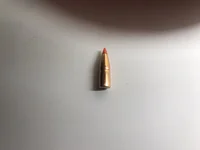
It’s a Lee factory crimp die with a Lee shell holder. I was just a little surprised at the result. you can see the deformed bullet
 

Attachments

  • image.webp
    image.webp
    55 KB · Views: 72
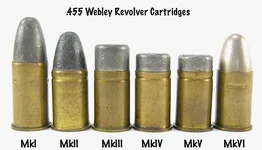
OK. Thank you for the picture. The dents are actually something that you'll see in "stab crimped" British military cartridges, especially the .455 Mk VI which had a hollow base.

Stab crimping is basically similar to what you Lee Factory Crimp die does but lower down the neck of the case and three (or sometimes four) contact points instead of crimping all around a full 360 degrees.

The other rounds in the picture all have an all around crimp but the Mark VI has this stab crimp. The uncrimped part of the case is evident. And yes you certainly would see it had "dented" the bullet as the OP refers to it as.

800px-455_Webley_Revolver.jpg
 
I had the same thing with the same die. I now have it turned back till its hardly visible. If i can just see a mark on the cack neck then its ok.
 
Perfectly normal - you are pretty much just creating your own cannelure on the bullet - I crimp everything up to and including 8mm with Lee Crimp Dies - if the late great Richard Lee said it is a good idea for hunting bullets then that is good enough for me! So simply screw the die in or out to obtain your chosen crimp. Simples.
🦊🦊
 
There is our friend a clue in the name.
noun
1.
a folded or compressed edge.

A crimp is rarely needed for bolt action .224" cartridges. It primary roll is to secure bullets that maybe subject to shifting via recoil or magazine type.
A secondary consideration is for military ammunition where reliability is desired from rough handled ammunition. Increased seating length could cause malfunction in automatic weapons.
It can aid ignition of certain powders and also slow a jacketed bullet that is designed to expand rapidly some what.
 
I am new to reloading but enjoying it very much. Just following the procedures in the Lee manual. I appreciate the “crimp or not crimp” issue but I don’t have enough experience to form an opinion. However, “Spud” at 1967spud.com has been a great help and obviously is very knowledgeable. he doesn’t crimp!….but he does use a custom mandrel to give a higher neck tension. They are available for the Lee die…under £10…Henry Krank has them in stock. I’ll buy one and work up some loads and see the results.
 
We do keep the factory crimps as well, technically speaking all seating dies partially taper crimp to some small extent, i personally dont add any extra crimp. Crimping on the cannelure is ok for high recoiling magazine fed guns in some calibre/gun configurations mostly military type stuff.
 
We do keep the factory crimps as well, technically speaking all seating dies partially taper crimp to some small extent, i personally dont add any extra crimp. Crimping on the cannelure is ok for high recoiling magazine fed guns in some calibre/gun configurations mostly military type stuff.
While crimping is used for the conditions you mention, most factory ammo is crimped to provide a uniformity in pull weight/neck tension. I have run lengthy tests comparing crimped and un crimped ammunition using same LOT components, loaded in one sitting with the only difference between loads being the addition of a crimp. SD and ES were both smaller in the crimpes ammo, this over 20-shot strings. Crimping won't necessarily make a poor load more accurate, but it will bring the numbers down.

I have been using the FCD since it came out and now won't consider load development without one. I never use the crimp that comes in some seating dies ~Muir
 
just on a side note ,i always crimp .many years ago i failed to put powder in a case !when fired the primer went off and as there was no recoil i thought i had a squib so waited the 30 seconds then unloaded and found the bullet had move a few mm but not left the case, the crimp had stopped the bullet from entering the rifling so to my mind the crimp stopped a problem that i had caused.
 
I am new to reloading but enjoying it very much. Just following the procedures in the Lee manual. I appreciate the “crimp or not crimp” issue but I don’t have enough experience to form an opinion. However, “Spud” at 1967spud.com has been a great help and obviously is very knowledgeable. he doesn’t crimp!….but he does use a custom mandrel to give a higher neck tension. They are available for the Lee die…under £10…Henry Krank has them in stock. I’ll buy one and work up some loads and see the results.
Would be interested in this
 
While crimping is used for the conditions you mention, most factory ammo is crimped to provide a uniformity in pull weight/neck tension. I have run lengthy tests comparing crimped and un crimped ammunition using same LOT components, loaded in one sitting with the only difference between loads being the addition of a crimp. SD and ES were both smaller in the crimpes ammo, this over 20-shot strings. Crimping won't necessarily make a poor load more accurate, but it will bring the numbers down.

I have been using the FCD since it came out and now won't consider load development without one. I never use the crimp that comes in some seating dies ~Muir
I certainly found that with 55gr Hornady FMJ-BT the accuracy improved in group size and I got a cleaner cases (guessing better burn)

Also I found helps with my 9.3x62 and 255gr Geco. Has a Cannelure so I used it!
 
I’ve used them since they first came available and agree with Muir, it’s possible to reduce group size and reduce the spread of muzzle velocities. I use a factory crimp die in all rifle calibers that I load and strongly recommend them to others.

As advised you will find a sweet spot that balances the crimp that the die produces.
 
Back
Top