Monometal bullets a question

Bavarianbrit

Well-Known Member
I was rereading an older 2012 German hunting mag where non lead was being discussed.
Points were made by DEVA Dienstleistungen GmbH (the German ballistic testing organisation) that depending on the shape/size and driving bands of the bullet the pressures that is created at entry into the bore can vary from 150 to 400 bar. They did a test of barrel fouling doing 350 shots allowing one hour minimum cooling between shots (a worst case non cleaned barrel like in shooting schools here) that left 4/100mm of copper coating inside the barrel = an 8/100mm smaller bore diameter, the result was a pressure rise to way over the present proof load limit.
This makes me wonder if the proof houses loads still use a lead projectile without planning for monometal future usage.

Comments?
 
1) which particular bullet caused the fouling? Bullet technology (in non lead) has moved on somewhat since 2012

2) most rifles are cleaned way before 350 shots

3) barrels at the proof house are likely cleaned way more often than every 350 shots so wouldn’t make a difference which bullet they use?
 
They were looking at what can worst case happen in real world. My question still stands, do proof houses use lead or monometals due to the pressure differences?
The shapes and materials are not different, the grooves may have been tuned with experience by the manufacturers but as an example and not belittling them Yew tree cannot have the funds for such testing as like Barnes will. They farm out I understand the lathe turning to a sub contractor CNC company
 
They were looking at what can worst case happen in real world. My question still stands, do proof houses use lead or monometals due to the pressure differences?
The shapes and materials are not different, the grooves may have been tuned with experience by the manufacturers but as an example and not belittling them Yew tree cannot have the funds for such testing as like Barnes will. They farm out I understand the lathe turning to a sub contractor CNC company
This is an irrelevant question. The German law on gun proofing states that the proof load must be 30% above the max. CIP pressure. How they achieve this is not stated. They might just as well use a wax plug.
 
Steff got on there first and put it better than I would have.

Material of proof house bullets is largely irrelevant given that the cartridge is designed to produce a certain pressure (ie if a mono metal bullet produced more pressure for a given charge the load would be reduced to suit)
 
There was a case where GMK sent an FLS rifle to Precision Rifle Sevices as a certain lot of Federal Copper ammo was being blamed for blowing primers.

Rifle was inspected and fired, result as expected (high pressure signs). Barrel/bore cleaned thoroughly and pressure signs went away.

Advice? Clean the rifle every 20 rounds or so, not 200+!
 
I was thinking more along the lines of break open combination guns that are not new and the owners being forced into shooting monometal by forestry organisations, somewhat like older & damascus shotguns not being suitable for steel shot.
 
This is an irrelevant question. The German law on gun proofing states that the proof load must be 30% above the max. CIP pressure. How they achieve this is not stated. They might just as well use a wax plug.
Here its a transducer and a faster powder is it not then tiail and error till it reads the pressure required ?
 
I was thinking more along the lines of break open combination guns that are not new and the owners being forced into shooting monometal by forestry organisations, somewhat like older & damascus shotguns not being suitable for steel shot.
If they are ‘in proof’ then there would be no problem.
Im no fan of lead free ammo but overpressuring firearms isn’t an issue if the cartridges are CIP proofed.
 
Here its a transducer and a faster powder is it not then tiail and error till it reads the pressure required ?
Yes, kind of. But this would be carried out in a proof barrel as load development. Once the correct pressure load is developed it is then used for proofing firearms.
 
There was a case where GMK sent an FLS rifle to Precision Rifle Sevices as a certain lot of Federal Copper ammo was being blamed for blowing primers.

Rifle was inspected and fired, result as expected (high pressure signs). Barrel/bore cleaned thoroughly and pressure signs went away.

Advice? Clean the rifle every 20 rounds or so, not 200+!
Forestry staff either look after the rifle or really don't . They aint like the old school British military who would put you on a charge for lack of maintenance.
The person who cares should really clean after every outing when the rifle is used and some when it wasn't
 
Here its a transducer and a faster powder is it not then tiail and error till it reads the pressure required ?
Like @palmer_mike said they will have a proof load for each chambering developed in one specific barrel acting as a reference.

They will only have to fine tune once they have a new batch of powder or the formulation of the wax plug changes 🤣.
 
There was a case where GMK sent an FLS rifle to Precision Rifle Sevices as a certain lot of Federal Copper ammo was being blamed for blowing primers.

Rifle was inspected and fired, result as expected (high pressure signs). Barrel/bore cleaned thoroughly and pressure signs went away.

Advice? Clean the rifle every 20 rounds or so, not 200+!
Surely that would depend on how badly (or not) the barrel fouls ?
 
Yes, kind of. But this would be carried out in a proof barrel as load development. Once the correct pressure load is developed it is then used for proofing firearms.
there are loads they do not have but yeah they start that way 243 no problem sir! 402 catbirdwizzbag ? this might take a bit longer
they do give it some though bolt often enough is hammered open with a mallet
 
Forestry staff either look after the rifle or really don't . They aint like the old school British military who would put you on a charge for lack of maintenance.
The person who cares should really clean after every outing when the rifle is used and some when it wasn't
Or the Armourer would give you a severe boll---ing for using Jenolite on the gas plug, which did remove carbon but left the metal pink. :lol:
It does make me think how much the bore would 'shrink' after putting 600 rounds through a GPMG in an hour (without cleaning)?
 
Last edited:
Or the Armourer would give you a severe boll---ing for using Jenolite on the gas plug, which did remove carbon but left the metal pink. :lol:
It does make me think how much the bore would 'shrink' after putting 600 rounds through a GPMG in an hour (without cleaning)?
out of my area of experience thank god and too old to be enlisted
 
All the new loads of factory ammo using monolithic bullets have to pass proof, and part of the proof is a pressure test. And from time during batches of cartridges need to be sent for follow on proof testing.

In order to meet proof requirements the loads have to be well within the CIP requirements as detailed for all the various cartridges. CIP - Homologation

@Edinburgh Rifles on its website publishes the load data that has been proofed for its factory Fox ammunition. Any other manufacturer of ammunition will need to have its ammo proofed by an appropriate proof house for it to meet CIP standards. And i think any ammo imported from outwith CIP countries, would also to have samples sent to the proof house.

And the same process happens regardless of the type of bullet used.

Going back to the OP, 2012 is now ten years ago, and a lot has happened in between.

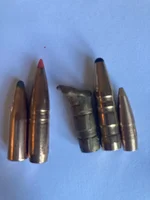
In the photo below from left to right is a Sierra 140gn lead bullet, a 140gn Hornady GMX from 2016 - one of the first monolithics. Note that these are full 7mm diameter bullets.

Things have moved on considerably On the right is 130gn Fox Bullet recovered from an earth bank behind zeroing target after being shot from Rigby rifle built in 1974, along with an unfired bullet. Note the driving bands and how only the driving bands engage with the rifling.

There is much less surface area in contact with bore and generally pressures are lower for the same velocity as lead bullets, and or same pressures yeald higher velocities. On the far right is a 223 Peregrine VLR4, and here the the main bullet diameter fits well within the lands and its only the narrow driving bands that engage the rifling, and with the net result of lower pressures.

Most other modern bullets - Barnes TTSX, Yewtrees etc all follow similar methodology.

As regards old rifles, fouled barrels etc, that is much more down to individual maintenance. A fully fouled barrel with lots copper, lead and carbon fouling will almost certainly increase pressures of whatever you fire down it. And with a thin light barrel potential harmful effects may be substantially higher, especially if a very old gun. Mind you steel qualities 100 years ago where often probably higher than today. With an old gun of uncertain vintage, provenance and condition shooting any ammo may be questionable.

Saying that I have a 7x65r Hambrusch or Ferlach built combination made in 1974. I bought a job lot of RWS HIT ammo about 5 years ago for it, and have had no issues whatsoever. Shoots accurately, hits hard and no great fouling. But I don’t shoot it rapidly and I work on basis of keeping bores clean. image.webp
 
All the new loads of factory ammo using monolithic bullets have to pass proof, and part of the proof is a pressure test. And from time during batches of cartridges need to be sent for follow on proof testing.

In order to meet proof requirements the loads have to be well within the CIP requirements as detailed for all the various cartridges. CIP - Homologation

@Edinburgh Rifles on its website publishes the load data that has been proofed for its factory Fox ammunition. Any other manufacturer of ammunition will need to have its ammo proofed by an appropriate proof house for it to meet CIP standards. And i think any ammo imported from outwith CIP countries, would also to have samples sent to the proof house.

And the same process happens regardless of the type of bullet used.

Going back to the OP, 2012 is now ten years ago, and a lot has happened in between.

In the photo below from left to right is a Sierra 140gn lead bullet, a 140gn Hornady GMX from 2016 - one of the first monolithics. Note that these are full 7mm diameter bullets.

Things have moved on considerably On the right is 130gn Fox Bullet recovered from an earth bank behind zeroing target after being shot from Rigby rifle built in 1974, along with an unfired bullet. Note the driving bands and how only the driving bands engage with the rifling.

There is much less surface area in contact with bore and generally pressures are lower for the same velocity as lead bullets, and or same pressures yeald higher velocities. On the far right is a 223 Peregrine VLR4, and here the the main bullet diameter fits well within the lands and its only the narrow driving bands that engage the rifling, and with the net result of lower pressures.

Most other modern bullets - Barnes TTSX, Yewtrees etc all follow similar methodology.

As regards old rifles, fouled barrels etc, that is much more down to individual maintenance. A fully fouled barrel with lots copper, lead and carbon fouling will almost certainly increase pressures of whatever you fire down it. And with a thin light barrel potential harmful effects may be substantially higher, especially if a very old gun. Mind you steel qualities 100 years ago where often probably higher than today. With an old gun of uncertain vintage, provenance and condition shooting any ammo may be questionable.

Saying that I have a 7x65r Hambrusch or Ferlach built combination made in 1974. I bought a job lot of RWS HIT ammo about 5 years ago for it, and have had no issues whatsoever. Shoots accurately, hits hard and no great fouling. But I don’t shoot it rapidly and I work on basis of keeping bores clean. View attachment 280228
No steel quality wasn't higher quality within the engineering grades of steel used in firearms 100 years ago! general mild steel yeah definitely ! because it comes from China and its made from various scrap as its main quantity , to such a degree that welds can fail and i have had it air harden after heating to red . Engineering steels and tool steels are i would say better than 100 years ago as we understand more and have better science available . We only just about managed the stainless steel around ww1 and they were not 100% sure why it worked initially
Books about metallurgy from the 50s have mistakes from having to guess what we can now see with better equipment .
BTW monolithic bullets where in use a very long time ago, i feel sure you know that but it appears very different in the text above
 
The variables are far to numerous to draw any conclusions from that.

The land and groove diameter variance from one brand of barrel the next is huge.
The design and materials used in the huge range if monolithics is considerable.
The difference in hardness between softer, annealed and heat treated monolithics and work hardened ones likewise not just a consideration in terminal effect but in how they take the form of the rifling.


We have come a long way from just cutting grooves in them
 
Back
Top