Muntjac Numbers: Playing with Artificial Intelligence

maximus otter

Well-Known Member
After another member posted about using AI in a deer-related calculation, l decided to play with some deer population numbers using ChatGPT.
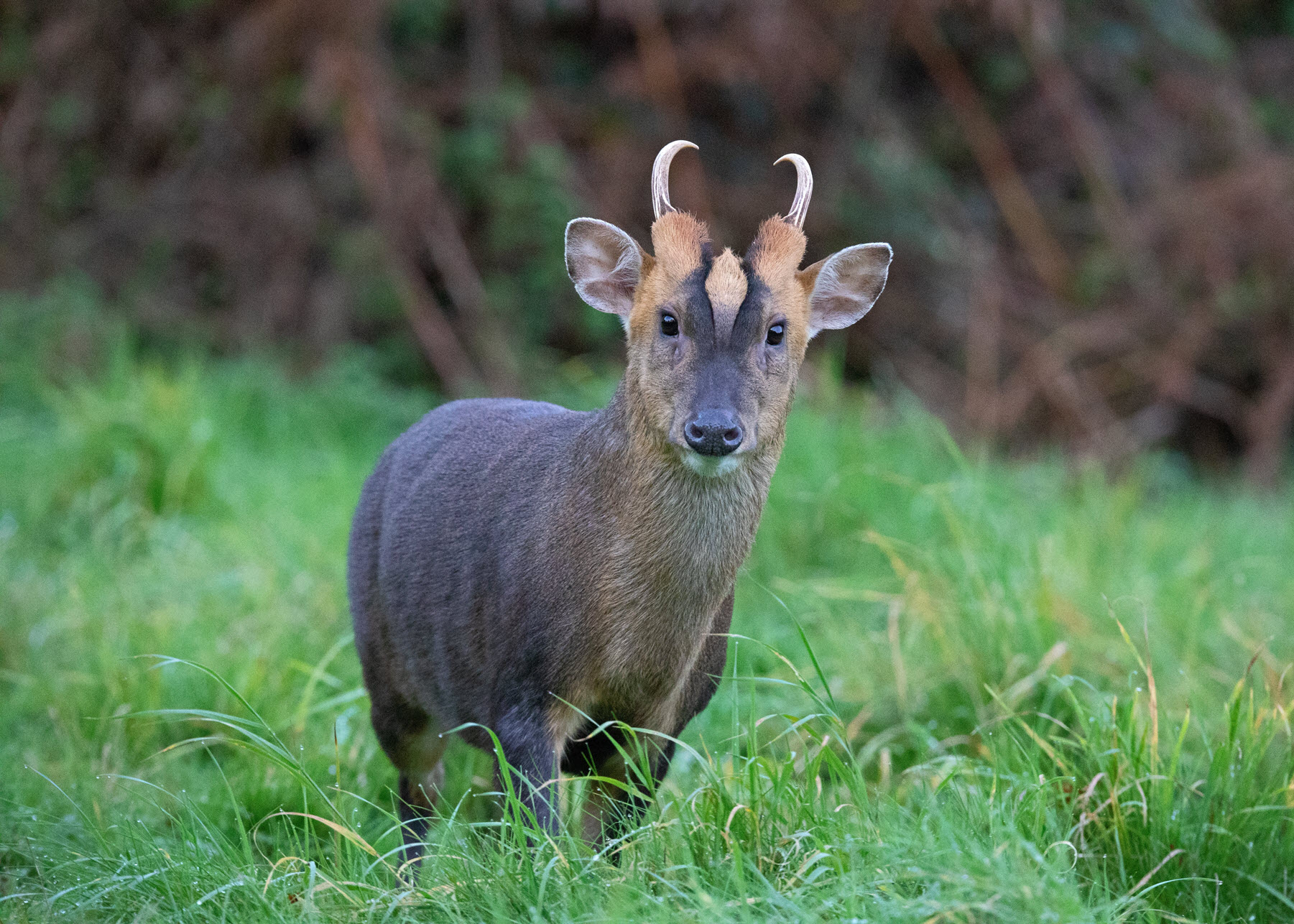
HC-Muntjac-portrait-by-Deb-HeathWEB.jpg


I eventually - after several revisions - made the following calculation. (The first four are the most authoritative information available):

Assume that muntjac live for 10 years.
Assume that there were 5000 muntjac in Britain in 1975.
Assume that they become mature at 7 months.
Assume that the females produce one fawn every 7 months.
Assume that 50% of young do not survive to sexual maturity.
Assume that 33% of all muntjac are shot, die of disease or are killed by cars every year.
How many muntjac are there in Britain in 2026?

ChatGPT came up with the number 600,000

I repeat: this was after quite a bit of shuffling of variables, which gave results from “about 200” to as high as many trillions!

To me, that number doesn’t seem to be unreasonably inaccurate, though it’s highly likely to be an underestimate.

There was no particular point in my making this rough estimate, but it provides some food for thought, doesn’t it?

maximus otter
 
After another member posted about using AI in a deer-related calculation, l decided to play with some deer population numbers using ChatGPT.

HC-Muntjac-portrait-by-Deb-HeathWEB.jpg


I eventually - after several revisions - made the following calculation. (The first four are the most authoritative information available):

Assume that muntjac live for 10 years.
Assume that there were 5000 muntjac in Britain in 1975.
Assume that they become mature at 7 months.
Assume that the females produce one fawn every 7 months.
Assume that 50% of young do not survive to sexual maturity.
Assume that 33% of all muntjac are shot, die of disease or are killed by cars every year.
How many muntjac are there in Britain in 2026?

ChatGPT came up with the number 600,000

I repeat: this was after quite a bit of shuffling of variables, which gave results from “about 200” to as high as many trillions!

To me, that number doesn’t seem to be unreasonably inaccurate, though it’s highly likely to be an underestimate.

There was no particular point in my making this rough estimate, but it provides some food for thought, doesn’t it?

maximus otter
They don't get to 10 around here :tiphat:
 
After another member posted about using AI in a deer-related calculation, l decided to play with some deer population numbers using ChatGPT.

HC-Muntjac-portrait-by-Deb-HeathWEB.jpg


I eventually - after several revisions - made the following calculation. (The first four are the most authoritative information available):

Assume that muntjac live for 10 years.
Assume that there were 5000 muntjac in Britain in 1975.
Assume that they become mature at 7 months.
Assume that the females produce one fawn every 7 months.
Assume that 50% of young do not survive to sexual maturity.
Assume that 33% of all muntjac are shot, die of disease or are killed by cars every year.
How many muntjac are there in Britain in 2026?

ChatGPT came up with the number 600,000

I repeat: this was after quite a bit of shuffling of variables, which gave results from “about 200” to as high as many trillions!

To me, that number doesn’t seem to be unreasonably inaccurate, though it’s highly likely to be an underestimate.

There was no particular point in my making this rough estimate, but it provides some food for thought, doesn’t it?

maximus otter
I can't see any references to gender balances in surviving fawns in your calculations?
 
I can't see any references to gender balances in surviving fawns in your calculations?
looks like Maximus is doing a rough basic calculation and assumes it is always 50/50 ...starting with 2500 females, then 50% of fawns are female as with those shot are 50% female. ... a simple extrapolation shows the growth of the Muntjac. Most likely an under estimation, more bucks are shot as they are more active than females that remain tighter in cover giving birth and raising the fawn.1772727777562.webp
 
looks like Maximus is doing a rough basic calculation and assumes it is always 50/50 ...starting with 2500 females, then 50% of fawns are female as with those shot are 50% female. ... a simple extrapolation shows the growth of the Muntjac. Most likely an under estimation, more bucks are shot as they are more active than females that remain tighter in cover giving birth and raising the fawn.View attachment 463673
Looks conjectural!
 
Very impressed by the picture. Did you take it?
Good estimate but accurately counting munties must be nigh on impossible.
D
 
Large Language Models can't do numbers!
They can - they’re remarkably good at simple equations, especially things like basic demographic modelling, where there’s a large and well established literature.

The trick is making sure you specify which models and which parameter settings to use. And then ask the AI to set out what it did actually use.

I’d guess the models above were simple exponential growth models, and probably didn’t include a density dependence term.
 
After another member posted about using AI in a deer-related calculation, l decided to play with some deer population numbers using ChatGPT.

HC-Muntjac-portrait-by-Deb-HeathWEB.jpg


I eventually - after several revisions - made the following calculation. (The first four are the most authoritative information available):

Assume that muntjac live for 10 years.
Assume that there were 5000 muntjac in Britain in 1975.
Assume that they become mature at 7 months.
Assume that the females produce one fawn every 7 months.
Assume that 50% of young do not survive to sexual maturity.
Assume that 33% of all muntjac are shot, die of disease or are killed by cars every year.
How many muntjac are there in Britain in 2026?

ChatGPT came up with the number 600,000

I repeat: this was after quite a bit of shuffling of variables, which gave results from “about 200” to as high as many trillions!

To me, that number doesn’t seem to be unreasonably inaccurate, though it’s highly likely to be an underestimate.

There was no particular point in my making this rough estimate, but it provides some food for thought, doesn’t it?

maximus otter
Can you get it to give you the equation it used?
 
Can you get it to give you the equation it used?
This is what really concerns me about AI. To the layman or uninitiated, the answers to questions look really good, truthful and well researched. Yet you have no clue as to how the answer is actually formulated.

You need to check through to where its drawing the information, data and equations from, to see if the answer it is providing is perfectly rational and correct.

I last built a complete systems model of an ecosystem model growth rates of african wild ungulates - both in liveweight as population, based on food availability, which was driven by rainfall back in 1991 for my thesis. In those days computers didn’t exist for mere Agricultural undergraduates, so I got as far as explaining all the interactions and formulas for each interrelationship, getting intimately involved in evapotranspiration and feed conversion ratios. That was many weeks of trawling through microfiche copies of journals at the Commonwealth Agricultural Bureau Library and making photocopies.

To take it further would have meant finding a computing geek to do all the programming to make it work.

Nowadays I could probably do it all from my bed on my iPhone.

But I probably would never fully understand how it all links together.
 
This is what really concerns me about AI. To the layman or uninitiated, the answers to questions look really good, truthful and well researched. Yet you have no clue as to how the answer is actually formulated.
Yes - though it’s now pretty straightforward to tell the AI to show its working. You add prompts saying things like ‘document the equation used, specify the parameter settings and justify the decisions taken’.

The more recent versions, especially the paid-for versions of GPT and its derivative O3 (which is specifically optimised for scientific use) usually do this as a matter of course anyway.

You need to check through to where its drawing the information, data and equations from, to see if the answer it is providing is perfectly rational and correct.

Absolutely. All the classical scientific critical skills are still very much required. As I tell students: you need to treat the AI as you would your overconfident friend from Oxbridge. They talk a convincing line, but there’s often a lot of bullsh*t hidden under the hood..
 
Now if you really want to play with the AI, feed it someone else’s projections and ask it to identify how they were derived.

It’s pretty frightening…
 
As for those AI bollox. Earlier today I googled REACH and powder regulations.

The AI came with a detailed answer. I then followed the links and went back to threads on SD and comments that I had made in the past - all utter bollox of course.

What I was expecting was it go and interrogate the actual REACH legislation and quote what that had said. :(
 
I think the model is:-

Once you have muntjac you will always have muntjac. Regular stalking just means you will always have about the same number of muntjac.

Once they arrive if there is any sort of cover the old question about best deer calibre is irrelevant. You will need nuclear weapons to get rid of them! Anything less is just recreational stalking frankly.
 
LLMs are built on a lie. I'd rather use Wikipedia.

The evolution of LLM’s can be traced back to the emergence of semantics in the late 19th century, and machine learning to the mid 20th century. Deep learning kicked off in the 1990’s, and LLM’s have largely evolved over the last decade. So it is not as though LLM’s have suddenly appeared out of nowhere - their foundations are as solid as any other development in the field of computing.

Similarly, the ability of computers to consume vast amounts of data, both structured and unstructured, and understand and learn from it is well proven, as is the ability of those computers to interpret that data and identify anomalies, trends, exceptions, etc. Technical developments, such as vectorized databases, that assist AI in terms of enabling semantic searches, making recommendations, and providing the ability to retain context and history, are founded on solid science.

As has already been found in other branches of the medical profession, AI can help clinicians improve diagnosis, enhance triage, assist with preventative care, and reduce administrative inefficiency. AI can also help boost the patient experience.


Within veterinary science as well, the potential benefits of AI are already being realised:


Still, if you prefer to rely instead on a source of information that is unverified, unaccountable, open to bias, and subject to manipulation and disinformation by the likes of PR companies, paid editors and corporate lobbyists….. kick on!
 
Last edited:
LLMs are built on a lie. I'd rather use Wikipedia.
They’re really not.

The people selling them might be lying, and the LLM’s often generate output that you can call a ‘lie’, but the underlying logic is robust. Ultimately, they’re a form of very advanced statistical model that makes a prediction based on associations in past data.

Wikipedia is in many ways a ‘wet’ version of an LLM. It’s essentially a slow and inefficient human powered algorithm!

Where LLM’s are enormously useful (and generally very accurate) is in situations precisely like this: you can use them as a tool to teach yourself new quantitative techniques.

Try it. Ask one something like ‘please give the equation for the elimination half life of a drug and explain the terms’.
 
I agree that AI is very useful. However, modelling of this sort, even done with conventional intelligence by alleged world experts still produces embarrassingly foolish outputs.
No amount of intelligence can make up for the problem of asking a silly question, using input assumptions which are unproven, biased or obvioudly faulty, and a model composed by an intelligence which does not have complete knowledge of the system.
 
Back
Top