

Namibia exceeded my expectations in several aspects. Firstly, the absence of high fences and the co-operative working of adjacent farms gave a strong feeling of hunting without boundaries. Certainly the animals were free to move on and off the 8.5kHa farm on which I was hunting at Heusis in the Khomas Hochland Conservancy. Secondly the land is very sparcely populated [humans], and the absence of dwellings and their associated infrastructure compounded the sense of true wilderness. And the terrain comprised both hill and valley, rocky kopjes and sandy riverine.

 www.thestalkingdirectory.co.uk
 www.thestalkingdirectory.co.uk
 www.thestalkingdirectory.co.uk
And then there was the game density. Despite relatively arid conditions, this part of Namibia supports very high numbers of Oryx, Mountain Zebra, Red Hartebeest, Kudu, Springbok, Blue Wildebeest and some Black Wildebeest. Steenbok are everywhere and we also saw more Wartog and Baboons than I have seen during similar length trips elsewhere in Southern Africa. Fleeting glimpses of Black-Backed Jackal, Porcupines, Rollers, a myriad raptors and shrill Red-Brested Shrikes fill the diary. The spot of the week? My wife disturbed a Aardwolf during one of her lengthy solo strolls in the bush. And that epitomises the this destination's attractiveness: the absence of lion or other DG meant Tina could ramble the countryside whilst I was out hunting elsewhere. Fearing boredom, she had brought reading and knitting with her on this trip and touched neither in 10 days, such was her wilderness walking rapture.
 www.thestalkingdirectory.co.uk
 www.thestalkingdirectory.co.uk
Before I wax lyrical about the hunting, let's get the unpleasant bit out the way first: because D&C FLO have yet to allow me to test expanding .375H&H ammunition domestically, I took my UK tried-and-tested 6.5x55mm with me to Namibia. The Namibian PH was doubtful that the 6.5x55mm would suffice, so I also took the untested .375H&H, but had hoped to make do with the rifle I use on domestic deer here in the UK. [The 6.5x55mm had worked fine on Waterbuck, Wildebeest and Nyala at close quarters in Limpopo in March]
Day one it became clear that (1) most shots here in Namibia were going to be at distances greater than 200m and that (2) at 200m+, the 6.5 was striking but not despatching the Red Hartebeest and Oryx. Following the initial shot, the animals would drop after a couple of steps but a second coup de grace shot was almost always required. And at the end of day two I had an Oryx walk after taking a good shot to the shoulder at 280m. Via the binos we could see the right shoulder was broken, but the animal persevered. Clearly the 140gr SST had not entered the chest but rather stopped on the shoulder. We tracked that animal for 5km, retrieved a blood hound from the ranch, trailed it even further onto an adjacent farm, but ultimately lost the trail. I was devastated. I hate injuring animals. Images below shows the miniscule blood trail on a rock.
 www.thestalkingdirectory.co.uk
So my hand was forced: The next day I spent way too much ammunition and time zeroing the .375 with expanding ammunition whose point of impact differed from the solids which D&C allow me to test domestically. The first two shots at live quarry later that day were clear misses [high]. Back to the range to tighten scope and fine tune. But once done...hoo boy...it was a point and shoot delight: I went with an MRD at circa 155m which gave an 9cm kill zone from 0-200m. 250m shots struck pefectly with a "coke can" sized holdover.
When the week began, the tracker assigned to me used a formula of driving until we espied game, followed by a quick dismount from the LandCruiser and after a short stalk he would throw the quad sticks up in front of me and pick out a candidate from the jittery melange of fur 200m away. It was clearly a formula that most clients seek. But it was wholly unsatisfactory to me for several reasons. Firstly it more closely resembled a Cribs drive-by shooting than walk-and-stalk hunting. And from a practical perspective: November is the end of the hunting season and the sound of a 'Cruiser parking up 500m away gets the now seasoned quarry on its toes. They were anything but settled by the time the quad sticks were deployed. Not ideal.
I persuaded the tracker that I was not only willing but also able to walk in Africa's heat and so from day 3 onwards, we engaged in true walk-and-stalk. We would walk miles, reading the ground as we went and then following the freshest spoor we encountered. Sometimes we got lucky. We had a few blanks. But even on walks that yielded no quarry, we made discoveries that would have eluded us on a vehicle-centric outing. For example: late one afternoon we decided to walk towards the homestead until we lost the light. We probably did 5-7km. As light was fading, we encountered two Porcupines foraging near their burrow. It was an utter delight.
 www.thestalkingdirectory.co.uk
 www.thestalkingdirectory.co.uk
As with so many hunting trips, the heat, dust, exhaustion and excitement blur the details of individual hunts somewhat. But a few really stand out. In particular the double Blue Wildebeest stalk. On this occasion we did first spot the animals from the vehicle, but deliberately drove past and parked up perhaps 800-1000m further on. We then doubled back on foot in a huge J-shaped arc through a parallel valley for about 2km to approach them from a downwind position. Cover was sparse, but there were only 7 animals in the group so not too many eyes. They were all relaxed and grazing contentedly as we leap-frogged points of cover. One last audacious manouver took us to the last offer of cover which was 250m distant from the animals. This was a car-sized chunk of rock. What that permitted was for me to calmly deploy the quads and slowly draw my self into a full standing position pretty much shielded from their gaze. If the Wildebeest had looked our way at that point, it might have looked like the distant rock had grown a sweat-stained fedora. My body and the sticks would not be visible. The tracker picked a candidate at 240m. Squeeze, bang, flop. The other Wildebeest startled and then stood still. They did not know what had happened and still did not know where we were. The tracker picked a second candidate. This second animal had actually started walking toward us and stood at 220m as the .375H&H launched. Bang. Flop. The remaining 5 animals trotted off. Still not in full flight, but now pretty sure that leaving that area was a good idea.
 www.thestalkingdirectory.co.uk
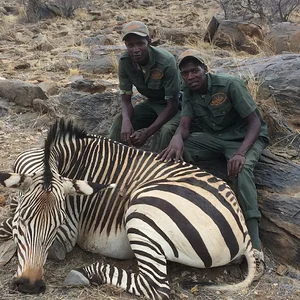
One of the other stand-out stalks was the old Zebra stallion. Many stalks into Zebra last week yielded no more than whinnying and dust clouds as hoofs sped the wiley quarry away from our approach. But this stalk went to plan. We saw some Zebra in a valley at distance [circa 800m] and made a plan to stalk into range. For much of the stalk, we did not have line-of-sight and could not know if the herd had remained in situ or moved on. On this occasion I overruled the tracker's suggestion that we contour lower to a position that would have brought us onto the same level in the valley bottom where we had first seen them. I had seen that the valley wall we would arrive at first had a saddle that would give us both hiding and an elevated viewpoint. It proved vital. The Zebra had strung out since first sighting. Some were now half way up the far side of the valley, some still on the valley floor but strung out. Had we trotted in at ground level, those on the higher slopes would definitely have seen us approach. As it was, the nearside kopje saddle threw up good cover and an opportunity for a slow set up on completely calm animals. An old and battle-scarred male was picked. He stood 3/4 facing us at 200m. I settled the .375 on the rock in front and took a bead on the shoulder nearest us. The 270gr Barnes TSX passed through the front of the right shoulder and exited just behind the left. The old fella went straight down.
 www.thestalkingdirectory.co.uk
 www.thestalkingdirectory.co.uk
For those who hunt in Africa a lot, sharing observations of my experiences are probably redundant or might even sound like preaching to the converted. Please take the following purely as notes I have made for myself based on experiences on this trip. First up, Namibia in November was too hot for me to wear trousers. But the thorns are ferocious. So be prepared to be scourged or sweat. There was always water in the 'Cruiser, but increasingly through the week we detatched from using the vehicle, so the need for frequent refreshment dictated that I carried my own water. I took to wearing a 2l rucksack water bladder and often drained that in half a day's walking. I probably drank 5-7l water a day. Dioralyte sachet every second day avoided muscle cramps. My wife wore boots she had not used a lot and blistered up quickly. I wore my well worn boots and was ailment free all trip.
 www.thestalkingdirectory.co.uk
 www.thestalkingdirectory.co.uk
 www.thestalkingdirectory.co.uk
 www.thestalkingdirectory.co.uk
Herewith a selection of photos of some the glorious animals that made it onto our braais, grills and stews this week:
 www.thestalkingdirectory.co.uk
 www.thestalkingdirectory.co.uk
 www.thestalkingdirectory.co.uk
 www.thestalkingdirectory.co.uk
 www.thestalkingdirectory.co.uk
 www.thestalkingdirectory.co.uk
 www.thestalkingdirectory.co.uk
And finally an unequivocal endorsement for Philip Henning and his family run operation at Heusis. The Southern African welcome is globally renowned. Philip and fam' are in the top draw of that hospitality chest. You are made welcome. Your needs are exceeded, food and drink are generous and excellent quality.The hunting is of the best I have encountered in Africa so far.
IMG_3563.JPG
www.thestalkingdirectory.co.uk
IMG_3593.JPG
www.thestalkingdirectory.co.uk
IMG_3592.JPG
www.thestalkingdirectory.co.uk
And then there was the game density. Despite relatively arid conditions, this part of Namibia supports very high numbers of Oryx, Mountain Zebra, Red Hartebeest, Kudu, Springbok, Blue Wildebeest and some Black Wildebeest. Steenbok are everywhere and we also saw more Wartog and Baboons than I have seen during similar length trips elsewhere in Southern Africa. Fleeting glimpses of Black-Backed Jackal, Porcupines, Rollers, a myriad raptors and shrill Red-Brested Shrikes fill the diary. The spot of the week? My wife disturbed a Aardwolf during one of her lengthy solo strolls in the bush. And that epitomises the this destination's attractiveness: the absence of lion or other DG meant Tina could ramble the countryside whilst I was out hunting elsewhere. Fearing boredom, she had brought reading and knitting with her on this trip and touched neither in 10 days, such was her wilderness walking rapture.
IMG_3703.JPG
www.thestalkingdirectory.co.uk
IMG_3688.JPG
www.thestalkingdirectory.co.uk
Before I wax lyrical about the hunting, let's get the unpleasant bit out the way first: because D&C FLO have yet to allow me to test expanding .375H&H ammunition domestically, I took my UK tried-and-tested 6.5x55mm with me to Namibia. The Namibian PH was doubtful that the 6.5x55mm would suffice, so I also took the untested .375H&H, but had hoped to make do with the rifle I use on domestic deer here in the UK. [The 6.5x55mm had worked fine on Waterbuck, Wildebeest and Nyala at close quarters in Limpopo in March]
Day one it became clear that (1) most shots here in Namibia were going to be at distances greater than 200m and that (2) at 200m+, the 6.5 was striking but not despatching the Red Hartebeest and Oryx. Following the initial shot, the animals would drop after a couple of steps but a second coup de grace shot was almost always required. And at the end of day two I had an Oryx walk after taking a good shot to the shoulder at 280m. Via the binos we could see the right shoulder was broken, but the animal persevered. Clearly the 140gr SST had not entered the chest but rather stopped on the shoulder. We tracked that animal for 5km, retrieved a blood hound from the ranch, trailed it even further onto an adjacent farm, but ultimately lost the trail. I was devastated. I hate injuring animals. Images below shows the miniscule blood trail on a rock.
IMG_3560.JPG
www.thestalkingdirectory.co.uk
So my hand was forced: The next day I spent way too much ammunition and time zeroing the .375 with expanding ammunition whose point of impact differed from the solids which D&C allow me to test domestically. The first two shots at live quarry later that day were clear misses [high]. Back to the range to tighten scope and fine tune. But once done...hoo boy...it was a point and shoot delight: I went with an MRD at circa 155m which gave an 9cm kill zone from 0-200m. 250m shots struck pefectly with a "coke can" sized holdover.
When the week began, the tracker assigned to me used a formula of driving until we espied game, followed by a quick dismount from the LandCruiser and after a short stalk he would throw the quad sticks up in front of me and pick out a candidate from the jittery melange of fur 200m away. It was clearly a formula that most clients seek. But it was wholly unsatisfactory to me for several reasons. Firstly it more closely resembled a Cribs drive-by shooting than walk-and-stalk hunting. And from a practical perspective: November is the end of the hunting season and the sound of a 'Cruiser parking up 500m away gets the now seasoned quarry on its toes. They were anything but settled by the time the quad sticks were deployed. Not ideal.
I persuaded the tracker that I was not only willing but also able to walk in Africa's heat and so from day 3 onwards, we engaged in true walk-and-stalk. We would walk miles, reading the ground as we went and then following the freshest spoor we encountered. Sometimes we got lucky. We had a few blanks. But even on walks that yielded no quarry, we made discoveries that would have eluded us on a vehicle-centric outing. For example: late one afternoon we decided to walk towards the homestead until we lost the light. We probably did 5-7km. As light was fading, we encountered two Porcupines foraging near their burrow. It was an utter delight.
IMG_3638.JPG
www.thestalkingdirectory.co.uk
IMG_3632.JPG
www.thestalkingdirectory.co.uk
As with so many hunting trips, the heat, dust, exhaustion and excitement blur the details of individual hunts somewhat. But a few really stand out. In particular the double Blue Wildebeest stalk. On this occasion we did first spot the animals from the vehicle, but deliberately drove past and parked up perhaps 800-1000m further on. We then doubled back on foot in a huge J-shaped arc through a parallel valley for about 2km to approach them from a downwind position. Cover was sparse, but there were only 7 animals in the group so not too many eyes. They were all relaxed and grazing contentedly as we leap-frogged points of cover. One last audacious manouver took us to the last offer of cover which was 250m distant from the animals. This was a car-sized chunk of rock. What that permitted was for me to calmly deploy the quads and slowly draw my self into a full standing position pretty much shielded from their gaze. If the Wildebeest had looked our way at that point, it might have looked like the distant rock had grown a sweat-stained fedora. My body and the sticks would not be visible. The tracker picked a candidate at 240m. Squeeze, bang, flop. The other Wildebeest startled and then stood still. They did not know what had happened and still did not know where we were. The tracker picked a second candidate. This second animal had actually started walking toward us and stood at 220m as the .375H&H launched. Bang. Flop. The remaining 5 animals trotted off. Still not in full flight, but now pretty sure that leaving that area was a good idea.
IMG_3606.JPG
www.thestalkingdirectory.co.uk
One of the other stand-out stalks was the old Zebra stallion. Many stalks into Zebra last week yielded no more than whinnying and dust clouds as hoofs sped the wiley quarry away from our approach. But this stalk went to plan. We saw some Zebra in a valley at distance [circa 800m] and made a plan to stalk into range. For much of the stalk, we did not have line-of-sight and could not know if the herd had remained in situ or moved on. On this occasion I overruled the tracker's suggestion that we contour lower to a position that would have brought us onto the same level in the valley bottom where we had first seen them. I had seen that the valley wall we would arrive at first had a saddle that would give us both hiding and an elevated viewpoint. It proved vital. The Zebra had strung out since first sighting. Some were now half way up the far side of the valley, some still on the valley floor but strung out. Had we trotted in at ground level, those on the higher slopes would definitely have seen us approach. As it was, the nearside kopje saddle threw up good cover and an opportunity for a slow set up on completely calm animals. An old and battle-scarred male was picked. He stood 3/4 facing us at 200m. I settled the .375 on the rock in front and took a bead on the shoulder nearest us. The 270gr Barnes TSX passed through the front of the right shoulder and exited just behind the left. The old fella went straight down.
IMG_3573.JPG
www.thestalkingdirectory.co.uk
IMG_3576.JPG
www.thestalkingdirectory.co.uk
For those who hunt in Africa a lot, sharing observations of my experiences are probably redundant or might even sound like preaching to the converted. Please take the following purely as notes I have made for myself based on experiences on this trip. First up, Namibia in November was too hot for me to wear trousers. But the thorns are ferocious. So be prepared to be scourged or sweat. There was always water in the 'Cruiser, but increasingly through the week we detatched from using the vehicle, so the need for frequent refreshment dictated that I carried my own water. I took to wearing a 2l rucksack water bladder and often drained that in half a day's walking. I probably drank 5-7l water a day. Dioralyte sachet every second day avoided muscle cramps. My wife wore boots she had not used a lot and blistered up quickly. I wore my well worn boots and was ailment free all trip.
IMG_3696.JPG
www.thestalkingdirectory.co.uk
IMG_3697.JPG
www.thestalkingdirectory.co.uk
IMG_3613.JPG
www.thestalkingdirectory.co.uk
IMG_3599.JPG
www.thestalkingdirectory.co.uk
Herewith a selection of photos of some the glorious animals that made it onto our braais, grills and stews this week:
IMG_3579.JPG
www.thestalkingdirectory.co.uk
IMG_3580.JPG
www.thestalkingdirectory.co.uk
IMG_3581.JPG
www.thestalkingdirectory.co.uk
IMG_3597.JPG
www.thestalkingdirectory.co.uk
IMG_3609.JPG
www.thestalkingdirectory.co.uk
IMG_3617.JPG
www.thestalkingdirectory.co.uk
IMG_3684.JPG
www.thestalkingdirectory.co.uk
And finally an unequivocal endorsement for Philip Henning and his family run operation at Heusis. The Southern African welcome is globally renowned. Philip and fam' are in the top draw of that hospitality chest. You are made welcome. Your needs are exceeded, food and drink are generous and excellent quality.The hunting is of the best I have encountered in Africa so far.


