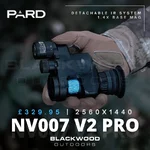
night vision scope recommendations

Which of these scopes would work best at night in woodland where there would be an increased risk of white out?
The Zulus set on Auto IR is the best I've tried for reducing white-out. It's very good. I have a video taken at max x20 digital zoom. It starts at 257yds and pans down to 152yds. The foreground grass at the end is 100yds. It's not a perfect video but does show the auto IR working. I think it will do what you want.
I can't attach the vid on here for some reason it won't let me.
If anyone can explain how to attach vid please do.
If you want I could try and what's app it to you?
 
I'm following your journey here with the Arken. You've found the eye-relieve/recoil issue fine?
No issues with recoil and eye relief even laying prone to zero it. I expect if you hold the rifle really loose with minimal pull into your shoulder then you could take a bit of a knock.
 
The Zulus set on Auto IR is the best I've tried for reducing white-out. It's very good. I have a video taken at max x20 digital zoom. It starts at 257yds and pans down to 152yds. The foreground grass at the end is 100yds. It's not a perfect video but does show the auto IR working. I think it will do what you want.
I can't attach the vid on here for some reason it won't let me.
If anyone can explain how to attach vid please do.
If you want I could try and what's app it to you?
Interesting - sadly to post a video I think you will need to put it on the Tube then copy to SD.
🦊🦊
 
Interesting - sadly to post a video I think you will need to put it on the Tube then copy to SD.
🦊🦊

Fair enough :D. I do have a couple of thermal scopes which are great in woodland. My question about NV was to improve ID and to give me more magnification when in the open but still be able to use around woodland blocks or bush.
This link has the video which shows the auto IR in use. Hope it helps.
https://youtu.be/Wk3hH_pOeSE
 
HI
In real time mode you have to have a continuous bluetooth connection between the the scope and your phone because, AFAIK, the scope sends the range to the app, the app calculates the aiming point and then sends that back to the scope
In ballistic table mode, you send the ballistic table for your chosen rifle/ cartridge profile to the scope using the bluetooth connection, but once that's done the bluetooth connection is no longer needed - all the calculations are done and the aiming point calculated in the scope
IMHO ballistic table mode is a better choice for most situations
In holdover mode the aiming point calculated by the ballistic calculator is shown as a red cross on the scope reticle
In dial in mode, the whole reticle moves so that the aiming point remains the centre of the reticle
If you have the PiP switched on and the ballistic calculator working, the reticle in the PiP is always in dial in mode (i.e, it is always in the centre of the PiP window)

Cheers

Bruce
Hi Bruce, just playing with app, but everytime time I add a different rifle they all change to the last one i created.?
Cheers blue.
 
In the region where I live and hunt it is forbidden to use any type of night vision device. However, instruments for watching (not aiming a gun) are legal.
What is a decent device, without any kind of mount for the rifle neither outstanding performances? An NVD with a range in the order of one mile (or more) could be useful for spotting game in the neighboring forest, but without telling a chamois from a fox.
Any suggestions, please?
 
In the region where I live and hunt it is forbidden to use any type of night vision device. However, instruments for watching (not aiming a gun) are legal.
What is a decent device, without any kind of mount for the rifle neither outstanding performances? An NVD with a range in the order of one mile (or more) could be useful for spotting game in the neighboring forest, but without telling a chamois from a fox.
Any suggestions, please?
Can you use thermal spotter?
 
On the LRF model the IR is removeable simply by unscrewing the IR module. 940nm modules are about to become available, so switching between wavelengths will be very quick and easy
At present, the IR on the non LRF model is not removeable

Cheers

Bruce
 
After fitting a rear extended picatinni rail I was out this morning with my Tikka T1x .17hmr, to zero and test the LRF and Ballistic Calculation, first using Remington 16gr Accutips.
I used my V3 chronograph. The average mv was 2690fps. Used my Leica LRF to place targets at 30, 40, 50, 60, 70, 100yds.
I zeroed the rifle at 50yds then fired 3 shot groups from 30yds to 100yds using the Zulus LRF and Holdover method.
Points to note:
1) The Zulus LRF was over reading the range 36, 45 ,52, 62,73,105. Or it was correct and my Leica is out? Need to check with a tape measure.
2) The Holdover method was correctly hitting POA. Rabbit head shots out to 70yds. At 100yds body shots.
3) I then chrono'd the 20gr Gamepoints at 2510fps average. Uploaded ballistic table for CCI 20gr Gamepoints, zeroed, then repeated the whole exercise. Same result
4) At the very end the low bright sun cleared the tree tops, shining straight into the Zulus. The LRF was defeated and would not work until aimed into shadow off to the side.
5) The image through the Zulus looking into the sun was hopeless. An A4 target at 100yds was virtually invisible, like looking through milk. Much worse than a glass 'scope.
None of the 50 odd cartridge cases had split necks and the combined group was 1" which included 3 fliers. very pleased with that. Over 200 rounds fired now and not one split neck.
I hope this info proves useful.
 
Last edited:
Yes, for observation only, not for aiming a firearm.
Then that's what I'd suggest. I've used night vision as a spotter & it's not great. You're relying on the animals being face on so you pick up on eye shine. Thermal far more useful.
 
Back
Top