LensBoii
Member
Hi all,
I made an introduction post last night. I'm writing up my investigation into a deer stalking telescope I got in the year 2000. I believe it is the number #3 model from Ross London, without a serial number, circa 1900 AD. I believe it's an imitation made in India. It's quite well-made, smooth draw action, crisp focus but with some aberrations. It came without a case, lens cap or eyepiece shutter. It has blue leather, cross stitched, on the body and the Sun shade. It has 4 knurled edges as seen in the photos (at the end of the writeup).
Not much has been said about all of the lenses themselves, in the originals or imitations. If you can point me to any measurements or specifications, that would be most appreciated. So, I will include my measurements and other observations here, including some geometrical optics calculations. The construction of these telescopes makes it very easy to switch lenses and upgrade them or modify them. There are 5 lenses, including the objective. I have a few photos and an illustration made to scale of the geometrical model.
I like the fact that these telescopes are quite portable and give me a better image than the few binoculars I have owned. My rifle has no separate scope. I also find this telescope useful for general sight-seeing, observing the moon, and just to exercise my eyes. I was shown one at school long ago and my teachers instructed me as to the fragility of the threads, and that the telescope was "worth more than your life"!
Basic measurements:
Weight: 1.2 kg or 2.6 lbs.
Length: 36 1/8" with Sun shade extended, or 33" exactly with it retracted. 11 3/8" closed (unlike original).
OD at edge of shade: 68.5 mm. ID: 63 mm.
OD of Objective lens mount: 58 mm.
OD of Eye relief: 35.5mm. ID: 9 mm.
Balance point: 14.5" from end of extended Sun shade.
Optics:
This is a terrestrial refractor telescope, with original design power of 20x. It did not have any blacking inside. As it has 3 draws, there cannot be baffles. The last draw seems to be twice as long as it needs to be, since the focus comes in at about halfway, whether looking 150ft or at the Moon. The draw closest to the eye (eyetube) may have been interchangeable. There was an upgrade available called a "Pancratic Tube" which was a further extension acting as a zoom lens, but I don't have that and it may have been just for other brands.
There are 5 lenses in the telescope. The objective lens in the original, as far as I know is an achromatic doublet either cemented together or just held together. Mine, as an imitation, may just be a single lens. The inside retaining ring of the Objective has no grip but is screwed in. The other four lenses are held as a pair in each of two cartridges. The cartridges are different lengths. The figures I give below are not exact, and at the principal plane of each lens. I measured focal lengths by imaging the Sun against a dark screen and measuring the focal length. I number lenses starting from the Eye relief.
Objective:
40 mm visible glass. Radius to field side.
Focal length: 450 mm.
All other lenses OD: 21 mm.
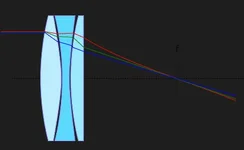
Trying to calculate the magnification is not that difficult, but yielded 8x. The equations were really only valid for lenses closer together. So I switched to ray-tracing the light paths in a full simulation. As below. I used a combination of parallel light rays and a point source, to simulate the stray light. The illustration of my model is to scale, with a scale shown in mm. I can move the objective closer to the eyepiece to make measurements at different focus. I am nearsighted. The brown lines are just to show an outline of the boundaries of the telescope tubes.

Close up at Eye tube:

As the eye is placed at the focal point in the eye relief, you can see the image. I haven't measured focus with my spectacles on. Between lenses 3 and 4, inside that lens cartridge was a small black stop, with a hole of 3.5mm. The stop is about 2mm thick with the outer ring to hold it in place is 5mm thick. It was in the wrong position and I think the diameter is wrong, so I just removed it. It needs some precise calculations and testing for it to be useful in making the image sharper.
If you extend the rays at the Eye relief back to the Objective plane, you can measure magnification. It is indeed 20x as it should be. However, I can only see a clear image on a sunny day at 8x magnification with the eye tube pushed in half way.
I hope this is useful for restorers.
You can change these lenses, with better ones. Coated lenses, achromatic doublets, etc. You can also change positioning of the lenses to increase magnification. I might make a separate post about that. I was able to get 80x with this telescope. Those images are rather dim and the field of view is a small fraction of a degree. I think 8x to 20x suits my purposes. I might only use 80x to see a planet if I'm out on a clear night on the hill. It is notable to me that the "Erector tube" (lenses 3 and 4) seem to perform the image inversion at the very end or even outside of itself as I have it focussed. I need more tests to know where to put the stop. Any information from you is welcomed.
Here are the photos! Note the heavy brass bushes have no glands or packing and are perfectly machined for a smooth draw. It feels like a 1 or 2 thou clearance at most. The threads are all smooth except for the eye shield. That metal is so thin that threads on the shield surface were only cut on one half of the circumference! So it has to be whacked on halfway and then screwed the rest of the way. There is a little felt inside the largest bush. No shutter.
Fully extended

Closed

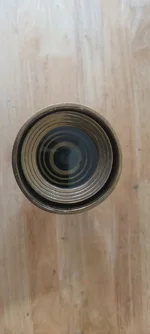
Objective end-on view
4 more photos in next post...
I made an introduction post last night. I'm writing up my investigation into a deer stalking telescope I got in the year 2000. I believe it is the number #3 model from Ross London, without a serial number, circa 1900 AD. I believe it's an imitation made in India. It's quite well-made, smooth draw action, crisp focus but with some aberrations. It came without a case, lens cap or eyepiece shutter. It has blue leather, cross stitched, on the body and the Sun shade. It has 4 knurled edges as seen in the photos (at the end of the writeup).
Not much has been said about all of the lenses themselves, in the originals or imitations. If you can point me to any measurements or specifications, that would be most appreciated. So, I will include my measurements and other observations here, including some geometrical optics calculations. The construction of these telescopes makes it very easy to switch lenses and upgrade them or modify them. There are 5 lenses, including the objective. I have a few photos and an illustration made to scale of the geometrical model.
I like the fact that these telescopes are quite portable and give me a better image than the few binoculars I have owned. My rifle has no separate scope. I also find this telescope useful for general sight-seeing, observing the moon, and just to exercise my eyes. I was shown one at school long ago and my teachers instructed me as to the fragility of the threads, and that the telescope was "worth more than your life"!
Basic measurements:
Weight: 1.2 kg or 2.6 lbs.
Length: 36 1/8" with Sun shade extended, or 33" exactly with it retracted. 11 3/8" closed (unlike original).
OD at edge of shade: 68.5 mm. ID: 63 mm.
OD of Objective lens mount: 58 mm.
OD of Eye relief: 35.5mm. ID: 9 mm.
Balance point: 14.5" from end of extended Sun shade.
Optics:
This is a terrestrial refractor telescope, with original design power of 20x. It did not have any blacking inside. As it has 3 draws, there cannot be baffles. The last draw seems to be twice as long as it needs to be, since the focus comes in at about halfway, whether looking 150ft or at the Moon. The draw closest to the eye (eyetube) may have been interchangeable. There was an upgrade available called a "Pancratic Tube" which was a further extension acting as a zoom lens, but I don't have that and it may have been just for other brands.
There are 5 lenses in the telescope. The objective lens in the original, as far as I know is an achromatic doublet either cemented together or just held together. Mine, as an imitation, may just be a single lens. The inside retaining ring of the Objective has no grip but is screwed in. The other four lenses are held as a pair in each of two cartridges. The cartridges are different lengths. The figures I give below are not exact, and at the principal plane of each lens. I measured focal lengths by imaging the Sun against a dark screen and measuring the focal length. I number lenses starting from the Eye relief.
Objective:
40 mm visible glass. Radius to field side.
Focal length: 450 mm.
All other lenses OD: 21 mm.
Lens number | f (mm) | distance between lenses (mm) or cartridges (( )) |
1 | 37 | |
| | 45 |
2 | 50 | |
| | (( 60 )) |
3 | 55 | |
| | 70 |
4 | 55 | |
Trying to calculate the magnification is not that difficult, but yielded 8x. The equations were really only valid for lenses closer together. So I switched to ray-tracing the light paths in a full simulation. As below. I used a combination of parallel light rays and a point source, to simulate the stray light. The illustration of my model is to scale, with a scale shown in mm. I can move the objective closer to the eyepiece to make measurements at different focus. I am nearsighted. The brown lines are just to show an outline of the boundaries of the telescope tubes.
Close up at Eye tube:
As the eye is placed at the focal point in the eye relief, you can see the image. I haven't measured focus with my spectacles on. Between lenses 3 and 4, inside that lens cartridge was a small black stop, with a hole of 3.5mm. The stop is about 2mm thick with the outer ring to hold it in place is 5mm thick. It was in the wrong position and I think the diameter is wrong, so I just removed it. It needs some precise calculations and testing for it to be useful in making the image sharper.
If you extend the rays at the Eye relief back to the Objective plane, you can measure magnification. It is indeed 20x as it should be. However, I can only see a clear image on a sunny day at 8x magnification with the eye tube pushed in half way.
I hope this is useful for restorers.
You can change these lenses, with better ones. Coated lenses, achromatic doublets, etc. You can also change positioning of the lenses to increase magnification. I might make a separate post about that. I was able to get 80x with this telescope. Those images are rather dim and the field of view is a small fraction of a degree. I think 8x to 20x suits my purposes. I might only use 80x to see a planet if I'm out on a clear night on the hill. It is notable to me that the "Erector tube" (lenses 3 and 4) seem to perform the image inversion at the very end or even outside of itself as I have it focussed. I need more tests to know where to put the stop. Any information from you is welcomed.
Here are the photos! Note the heavy brass bushes have no glands or packing and are perfectly machined for a smooth draw. It feels like a 1 or 2 thou clearance at most. The threads are all smooth except for the eye shield. That metal is so thin that threads on the shield surface were only cut on one half of the circumference! So it has to be whacked on halfway and then screwed the rest of the way. There is a little felt inside the largest bush. No shutter.
Fully extended
Closed
Objective end-on view
4 more photos in next post...