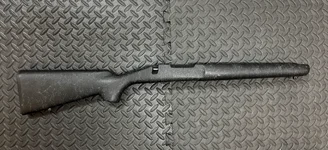
Rifle Bedding, free float vs full length vs pressure point

Instead of avoiding a bipod just avoid any part of the barrel touching the stock, then it doesn't matter how or on what you rest the rifle. The bigger the barrel channel the better. Also a not so stiff forend should have a larger gap. Tube guns are not the worst shooters for a reason.
edi

My "avoid" comment was part in jest, part in earnest. The prime reason for my not having a bipod is no need for one on the places I have for shooting. I do remember lugging the guide's one around on the stalks for my first and second deer and actually used one from a sitting position for the second. But I do not have the sort of open country where prone and bipod would be appropriate. And my back definitely prefers shooting from quad sticks.

My abiding memory is how uncomfortable it was to lug.

Alan
 
  • Like
Reactions: VSS
I've owned a few full length bedded rifles . Two in particular were pre-war ( WW2 ) sporters , one built on a Mauser 98 , the other built on a Springfield 1903 action . Both defied logic and shot sub MOA . I think one of the reasons they shot so well was the quality of Walnut used to stock them in , as well as the amount of skill and craftmanship that went into building them , both commodities that are hard to come by these days . I've had a few rifles that shot considerably better with a little upward pressure on the barrel , notably Lee Enfield No1's and No4's , in fact it was armourer recommended to do so . I think , in some cases , controlling barrel harmonics has a bigger influence on accuracy than minor amounts of stock shrinkage or warping , something that was controllable in years past because of a unlimited supply of suitable hardwoods , again , difficult to do these days . On a side note , the old , straight grained , ugly and featureless beech stocks were amazingly stable . They are extremely resistant to warpage and shrinkage and make excellent handles for a rifle , but they are butt ugly and won't impress your friends . There isn't much decent wood left on a commercial basis and we , to a very large extent , have switched to synthetics , so that art form is a thing of the past . It's not a bad thing , the newer synthetics are very stable platforms . I hate generalizing , but with todays synthetic stocks and quality of barrels , free floating will usually give you more consistent results . There will always be one of those rifles that defy all the rules though , something to keep in mind .

AB
 
lt's most likely that l'm not explaining myself too well. Andy just looks at me sideways at the best of times.... Sorry old man but two years in that steel box, you know what l'm saying....

l started the project from two angles at once, with one being a desire to have a nice light actioned walking rifle and the other was to duplicate the venerable Hornet but with the ability to shoot a more varied range of bullets and to get around the issue of brass life and availability.
Only the former issue is up for debate here.

Against... ls there a need in this day and age of synthetic ultra stable stocks, to have the barrel channel bedded?
Edi's stocks are superb and without doubt beyond any questioning need to perform such an act of heresy as bedding the barrel channel, as it would serve no purpose and only cause far more issues.
As Andy says, there's a distinct difference between a single pressure point attempting to affect barrel harmonics and a fully bedded channel, with changes to either in performance as the barrel heats up, either by firing or external atmospherics. There's also the issue that if the rifle is stocked with wood, then nature comes into play and the possibility that all bets at this point are off, if there is any chance at all in dramatic swings in ambient temperatures or humidity (or both at once). l've removed countless pressure pads from fore ends only to have the rifle shoot considerable better from that point onwards.
Many like the barrel to be bedded up to two inches under the knox/chamber, in the belief it supports the barrel and removes stress from the action. lf you speak to the likes of Callum he will tell you he never does it and an action should be strong enough to support the barrel off the front receiver ring alone. l've got both types and they all shoot better than l can most days of the week.

For... ls there one
On this gentlemen l too agree with you.... ln this modern age, Absolutely Non!!
But wait a minute..... As l said, Melvin's stocks can be so light and thin that when removed from the rifle and in the raw they display all the characteristic's of a paper drinking straw, where you can hold the pistol grip and fore end and twist them nearly round they're that thin. So any contact with the ground/bag/bi-pod with instantly cause the barrel to come into contact with the fore end, so he just bedded the lot, found that the rifle still shot for purpose and called it good.
l too began with a stock that is fairly light out front and also because it was a simple case of l too wanted to learn if the old theories played out to any advantage, and a little self indulgence. l bedded the barrel with as little stress as l could achieve, l treated the wood again as best l could without hard varnish to seal it from the air.

The fully floated stock is yet to test, and l will try and post the results here for no other reason than academic study.

What have l ended up with....
A nice little, light (ish, by the time you add scope/bi-pod/sling/cheekpiece/mod') walking rifle, that shoots exceedingly well, nothing else.

BTW, l too like "Tube" guns, the EDM "Wind Runner", and right at the end of the list Lever Actions and the No1 Ruger and a lot more in between..... Now who's up for a game of Conkers, l've got a nice leather thong (get your mind out of the gutter Andy!!) here that needs stringing.

Ratty.
....
 
[/QUOTE]

Very interesting @Ronin , would you say a sporting rifle that is only fired for maybe two to three shots sequentially would benefit from any work?
I just can't understand how a half bedded barrel should work or have an advantage.... only half of the barrel bounce is stopped, half of the barrel cools different to the other half. Sorry does not make sense to me.
The only time a stressed/bent pressured barrel "might" make sense would be in the target scene in certain circumstances. Even then controlling the changes would be fun.
edi
lt's most likely that l'm not explaining myself too well. Andy just looks at me sideways at the best of times.... Sorry old man but two years in that steel box, you know what l'm saying....

l started the project from two angles at once, with one being a desire to have a nice light actioned walking rifle and the other was to duplicate the venerable Hornet but with the ability to shoot a more varied range of bullets and to get around the issue of brass life and availability.
Only the former issue is up for debate here.

Against... ls there a need in this day and age of synthetic ultra stable stocks, to have the barrel channel bedded?
Edi's stocks are superb and without doubt beyond any questioning need to perform such an act of heresy as bedding the barrel channel, as it would serve no purpose and only cause far more issues.
As Andy says, there's a distinct difference between a single pressure point attempting to affect barrel harmonics and a fully bedded channel, with changes to either in performance as the barrel heats up, either by firing or external atmospherics. There's also the issue that if the rifle is stocked with wood, then nature comes into play and the possibility that all bets at this point are off, if there is any chance at all in dramatic swings in ambient temperatures or humidity (or both at once). l've removed countless pressure pads from fore ends only to have the rifle shoot considerable better from that point onwards.
Many like the barrel to be bedded up to two inches under the knox/chamber, in the belief it supports the barrel and removes stress from the action. lf you speak to the likes of Callum he will tell you he never does it and an action should be strong enough to support the barrel off the front receiver ring alone. l've got both types and they all shoot better than l can most days of the week.

For... ls there one
On this gentlemen l too agree with you.... ln this modern age, Absolutely Non!!
But wait a minute..... As l said, Melvin's stocks can be so light and thin that when removed from the rifle and in the raw they display all the characteristic's of a paper drinking straw, where you can hold the pistol grip and fore end and twist them nearly round they're that thin. So any contact with the ground/bag/bi-pod with instantly cause the barrel to come into contact with the fore end, so he just bedded the lot, found that the rifle still shot for purpose and called it good.
l too began with a stock that is fairly light out front and also because it was a simple case of l too wanted to learn if the old theories played out to any advantage, and a little self indulgence. l bedded the barrel with as little stress as l could achieve, l treated the wood again as best l could without hard varnish to seal it from the air.

The fully floated stock is yet to test, and l will try and post the results here for no other reason than academic study.

What have l ended up with....
A nice little, light (ish, by the time you add scope/bi-pod/sling/cheekpiece/mod') walking rifle, that shoots exceedingly well, nothing else.

BTW, l too like "Tube" guns, the EDM "Wind Runner", and right at the end of the list Lever Actions and the No1 Ruger and a lot more in between..... Now who's up for a game of Conkers, l've got a nice leather thong (get your mind out of the gutter Andy!!) here that needs stringing.

Ratty.
....

Thanks for that, very interesting. Could you please post some pictures of your creation? Sako A1 (Not 75 action length 1) action yes?
 
Thanks for your reply! Not many people own fully bedded rifles.

Do you ever take them out of the stock for cleaning?

funnily enough I did during lockdown. Both rifles are 15plus years old. Difficult to get out. Needed gentle tapping. Expecting a bit of rust. Absolutely clean as a whistle and the 275 had a few days in snow on the hill and often out in rain

s
 
I have read that full free floating put"s too much side / up down loads onto the threaded part of where the barrel attaches into the system (I am not a fan of calling them receivers) and the wisdom advised was to glass bed the barrel for 1-2 inches forward of this point.
 
I have read that full free floating put"s too much side / up down loads onto the threaded part of where the barrel attaches into the system (I am not a fan of calling them receivers) and the wisdom advised was to glass bed the barrel for 1-2 inches forward of this point.
A 1.5kg barrel putting too much bending stress on a threaded joint that routinely withstands roughly 4 tonnes upon firing? Not likely. Most factory rifles are configured like this.
 
So any contact with the ground/bag/bi-pod with instantly cause the barrel to come into contact with the fore end, so he just bedded the lot, found that the rifle still shot for purpose and called it good.
l too began with a stock that is fairly light out front and also because it was a simple case of l too wanted to learn if the old theories played out to any advantage, and a little self indulgence. l bedded the barrel with as little stress as l could achieve, l treated the wood again as best l could without hard varnish to seal it from the air.

So in that instance the forend is not under stress at all and in fact the weight of the front of the rifle is being taken directly/supported by the barrel? First shot accuracy would depend on how far along the forend the support point was?

In the fully bedded scenario is it not likely to be unbalanced heat dissipation which causes any POI shifting in a string of shots? Even with a free floating barrel the proximity of the forend is likely to insulate / slow the air cooling / and reflect heat back to the underside of the barrel so causing it to expand more than the open to the atmosphere top half?

Alan
 
I have read that full free floating put"s too much side / up down loads onto the threaded part of where the barrel attaches into the system (I am not a fan of calling them receivers) and the wisdom advised was to glass bed the barrel for 1-2 inches forward of this point.

This was usually advised for rifles like 98 mausers that had the front action screw threaded into the bottom of the recoil lug . If the front screw is over torqued it can distort the action ( see , I didn't call it a receiver lol ) and cause accuracy problems . I've seen a couple where it was actually binding the bolt . The support under the barrel helped avoid this issue . It's only a problem if you get a bit ham fisted with a screw driver . I have a number of 98's with completely free floated barrels that shoot extremely well . It's something to keep in mind with any rifle that has this feature .

AB
 
In the example above - a steel or alloy pillar fitted in the stock would prevent any action distortion / bolt binding caused by poor inletting / pressure pad

As the action will be drawn onto the pillar and go no further
 
@caberslash

If the sporting rifle (presumably with sporter weight profiled barrel ) suffered from inconsistent accuracy and had a pressure pad in the forend I would recommend pad removal and pillar bedding

This is something I have carried out on many older rifles with positive results

With regards Alan’s point of heat build up underneath floated barrels causing thermal expansion in that area - it isn’t something I’ve come across as the heated area causes convection and subsequent cooling as cool air is drawn around the chamber and swept down area of the profile on all surfaces

I’d suggest this will be more of an issue in the case of a fully bedded barrel or stutxen where air cannot get as the gap is too small and some insulation takes place heating the lower area of the barrel - thermal expansion and point of impact travel
 
I have had a few examples of custom actions binding, even with very light action screw tightening when sitting in a milled un-bedded stock. I believe one can distort any action if the bedding isn't right. The Mauser I have is bedded well, well free floating and can be torqued up like any other rifle, shoots fantastic. In it's third or forth season without needing to re-zero. Paul Mauser would have loved this rifle.
edi
 
Interesting...I had always assumed that the flex of the forend would be the same whatever the support, whether bench bag, hand, sticks or high seat rail because the barrel is the same weight whatever...I have never owned a bipod and had not twigged the forend stresses a result of "leaning in".

I guess the effect on a free floating barrel would be insignificant because the "leaning in" flex would be increasing the barrel/forend clearance.

Another good reason to continue to avoid bipods then! :)

Alan
I think, the technical term is ‘Loading the bipod.’
Ken.
PS. If the first shot goes where you want it to, that’s really all that matters if it’s for deer stalking.
Fire a shot at a paper target the move the reticle to to POI, job done.
Ken.
 
Last edited:
Back
Top