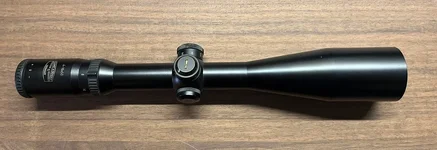
schmidt and bender disappointment

simjim33,
When I was a kid I bought a Tasco astronomical telescope it was a refractor with lenses not a reflector type with a mirror. It had a magnification of something like 230X which impressed me before I bought it. Once I put it together and pointed it at something though at 230x there was next to no light transmission. So I looked into it further. The telescope had an objective lens of 60mm and the textbooks indicated that such a size of lens meant that the scope should only really have a maximum magnification for astronomy of 60X ie 1x per mm of lens as beyond this it did not "collect" enough light. So if I wanted more magnification that worked I needed a larger objective lens. Dont know if that helps.
 
I upgraded a vortex scope for an S&B and to be honest for my eyes it was not an upgrade. Some of this may be to do with your own eyes, Leica for example do not suit my eyes, but are undoubtably brilliant optics - try before you buy is best method
 
Ive had a similar experience with a Bushnell trophy 1.75-5 x 20 from the 1980s, it has better light gathering than a similar scope from Vortex but which had a 42mm objective.
I recently put a Simmons 6.5 - 20 x 44 next to my new Zeiss 6.5 - 20 x 50 and discovered to my dismay that the Simmons has finer resolution than the Zeiss.
What the F#(k!
At full zoom focusing on twigs and gum nuts at 500m the Simmons is better.
However the Zeiss has the full package. Better parallax adjustment, better tracking, holds its zero better and has better light gathering. Even so Im still ****ed off that the Simmons has better optics.
 
Please can someone explane to me why a bigger objective means a scope can gather more light!
Please also include any papers written on the subject.
Internal machanics play a bigger role in light transmission than objective size.
It is perfectly reasonable to assume that the redfiled has a better design for its internals.
"A set of 7×50 binoculars has an exit pupil just over 7 mm, which corresponds to the average pupil size of a youthful dark-adapted human eye in circumstances with no extraneous light."
http://en.wikipedia.org/wiki/Exit_pupil
Have a read , then just accept every ones vision is different and the difference in quality of optics between price bands is much reduced from what it once was.
 
In comparison the schmidt has better optics than my viper pst and a much bigger field of view on the same magnification and it has a smaller objective by 8mm.
 
Of course it is. You asked for light gathering.
Just look at the simple explanation that 762 scot gave.

Another thing is field of view, great to have a huge field of view with low mag, however what you want to shoot can be terribly small in the big picture and at low light it can make things worse......tiny grey deer in a huge grey background. That is why the many who shoot throughout the night prefer an 8x56....more magnification even if they mainly shoot under 100yds. The 56 lens gathers more light and you have 56/8= 7mm exit. More light of what you actually want to see....less trees, grass etc.

Even under the lamp I prefer 10, 15 sometimes 20 mag, just to make sure it isn't a cat.
edi
Edi your first responce to my question was to confuse focusing of light. With mythical "light gathering".
762scots second response below gives you a better idea of what is going on.
But there are limitations as to what a lens can see. Also there is a reson why lens are shaped the way they are. None of these design features have a bearing on light Transfer. One more thing you mentioned magnification.
Adjustable mag is only a way of moving a object closer. You do this by sacrificing field of view. That's all it is. Your gray deer fills more of you filed of view.
simjim33,
When I was a kid I bought a Tasco astronomical telescope it was a refractor with lenses not a reflector type with a mirror. It had a magnification of something like 230X which impressed me before I bought it. Once I put it together and pointed it at something though at 230x there was next to no light transmission. So I looked into it further. The telescope had an objective lens of 60mm and the textbooks indicated that such a size of lens meant that the scope should only really have a maximum magnification for astronomy of 60X ie 1x per mm of lens as beyond this it did not "collect" enough light. So if I wanted more magnification that worked I needed a larger objective lens. Dont know if that helps.
thats getting more toward the issue. But slightly off track. Let me ask you a question what bore did your telescope have? As thats how much light can travel through your telescope.

"A set of 7×50 binoculars has an exit pupil just over 7 mm, which corresponds to the average pupil size of a youthful dark-adapted human eye in circumstances with no extraneous light."
http://en.wikipedia.org/wiki/Exit_pupil
Have a read , then just accept every ones vision is different and the difference in quality of optics between price bands is much reduced from what it once was.
wikipedia.! Love it.
I accept everyones vision is different. In fact that's my first problem with this. Lots has been mentioned about the 7mm exit pupil. It's somthing that has been jumped on by the optics makers. And has been mentioned in this thread. 7mm can be achived by a 6x42 obj. Funny how a 4x32 gives you 8mm and a 4x36 will give you 9mm. Lastly a 1.5-4 x 24 gives the following exit size. 1.5x 16mm, 2x=12mm 3x= 8mm and 4x= 6mm So that's that idea. Sorry but that's only the maths that has been quoted before.

So my question stands where do you get the idea that the objective lens diameter can transmit more light than what the bore of the scope minus the mechanics inside the tube will allow?

Or or rather imagine this. We tock 762scots telescope and re bored it to the Same dia as the obj lens. Do you think he would have seen a brighter picture aka gatherd more light?
Or put it this way your 56mm scope would need to have a 56mm main tube! That would look hideous! Not to mention the comb height would be huge. Fancy making a stock for that Edi? I don't!
 
Simjim, you just don't get it.... one can concentrate/bundle light so to speak. Look how bright the light is when one focusses a magnifying glass. The large lens diameter takes up the surrounding light and bundles it onto one small spot. (focal point)
Take a scope, hold it towards the sun, hold a piece of paper at the 80-90mm behind eye piece...pretty bright eh, just as bright with a 1" tube as with a 34mm tube if magnification and objective are of the same value.
Also for the eye a 1" scope tube is just as bright as a 34mm scope tube if objective and magnification are equal.
If you don't believe any one on here just read FAQ on S&B website...or post Mr Goerzel an e-mail... or any other scope bino manufacturer.
Yes everyone has different eyes...however optics all work after the same physical laws.

edi
 
Edi your first responce to my question was to confuse focusing of light. With mythical "light gathering".
762scots second response below gives you a better idea of what is going on.
But there are limitations as to what a lens can see. Also there is a reson why lens are shaped the way they are. None of these design features have a bearing on light Transfer. One more thing you mentioned magnification.
Adjustable mag is only a way of moving a object closer. You do this by sacrificing field of view. That's all it is. Your gray deer fills more of you filed of view.

thats getting more toward the issue. But slightly off track. Let me ask you a question what bore did your telescope have? As thats how much light can travel through your telescope.


wikipedia.! Love it.
I accept everyones vision is different. In fact that's my first problem with this. Lots has been mentioned about the 7mm exit pupil. It's somthing that has been jumped on by the optics makers. And has been mentioned in this thread. 7mm can be achived by a 6x42 obj. Funny how a 4x32 gives you 8mm and a 4x36 will give you 9mm. Lastly a 1.5-4 x 24 gives the following exit size. 1.5x 16mm, 2x=12mm 3x= 8mm and 4x= 6mm So that's that idea. Sorry but that's only the maths that has been quoted before.

So my question stands where do you get the idea that the objective lens diameter can transmit more light than what the bore of the scope minus the mechanics inside the tube will allow?

Or or rather imagine this. We tock 762scots telescope and re bored it to the Same dia as the obj lens. Do you think he would have seen a brighter picture aka gatherd more light?
Or put it this way your 56mm scope would need to have a 56mm main tube! That would look hideous! Not to mention the comb height would be huge. Fancy making a stock for that Edi? I don't!
Its the simplest explanation i could find , thought you might be able to understand it , never mind .
 
Simjim, you just don't get it.... one can concentrate/bundle light so to speak. Look how bright the light is when one focusses a magnifying glass. The large lens diameter takes up the surrounding light and bundles it onto one small spot. (focal point)
Take a scope, hold it towards the sun, hold a piece of paper at the 80-90mm behind eye piece...pretty bright eh, just as bright with a 1" tube as with a 34mm tube if magnification and objective are of the same value.
Also for the eye a 1" scope tube is just as bright as a 34mm scope tube if objective and magnification are equal.
If you don't believe any one on here just read FAQ on S&B website...or post Mr Goerzel an e-mail... or any other scope bino manufacturer.
Yes everyone has different eyes...however optics all work after the same physical laws.

edi
Edi.
Focus of light and transmition of light are two very different things. And in a way you have just answered my question by completely misunderstanding it.
If you tock all the lenses apart form the obj lens of you scope and let the light come striaght down the tube what size dot would you get? I will give you a clue. You won't get a 56mm dot if you obj is 56mm
Yes I have talked to a major optics manufacture on this. He asked not to quote him. What does that tell you?

I understand and well enogh to know that obj size means nothing. If you feel safe other wise good for you. You won't find any papers on the subject because there are none.
 
Edi.
Focus of light and transmition of light are two very different things. And in a way you have just answered my question by completely misunderstanding it.
If you tock all the lenses apart form the obj lens of you scope and let the light come striaght down the tube what size dot would you get? I will give you a clue. You won't get a 56mm dot if you obj is 56mm
Yes I have talked to a major optics manufacture on this. He asked not to quote him. What does that tell you?

I understand and well enogh to know that obj size means nothing. If you feel safe other wise good for you. You won't find any papers on the subject because there are none.

Maybe you should read up on the absolute basics of how optics work. Don't embarrass your self even more.
Do you actually think optics companies fit a 56mm objective to a scope without any reason?
Papers? every optics company is full of their optics calculations for every design. That is how you start a design...first calculate.
Yes, if you take the lenses out of a scope...it won't work anymore...what does that tell us?????
edi
 
A pic off the net, you'll understand that a larger objective will gather more light and that the tube size has little or nothing to do with transmission.
Size of objective should be in relation with the magnification otherwise the human eye won't be able to use the extra light under last light conditions.

image161_zpsd02d433b.jpg


edi
 
slimjim33 , would you mind telling us your qualifications on this subject ? you seem to be going against all accepted thinking on the subject but I'm open minded enough to consider other possibles.

I have no qualifications or training in this subject except what my own eyes have told me over the last thirty years.

currently I'm with edi on this.
 
Last edited:
Just screw it down to 6x and leave it there this scope should be as good in low light as any other as mentioned the higher the mag the less effective in low light but as it's a vari power keep it low...........


+1
 
Maybe you should read up on the absolute basics of how optics work. Don't embarrass your self even more.
Do you actually think optics companies fit a 56mm objective to a scope without any reason?
Papers? every optics company is full of their optics calculations for every design. That is how you start a design...first calculate.
Yes, if you take the lenses out of a scope...it won't work anymore...what does that tell us?????
edi

god is in the detail Edi.
The reason why scopes transmit more light than they used to is down to the fact we can now machine in ways we couldn't before. Hell we can print Ti moderators now. The design can not change in any far out way. The process of making the parts can.
All you have done is explane how,or try to explane how magnification works. My question was simple please explane how the size of your obj lens GATHERS more light. Then back it up with papers on the subject. SO WE CAN REVIEW THE MATH. Shouldn't be a problem for you. You have tons of papers on the subject. Name some!


Oh forgot. A 8x56 gives 7mm exit dia. That even by the wiki link means a fit adolescent eye can use it.
If 56mm was the golden ticket to light, then scope makers wouldent keep making 42 or 36 or even 24mm obj lens for scopes. Would they?they too give you 7mm if set with the right mag! If your going to up the mag you need a bigger front lens or you lose the magic 7mm.

But I don't understand the Ideas of basic scope design. Evidently!
oh nice diagram by the way. Proves nothing! Except that the light comes in at a angle then magicly straightens out. Come on you can do better.
 
Last edited:
Maybe you should read up on the absolute basics of how optics work. Don't embarrass your self even more.
Do you actually think optics companies fit a 56mm objective to a scope without any reason?
Papers? every optics company is full of their optics calculations for every design. That is how you start a design...first calculate.
Yes, if you take the lenses out of a scope...it won't work anymore...what does that tell us?????
edi


Now now gentlemen! we are all here to help each other.
 
slimjim33 , would you mind telling us your qualifications on this subject ? you seem to be going against all accepted thinking on the subject but I'm open minded enough to consider other possibles.

I have no qualifications or training in this subject except what my own eyes have told me over the last thirty years.

currently I'm with edi on this.
Part time study for a BSc
 
I would just like to interject here. I admit to having no specialist knowledge of the subject beyond what i was taught in a-level physics and a first year astrophysics module last year, but my reasoning is this. Any array designed to gather light, be it a lense in a telescope or a photovoltaic panel, can gather more energy if it is of a larger size. This is a widely known and scientifically acknowledged fact. This is because any ambient light source is highly diffuse. Think of it this way, a 1 watt laser and a 1watt LED bulb have roughly equivalent efficiencies and broadly similar wavelengths. Therefore both are putting out the same number of js-1 of light energy. However, because the laser is focused onto a much smaller area, it appears much brighter, and can cause damage to ones retinas. THerefore, in addition to energy output, there must be an energy density of the emitted light, giving values of W/m2 or similar (for those who haven't done science in a while 1W=1Js-1) This is also the case of any light source, be it the sun or a street lamp. THis means that logically, within the area of emission, i.e everywhere we are likely to use the scope, having a larger area, will allow for the collection of a larger proportion of the emitted light. Effectively this is what the lense does, it collects this light with an efficiency of approx 90-95% dependent of the quality of the coatings +the thickness and optical quality of the lense, and focuses it onto a selection of other lenses down the tube to magnify the image and direct it into ones eye. It is also worth noting that the amount of deflection down the tube will decrease with the size of the objective and the diameter of the tube, allowing for larger objective 30mm tubed scopes to have a higher percentage transmission through the lenses by virtue of them being thinner and less curved (I can't recall if they are concave or convex). It is also widely accepted that resolution and definition improve with objective size all other factors being equal, hence why astronomers keep building bigger and bigger telescopes.This also explains why fixed mag scopes have better light transmission- they contain fewer lenses. If i am wrong, I apologise and i would welcome the input of those more qualified, but this seems logical to me...
 
Alistar thanks, makes sense to me.
Only point is that scope manufacturers seem to quote that there is no difference when transmitting through a 1" or 30mm tube. maybe the difference is very small or other aspects are more important. 90-95% transmission is a large gap already. Would a higher concentration of light through a smaller lens have higher losses than a lower concentration of light through a larger piece of glass (more glass=more reflection)? I wouldn't know.

Apparently the Zeiss Duralit scopes have one lens less than the higher end Zeiss scopes and should therefore (according to a Zeiss optic guru) have better light transmission values.
edi
 
Back
Top