

I posted this on the NZ forum as part of a planned series of threads on the bullets we commonly use here.
Following on from some recent threads with Q&A on some of the common bullets we use, I thought I'd have another look at the comparative construction using sections, some we've done ourselves (thanks @Wingman and others), some I've downloaded off the interweb. There's a fair bit of ongoing confusion about what's what, primarily because both Sierra and Hornady have use terminology you'd think was designed to confuse... Tipped, King, GameChanger, Xs and Ms, ELD, and so on.
First up, how does the Tipped GameKing (TGK) relate to the traditional GameKing? Putting sections side-by-side demonstrates very clearly the step change in bullet design with the TGK.

The traditional GameKing has a much thinner jacket than the new TGK. The traditional GameKing is a partially frangible bullet that will fragment and lose weight upon expansion, and depending on the velocity, weight and calibre of the bullet, and size and weight of animal and where it is hit, the degree of through-and-through penetration will vary. Generally, the bigger the GameKing, the tougher the bullet. From .223 to .30 cal and 165gr, the GameKing is an excellent medium game bullet, from .30 cal 180gr and up, it's better suited to the largest of deer and proper big game.
The TGK is designed to be much tougher, to retain more weight as it passes through the animal. It is designed with aerodynamic efficiency as a priority, as are almost all new bullets in today's "BC" battle. The size of the cavity behind the TGK tip is really something, that's as striking as the thickness of the jacket.
Putting the traditional GameKing next to the Tipped MatchKing (TMK) and TGK is interesting. You can see how the traditional GameKing's jacket thickness is only slightly thicker than the TMK, and both are a lot thinner the TGK.

The two Hornady bullets side-by-side are more similar to one another than the Sierras. The ELD-X has a slightly thicker jacket than the ELD-M, especially at the base, and a nominal interlock ring. I say nominal because when I've cut sections of this bullet, it's hardly visible. Plus, I've recovered a few jackets minus their lead cores, so it's not like it's a bankable mechanical lock. The biggest difference is in the size of the tip and void, the ELD-X is designed to initiate expansion more readily, in a more controlled manner through the thicker jacket. That's the idea anyway.

Of real interest to me is the side-by-side comparisons of the two brands. I've got them here in order of apparent jacket thickness.
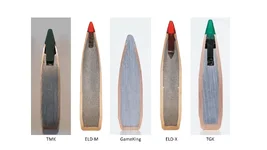
To my eyes, there's very little in it between the TMK, ELD-M and traditional GameKing. There's a small step up in toughness to the ELD-X, then a much bigger step up to the TGK. This is really interesting, because the GameKing must be one of the most successful hunting bullets every produced - it's been around for over 40 years? So history and stats would suggest that there's something to be said for the thinner jacket design, with no apparent need for the cavity behind the tip.
So how does this all translate to preferred field performance? One thing for sure - New Zealand hunters are more inclined to use supposed "match" bullets on deer than elsewhere in the world, particularly America. Lots of threads on here including the current one, and elsewhere, have experienced users favouring the "match" variants. We all know that the ELD-M is a simple like-for-like replacement of the A-Max, and the A-Max was a highly successful and popular medium game bullet from the get go.
Sierra on the other hand have put clear distance between the TMK and the TGK. They say "While they are recognized around the world for record-setting accuracy, MatchKing® and Tipped MatchKing® bullets are not recommended for most hunting applications." I think most users of the TMK here would regard the bullet as perfectly fine for typical NZ open country hunting.
The ELD-X has had a lot more reviews posted than the TGK. It's actually quite hard to find objective field assessment of the TGK. I've used the ELD-X in .30 cal and a great deal in 6.5mm, and I've never used a better bullet. It does exactly what it says on the box, extremely accurate and reliable expansion at all ranges, it's done the business for me from 30-700m+ on hundreds of goats and deer, with an exceptionally low fail rate.
The TGK seems to have had a lot less take-up in NZ, possibly as a function of price. Some reports suggest that the bullet is too hard for our game, though that will be in the eye of the beholder. The huge cavity behind the tip should cause instant and impressive expansion and a potentially massive wound channel, assuming impact velocity is high enough. But I'm not sure the bullet will slow up enough in our small to medium deer as some of the exit holes I've seen with the larger calibre TGKs are enormous. The few reviews I've found suggest that the 6mm and 6.5mm versions are too small a calibre and over-penetrated in whitetail with narrow wounding, but that the .30 cal 165gr is a whole different proposition.
One key requirement is that I want a bullet to exit as slow as possible, not carry heaps of its energy into the backstop. The bullet must expand and partially fragment and rapidly pull up, creating a halo of damage. So whilst I was stone cold on the TGK design initially, I've come round to thinking that in certain applications it would be a good choice, particularly in .30 cal. But maybe not for the kind of 6mm and 6.5mm shooting I mostly do. The only scenario in which I'd choose a harder bullet than I currently use is close range bush hunting. But I don't need super expensive high BC options for that, there's plenty of traditional bullets at less than half the price that will achieve excellent results.
I think the sections speak for themselves, there's a reason the GameKing and "match" variants from Hornady and Sierra are so popular here, and you can say the same for some of the Bergers too. It will be interesting to see which direction the market moves in, and whether the uptake of the harder high BC bullets ever competes with the direction Hornady has gone in.
Following on from some recent threads with Q&A on some of the common bullets we use, I thought I'd have another look at the comparative construction using sections, some we've done ourselves (thanks @Wingman and others), some I've downloaded off the interweb. There's a fair bit of ongoing confusion about what's what, primarily because both Sierra and Hornady have use terminology you'd think was designed to confuse... Tipped, King, GameChanger, Xs and Ms, ELD, and so on.
First up, how does the Tipped GameKing (TGK) relate to the traditional GameKing? Putting sections side-by-side demonstrates very clearly the step change in bullet design with the TGK.
The traditional GameKing has a much thinner jacket than the new TGK. The traditional GameKing is a partially frangible bullet that will fragment and lose weight upon expansion, and depending on the velocity, weight and calibre of the bullet, and size and weight of animal and where it is hit, the degree of through-and-through penetration will vary. Generally, the bigger the GameKing, the tougher the bullet. From .223 to .30 cal and 165gr, the GameKing is an excellent medium game bullet, from .30 cal 180gr and up, it's better suited to the largest of deer and proper big game.
The TGK is designed to be much tougher, to retain more weight as it passes through the animal. It is designed with aerodynamic efficiency as a priority, as are almost all new bullets in today's "BC" battle. The size of the cavity behind the TGK tip is really something, that's as striking as the thickness of the jacket.
Putting the traditional GameKing next to the Tipped MatchKing (TMK) and TGK is interesting. You can see how the traditional GameKing's jacket thickness is only slightly thicker than the TMK, and both are a lot thinner the TGK.
The two Hornady bullets side-by-side are more similar to one another than the Sierras. The ELD-X has a slightly thicker jacket than the ELD-M, especially at the base, and a nominal interlock ring. I say nominal because when I've cut sections of this bullet, it's hardly visible. Plus, I've recovered a few jackets minus their lead cores, so it's not like it's a bankable mechanical lock. The biggest difference is in the size of the tip and void, the ELD-X is designed to initiate expansion more readily, in a more controlled manner through the thicker jacket. That's the idea anyway.
Of real interest to me is the side-by-side comparisons of the two brands. I've got them here in order of apparent jacket thickness.
To my eyes, there's very little in it between the TMK, ELD-M and traditional GameKing. There's a small step up in toughness to the ELD-X, then a much bigger step up to the TGK. This is really interesting, because the GameKing must be one of the most successful hunting bullets every produced - it's been around for over 40 years? So history and stats would suggest that there's something to be said for the thinner jacket design, with no apparent need for the cavity behind the tip.
So how does this all translate to preferred field performance? One thing for sure - New Zealand hunters are more inclined to use supposed "match" bullets on deer than elsewhere in the world, particularly America. Lots of threads on here including the current one, and elsewhere, have experienced users favouring the "match" variants. We all know that the ELD-M is a simple like-for-like replacement of the A-Max, and the A-Max was a highly successful and popular medium game bullet from the get go.
Sierra on the other hand have put clear distance between the TMK and the TGK. They say "While they are recognized around the world for record-setting accuracy, MatchKing® and Tipped MatchKing® bullets are not recommended for most hunting applications." I think most users of the TMK here would regard the bullet as perfectly fine for typical NZ open country hunting.
The ELD-X has had a lot more reviews posted than the TGK. It's actually quite hard to find objective field assessment of the TGK. I've used the ELD-X in .30 cal and a great deal in 6.5mm, and I've never used a better bullet. It does exactly what it says on the box, extremely accurate and reliable expansion at all ranges, it's done the business for me from 30-700m+ on hundreds of goats and deer, with an exceptionally low fail rate.
The TGK seems to have had a lot less take-up in NZ, possibly as a function of price. Some reports suggest that the bullet is too hard for our game, though that will be in the eye of the beholder. The huge cavity behind the tip should cause instant and impressive expansion and a potentially massive wound channel, assuming impact velocity is high enough. But I'm not sure the bullet will slow up enough in our small to medium deer as some of the exit holes I've seen with the larger calibre TGKs are enormous. The few reviews I've found suggest that the 6mm and 6.5mm versions are too small a calibre and over-penetrated in whitetail with narrow wounding, but that the .30 cal 165gr is a whole different proposition.
One key requirement is that I want a bullet to exit as slow as possible, not carry heaps of its energy into the backstop. The bullet must expand and partially fragment and rapidly pull up, creating a halo of damage. So whilst I was stone cold on the TGK design initially, I've come round to thinking that in certain applications it would be a good choice, particularly in .30 cal. But maybe not for the kind of 6mm and 6.5mm shooting I mostly do. The only scenario in which I'd choose a harder bullet than I currently use is close range bush hunting. But I don't need super expensive high BC options for that, there's plenty of traditional bullets at less than half the price that will achieve excellent results.
I think the sections speak for themselves, there's a reason the GameKing and "match" variants from Hornady and Sierra are so popular here, and you can say the same for some of the Bergers too. It will be interesting to see which direction the market moves in, and whether the uptake of the harder high BC bullets ever competes with the direction Hornady has gone in.


 In countries where insurance isn't compulsory, basic cover is very cheap to encourage people to get it.


