The Decline of BSA (Birmingham Small Arms)

I heard many years later that BMW in Berlin had a woman who did the same job and when she retired they stopped this feature as nobody else could manage to do it.

Hardy the tackle makers had to change to using stick on transfers (like on an effing Airfix kit for God's sake) on their rods when the lady there who did the hand lettering in white paint on their rods retired.
 
Last edited:
Made for Africa. It has sights out to 1000 Yards which rifles made for India don't usually have.

OK. So nobody hunts game at one thousand yards in Africa surely? That's silly daft! Well they do, or did, but not quite as we know it. The thousand yard sight was to enable a hunter on a true safari to fire off two, three, maybe four, or more, rounds at a distant herd of animals and then to send a tracker to follow them up to use the (by then you hoped dead) animals for meat. So enabling your safari and its members to be fed. I had years ago a Ross 1905 in .280 Ross with the same sort of rearsight. So, yes, that also was for Africa.
 
I was just reading in an old American Rifleman issue (USA NRA magazine) about the Heym Ruger #1. They "Heym" used Ruger actions with their own Krupp steel barrels fitted and made the comment that the only other companies with the same high end barrel making machines were FN & BSA, as Heym have a top reputation for accuracy this might point to BSA having a similar potential.
 
BSA still make air rifles and barrels, and are based on Armoury Road.

In the 70s they closed their UK operations and moved abroad. A friend of our family was a huge enthusiast and bought up all their machines and tools. I remember going to his house near Marston Green and obtaining a foresight for an Airsporter which he made for me. Wasn't such as bad idea, as he is now the go-to supplier of all BSA spares in the UK.

That would be John Knibbs, his son Mark has a gun shop at Furnace end.
 
  • Like
Reactions: JTO
My other half of the oiling squad told me last year that a .22 lr BSA international usually walked out of the main gate by itself every week before a s/n was stamped on it. Seemed to be the done thing in the 60"s to help with the wage deficit.
We apprenties wore deep red overalls to differ us from the main workforce.
Up I think it was over on the top floor of the motorbike bike assembly area there was a one man operation who pinstriped the fuel tanks with a fine line between the chrome and the painted area of it, he used a very long sable brush with a saucer of gold paint, he would hook the tank into his armpit then with one movement "woof" he would have a full 360 degree of pinstripe applied. We watched him for hours on end. I heard many years later that BMW in Berlin had a woman who did the same job and when she retired they stopped this feature as nobody else could manage to do it.
If you watched Guy Martin great escape they showed one of the blokes who does The tanks for Triumph he made it look effortless then Guy had a go 😂
 
I just found the clip. The real pinstriper was very like the old chap I remember and it shows it is all in the confident paint flow.
My oiler mate had a Lambretta that he wanted the same paint job put on the side panels as one of the new special paint jobs BSA was doing for the USA market which meant overpainting a base coat to get a metallic blue (I hope that"s right) anyway he sneaked them in got them painted up and out again then a week or so later he noticed a pink bleed through of the base colour. He moaned to the paint forman who went a bit white then ran down to the storeroom where all the tanks they had painted were waiting to be fitted only to find them all in a pink colour. They had to put a sealer coat on after the base coat as I remember.
 
The second rifle I ever owned was an BSA Imperial lightweight in 30-06 Then a CF2 Stutzen in 6.5 x 55 I had for 22 years and at the moment I own 2 CF2s one in 22-250 and one in 30-06.
I also own a couple of custom rifles that were not cheap, and the BSA rifles shoot just as accurately, and I like wood.
 
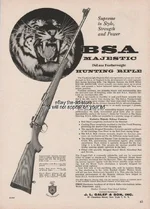
bsa tiger.webp

Something to note, the 'bolt head fully enclosed by the receiver' sounds awfully similar to the Remington 700's selling point ('three rings of steel' was a marketing spiel anyway).

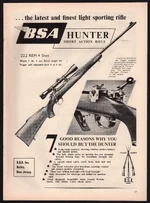
The fact that BSA achieved this with a modified, cartridge length specific Mauser action with integrated scope rails, hand lapped barrel, adjustable trigger, muzzle break and well designed sporter stock in 1960 for an affordable price, no wonder they were popular at home and abroad.

Sad to see how another part of British industry went from world class to defunct in a few decades.
 
"Sad to see how another part of British industry went from world class to defunct in a few decades."

Yes very sad but unfortunately they just didn't keep up with the pace. They took their eye off the ball and relied upon previous government contracts, old technology and their previous good name.
Unfortunately the quality control at the end started to get a bit sloppy. I remember a friend buying one of the very last CF2 target rifles to be produced. It was very ammo sensitive being able to chamber only certain factory ammunition and the amount of play in the rear sight after only a year required the sight to be physically repositioned after each shot. Too late to return it to BSA as by then they had closed.
 
It went the fate of most of British manufacturing. Most of the british manufacturing companies were established by very entrepreneurial inventors and businessmen in the late 1800s. They grew and prospered in the Edwardian era, some really flourished during the WW1, but by that stage many industrialists were enjoying the fruits of their endeavours. Many of the businesses were in the 2nd if not third generation and for most of businesses providing income to family members was the priority rather than reinvestment. Think the beautiful products made by the likes of Purdey, H&H, Dicksons etc, along with all the yachts built in the Clyde etc. and of course Scottish estates.

The depression did put a grinding hault of some businesses. But then we had a really innovative period of the 2nd war and the cold war. And again we were at the forefront of manufacturing - but again the businesses were funding dividends not future growth.

And the biggest challenge for industry was lack of investment and interest from government or society. Take shipbuilding - we built ships on most of the major rivers of the UK. But they were built with lots of men all banging away with large rivets. In the meantime everywhere else had moved across to welding technologies which allow you to build much quicker, stronger, lighter and above all cheaper.

In cars, by the late 1970s - our mini metro, austin Allegros were still pretty much pre war technolgy and were competing head on with the likes of the VW Golf etc.

And with gunmaking, loss of the colonial market, designs that required a lot of hand labour all fell victim to overseas competition from the likes of Sako, who continually developed new designs and manufacturing techniques with increased simplicity, automation but much better performance.

Compare a Tikka T3 and an old BSA. Both addressed at the same market. But to build a BSA today with modern labour rates would probably cost a few thousand pounds. The T3 retails in the US for the $599 price point. It probably a factory gate price of €150, which includes a healthy margin.

They achieve this by using automation, which requires major commitments of capital and a long term view of the shareholders, and not pension funds or family trusts who have an endless need for cash now, and we won’t worry about tomorrow’s needs.
 
Hmmm. I am old enough to remember British bikes like Norton, Triumph and BSA dominating the racing circuits. Then in the late 50s/early 60s these strange little yellow chaps with large teeth and glasses regularly were seen to be doing lots of tours of the various bike plants, scribbling away on their little notebooks and taking lots of photographs with their shiny small cameras, escorted by senior managers who were only too pleased to display the fruits of the workforce’s labours. How we laughed.
Then about the mid-60s these very high-pitched machines started to appear on the circuits, their high fast-revving engine noise contrasting starkly with the deep thrummmmm of the brit bikes. Lord how we laughed again. Funny names like Suzuki, Honda, Yamaha and even Yamsel. The common belief was that they would never last - “it will blow up by the 3rd lap” was the common belief. Lord how we laughed again. What fun! But boy, could they accelerate and even worse after some “fettling” outperform the local bikes……
What no-one appreciated was that the comparatively small British bike manufacturing industry was about to be swallowed by the burgeoning Japanese industrial leviathon which was bankrolled by billions of dollars (and pounds) from the rebuilding of Japan after the war, just a few years before. Sooo, whilst this was going on the British bike industry stood still and had little money for investment why was that then, you may ask).
This of course was only the start - cars and very many other “essentials” were to go exactly the same way. For heaven’s sake even well known names in the gun industry like Browning and Winchester suddenly had their guns made in Japan rather than in Belgium and America!
For those younger readers, it seemed to us that suddenly everything was “Made in Japan”, which in truth it pretty much was - precisely how it is going nowadays with China.
Enough of the history lesson.
Nurse!!!
🦊🦊
 
That is an interesting perspective.

And the biggest challenge for industry was lack of investment and interest from government or society

I found that to my cost in the late 1970s early 80s when I was setting up...the banks were only interested in supporting service industries. Short term-ism rules. Anybody involved in physically making stuff who needed to invest in premises and machinery just couldn't get funding. The banks were only interested in someone with a business plan that could show a profit in the first year, or two at the outside. Thatcher's credo famously reversing the Ruskin complaint of "Cost of everything and value of nothing"

A couple of my contemporaries in Germany couldn't believe my tale of woe. They described their bank mangers as effectively partners in the business. Their business plans as sole traders/entreprenuers were funded over the longview / lifetime of the proprietor and likely trajectory of the business. Huge capital outlay at the outset and support over the years required to establish reputation and take on larger projects, leading to more profitable turnover provided by the investment in plant.

Alan
 
That is an interesting perspective.


I found that to my cost in the late 1970s early 80s when I was setting up...the banks were only interested in supporting service industries. Short term-ism rules. Anybody involved in physically making stuff who needed to invest in premises and machinery just couldn't get funding. The banks were only interested in someone with a business plan that could show a profit in the first year, or two at the outside. Thatcher's credo famously reversing the Ruskin complaint of "Cost of everything and value of nothing"

A couple of my contemporaries in Germany couldn't believe my tale of woe. They described their bank mangers as effectively partners in the business. Their business plans as sole traders/entreprenuers were funded over the longview / lifetime of the proprietor and likely trajectory of the business. Huge capital outlay at the outset and support over the years required to establish reputation and take on larger projects, leading to more profitable turnover provided by the investment in plant.

Alan
Quite.

Look at the Blaser Group. I pulled their accounts a couple of years ago. Innovative business owned by two individuals. € 150m odd a year profit, average salary high tens of thousands, pay €10m a year in tax to the state and the two owners share a €5m a year dividend. And they spend 10% of revenues on R&D and new product design. And they have grown since then.
 
Cheers for the insights guys. I was fortunate enough to have a walk round Westley Richards last year which was a real eye opener, got me thinking about fieldsports in general and how Britain has gone from being the epicentre to what it is now.

Had a good chat with a gunsmith the other day who occasionally refurbishes BSA sporting rifles. Hard to see how a company that made a rifles 50 years ago with all the features you would want today go bust.

At least there are enough examples floating around to remind us of that fact. Seems they are appreciated more abroad then they are over here.


Incredibly cheap second hand for what you get
 
Back
Top