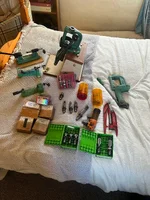
Thinking of reloading,

I have 3-4 loads for varying bullets for my 223 and not one of them has gone over a chronograph. Once I've settled on a load I then confirm drop data by firing at those ranges, a chrono is very helpful but the bullet doesn't lie and in the end the bullet impact is whats to be led by. Chronographs will get you very close but always worth verifying.

I saw Todd Hodnett verifying 4 rifle systems in this,manner and each of them needed a tweak to get POA /POI dialled in. Admitted this was at long range but even more so important at those ranges.
I dont doubt your experience. I just feel if available a chrono is better to use than complicated calculations. My first attempts to produce loads to match factory ammo were based on groups size and POI alone. That iswhat I was searching for. I didnt have or need a chrono at that point.
I use one now, simply to show the calculations I have used to develop those loads are producing velocities and energies that I am looking for. I load for a couple of cartridges that dont have any data published anywhere as they are considered rare and obsolete despite being very close to many of the current attempts to eke a bit more out of brass and bullets with modern powder.
In the OP's case he is looking for accuracy which normally means tight groups. He doesnt need a chrono for that, he can just assume the published data is accurate enough and rely on that for not exceeding safe limits.
 
Don't get me wrong a chrono is a worthy piece of kit for reloading. I've jumped the gun a bit here and talking about once a load has been chosen...my error there.

Using a chrono for finding flat plateaus on velocity can save a lot of consumables also.

As with differing aspects of reloading single tools can be used in multiple ways to give multiple results and certainly what keeps me interested. I'm by no means a reloading guru and always happy to learn new techniques and information.
 
so chaps, todays questions go like this,

after making up my first batch with RL-10X and V-max bullets, i decided to make a start on the sierra bullets with the same powder, and going off GRT, i came across my first problem, case length states 1.7598, after resizing not one of my cases even measured this, they ranged from 1.751 to 1.756, so i trimmed them all down to 1.750 and if all else fails i can use them some other time,
question is. when resizing why are they not all sized to the same length,
 
so chaps, todays questions go like this,

after making up my first batch with RL-10X and V-max bullets, i decided to make a start on the sierra bullets with the same powder, and going off GRT, i came across my first problem, case length states 1.7598, after resizing not one of my cases even measured this, they ranged from 1.751 to 1.756, so i trimmed them all down to 1.750 and if all else fails i can use them some other time,
question is. when resizing why are they not all sized to the same length,
Not all of the brass will stretch at the same rate which is why you measure them after resizing.
I wouldn’t worry too much about it as you aren’t reducing case capacity enough to lead to a compressed load.
 
all read and nearly understood, i think im going to stop making any bullets until im sure im making something worth using, for the time being i wont be doing to much messing about, i wont be ever searching for that perfect bullet on bullet round (although it would be nice) anything under 1" moa at this stage will do, 1/2 moa would be nice though, i will obviously have to work up loads with the powders iv got and bullets and see if any comb works well, so far iv made 5 with RL 10 v max bullet with 19.5g and 5 with 20.4g, im thinking of making 5 more with 21.3g then go out and test them, but as were due rain here all week, it will probably have to be next weekend,
You may be disappearing up your own confusion... I've not got a tenth of the knowledge about reloading as most folks on this forum, but I produce good accurate homeloads for my .223 that kill foxes well, I only really started a short while ago;
#1 Manual
#2 Youtube
#3 SD
#4 Powder company load data
#5 Steady as she goes Captain Kirk...
N135 23.3 grains... 60 grain Vmax... CCi primer... 20" 1-8 twist barrel.. no idea what it may be traveling at, but since I bought the rifle I've not missed anything, always shot homeloads as it never produced a satisfactory group with factory for my needs, the longest shot was 284 yards on a fox, which is plenty far enough for me.
Get something safe together and go shooting... reloading is a marathon.. not a sprint :norty:
 
I'm all over your guide mate, i find so many variables between book weather from bullet manufactures, powder producers, guide books and videos on you tube, so iv decided to stick to one, and thats GRT,
as soon as i find something that works then ill be sticking with it for the foreseeable, its all seem so simple yet so terribly complicated at the same time:) but I'm enjoying the prosses and learning all about it, and until people get bored of me i will continue to ask question, of which I'm most grateful for the answers and replies👍
 
Not all of the brass will stretch at the same rate which is why you measure them after resizing.
I wouldn’t worry too much about it as you aren’t reducing case capacity enough to lead to a compressed load.
not much point in GRT quoting 1.7958 when none of my brass has ever been that:banghead:
 
not much point in GRT quoting 1.7958 when none of my brass has ever been that:banghead:

It's of no consequence , don't get bogged down in the detail. I'm assuming you're using GRT's case values .
Enter your COL and charge weights , you still need to use safe practice during load development .

HOMEWORK
Just as a point of interest , adjust the max' allowed pressure in line with CIP as opposed to SAAMI . The UK falls under CIP .


Just in case , 55gr SBK data .

Screenshot_20240122-221919.webpScreenshot_20240122-221938.webp
 
I'm all over your guide mate, i find so many variables between book weather from bullet manufactures, powder producers, guide books and videos on you tube, so iv decided to stick to one, and thats GRT,
as soon as i find something that works then ill be sticking with it for the foreseeable, its all seem so simple yet so terribly complicated at the same time:) but I'm enjoying the prosses and learning all about it, and until people get bored of me i will continue to ask question, of which I'm most grateful for the answers and replies👍
Forget GRT!!

Use book or manufacturers’ website data and nothing else, it is straight forward and won’t confuse you, it also means you know you’ll be safe rather than a simulation.

GRT, quick load etc. are for experienced handloaders who know what they are doing and what to look for so they don’t get to a point where they put themselves or others in danger.

No offence, but KISS until you have a bit more experience under your belt, that means sticking to book minimum and max and working slowly between the 2.
 
not much point in GRT quoting 1.7958 when none of my brass has ever been that:banghead:
That is why you can edit that number in GRT.

You can see quickly what is relevant and what is not in GRT by editing the numbers. If the peak pressure does not change, and the velocity from the barrel does not change, that tolerance is not important.

You can go to 62.5K psi for European and UK rifles, or use safety factors as a fraction of that rather than the US 55K. Setting it will help some of your warning signs go away.
 
Forget GRT!!

Use book or manufacturers’ website data and nothing else, it is straight forward and won’t confuse you, it also means you know you’ll be safe rather than a simulation.

GRT, quick load etc. are for experienced handloaders who know what they are doing and what to look for so they don’t get to a point where they put themselves or others in danger.

No offence, but KISS until you have a bit more experience under your belt, that means sticking to book minimum and max and working slowly between the 2.
with this in mind and me not being experienced, im now going to use my hornady book for my hornady bullets and the sierra website for my seirra bullets,
 
Maybe not ideal but it's a simple load data from nosler bullets, very similar to the other manufacturers

 
with this in mind and me not being experienced, im now going to use my hornady book for my hornady bullets and the sierra website for my seirra bullets,
Why? You used the data from that to put into GRT and GRT is now giving you nice loads. 23.7 to 24.7gn.
GRT is giving you a full 100% burn of Reloader 10X, with that combo. Load ratio is great at 97%.
Start with 23.7, try 24.2 and 24.7gn, and stop there. With a lot of experience, one could go straight to 24.7gn, but use the two lower loads (23.7 and 24.2) as your workup to check everything is correct.
CHECK ALL THE PARAMS ARE RIGHT, then time to put the tools down, load and head to the range.
 
Data for 1345 , Sierra Blitz 55 gr .

Screenshot_20240123-051533.webp
Screenshot_20240123-051557.webp

Don't take short cuts , you still need to "work up to max ". GRT is useful as a guide . Any differences between the test cases internal volume and temperature used in the data and yours , could see pressure signs far earlier than max charge . Just to demonstrate the point , the case volume for my 223 brass is 29.9 grains of H2O , enter that into GRT .

Remember you're looking for accuracy , accuracy nodes are generally 4 to 5% charge weight apart , that could be the difference between near maximum and dangerous .
 
Last edited:
with this in mind and me not being experienced, im now going to use my hornady book for my hornady bullets and the sierra website for my seirra bullets,
You may find that restrictive and may not find the exact bullet you are looking for but the rule is find the nearest similar bullet, so a flat base soft point is a lot shorter and therefore takes up less case space (so generally lower pressure all else being equal) than a poly tipped boat tail of the same weight which will be longer.

So, always find the most similar bullet when substituting bullets, if you can’t find the same weight use the next weight UP never use data for a lighter bullet.

When substituting any components, not powder, so primer, brass & bullet then start at the minimum charge weight and work up in 5-10% charge weight increments.
 
Why? You used the data from that to put into GRT and GRT is now giving you nice loads. 23.7 to 24.7gn.
GRT is giving you a full 100% burn of Reloader 10X, with that combo. Load ratio is great at 97%.
Start with 23.7, try 24.2 and 24.7gn, and stop there. With a lot of experience, one could go straight to 24.7gn, but use the two lower loads (23.7 and 24.2) as your workup to check everything is correct.
CHECK ALL THE PARAMS ARE RIGHT, then time to put the tools down, load and head to the range.
would you not bother with the 20.7 21.7 and 22.7, if you were me,
 
Data for 1345 , Sierra Blitz 55 gr .

View attachment 347387
View attachment 347388

Don't take short cuts , you still need to "work up to max ". GRT is useful as a guide . Any differences between the test cases internal volume and temperature used in the data and yours , could see pressure signs far earlier than max charge . Just to demonstrate the point , the case volume for my 223 brass is 29.9 grains of H2O , enter that into GRT .

Remember you're looking for accuracy , accuracy nodes are generally 4 to 5% charge weight apart , that could be the difference between near maximum and dangerous .
changed my case volume from 31 what it was, to 29, its now changed the max charge to dangerous, on the parameters there are things i dont even know what they are, let alone what they shoud be changed to, Screenshot 2024-01-23 105756.webp
 
Back
Top