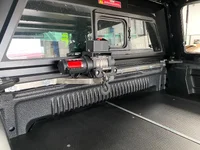
Truck bed winch solution anyone

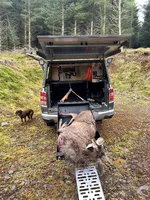
I'm not sure if you meant using vehicle mounted winch to aid in carcass recovery?

If yes, you have a long night ahead... check your winch manual, or if not bought yet do some research. Retrieve speeds are only single digit meters per minute for most models.
Yes just read this, eg Ninja Warrior 2000lb line pull under full load 1m/minute, line pull under no load 3.2m/minute, off down the winch rabbit hole I go…
 
View attachment 361891View attachment 361892

I use a tressle to get height at the lifting point. Front connection is the fitted tie down points and a cable nicked off a body building machine. Manual pulley system, boat pulleys here 2:1, no electrics. Just swapped over to double pulleys that give 4:1 advantage.
This seems to be a cheap efficient setup, I’m thinking about a set up where I need to drag for say 100 meters away back to the truck then up and in, have a ramp and me at the moment .
 

That looks quicker than 1m per minute under load .
That’s what’s putting me off a leccy winch can’t be spending a long time to drag distance, especially when it’s warmer with flys about, currently weighing up pulley system with 4:1 5:1 etc mechanical advantage . That looks tidy though 👍
 
The specs are quite OK for fallow / whitetail size. 200kg max load, 100m wire rope, 18m per minute. Problems start there, because they don't tell you what most numbers mean (min/max/average). Since the drum has several layers of rope, the performance will vary a lot.

The most important information, how much energy it takes to drag is missing. Also electric screwdrivers are not meant for that kind of job, and will probably cook off in short time. On the other hand required torque is low (4Nm) but several minutes of constant running will heat the screwdriver up anyway. I'd also try to construct some kind of holder for the screwdriver to keep it in place.

Also the video is one year old and the website still shows "new product" and there is no price or availability info.

Regarding the pulley system, best way to "work" for human is using your legs. In this case walking. Try to use odd numbers for advantage, meaning you would walk the opposite way to the dragged animal. I think 3:1 would be sweet spot. That way if you drag uphill, you'd be walking downhill. Keep the pulley system somewhat short, I think max. 20 meters (you'd be walking 60m for single leg of the drag). Construct short sections of rope that are same length, or long rope that has loops with the same interval. So that you can reset the pulley system and attach it to new drag point without extra walking along the line. I think it'd be best to use vehicle as anchor point, and keep the pulley system on the same end as the dragged animal. That way you can address all the problems like snagging.
 
The specs are quite OK for fallow / whitetail size. 200kg max load, 100m wire rope, 18m per minute. Problems start there, because they don't tell you what most numbers mean (min/max/average). Since the drum has several layers of rope, the performance will vary a lot.

The most important information, how much energy it takes to drag is missing. Also electric screwdrivers are not meant for that kind of job, and will probably cook off in short time. On the other hand required torque is low (4Nm) but several minutes of constant running will heat the screwdriver up anyway. I'd also try to construct some kind of holder for the screwdriver to keep it in place.

Also the video is one year old and the website still shows "new product" and there is no price or availability info.

Regarding the pulley system, best way to "work" for human is using your legs. In this case walking. Try to use odd numbers for advantage, meaning you would walk the opposite way to the dragged animal. I think 3:1 would be sweet spot. That way if you drag uphill, you'd be walking downhill. Keep the pulley system somewhat short, I think max. 20 meters (you'd be walking 60m for single leg of the drag). Construct short sections of rope that are same length, or long rope that has loops with the same interval. So that you can reset the pulley system and attach it to new drag point without extra walking along the line. I think it'd be best to use vehicle as anchor point, and keep the pulley system on the same end as the dragged animal. That way you can address all the problems like snagging.

Thank you for taking the time to point out the short comings as such of that system and the various factors to consider when putting together a pulley system .
I did think that 50m should be the max hauling distance and was thinking if 3:1 then a 150m rope ?
 
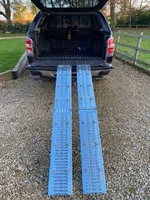
Looks the business.

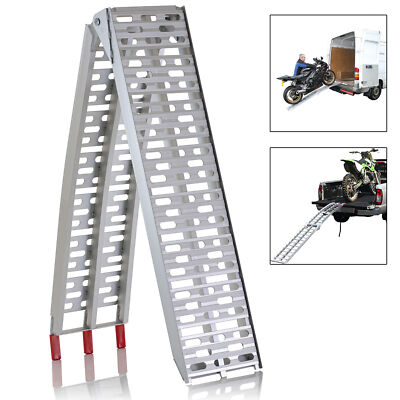
Got a link for the ramp?

Like this or similar

Just search motorcycle loading ramps on evil-bay, If i remember correctly we bought them as a set of two (for about £80 quid).

The skinny ramps are okay, but ideally would have something a bit wider, and with a flat surface, so that you can get a wider tray pulled up, or to just pull beasts straight up into the bay on a flat ramp (without a sled).
 
@Suilven Just be careful with those motorbike ramps - some don't have the 2 sides in the photo above but have very "grippy" slots cut into them. Ideal for getting traction on bike tyres and also idea for tearing the bottom of your drag tray to bits!

There's a close up photo in this link (second image along): VonHaus Motorbike Ramp Portable - 400kg Max Weight, 200kg Per Ramp - Folding Heavy Duty Loading Ramps for Van (Galvanised Steel) | DIY at B&Q

But I reckon something wider like this would be great: https://www.amazon.co.uk/LIEKUMM-Aluminum-Capacity-Motorcycle-Foldable/dp/B09CPNB9L1?th=1
 
@Suilven Just be careful with those motorbike ramps - some don't have the 2 sides in the photo above but have very "grippy" slots cut into them. Ideal for getting traction on bike tyres and also idea for tearing the bottom of your drag tray to bits!
I added some castors to try to avoid any such damage and aid the loading.
 

Attachments

  • ramps.webp
    ramps.webp
    123 KB · Views: 35
Back
Top