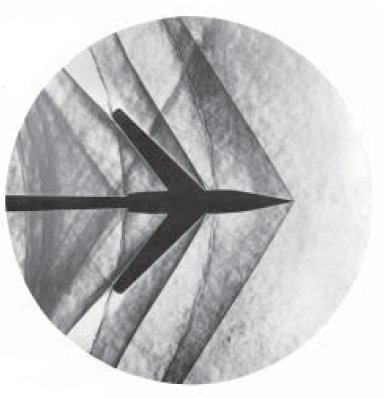
Not technically a shock wave. That is when something, a bullet say, travels through a medium faster than the speed of sound in that medium. The medium can't get out of the way fast enough, so gets compressed, if it is compressible, forming a Mach cone trailing behind. Possibly the opposite of a temporary wound channel. Not going to happen at any credible rifle velocity.
Hence the crack from supersonic rifle bullets, that's not possible to moderate, only the shock and pressure waves at the muzzle.
A giveaway on the battlefield, or urban areas with a gun problem. Modern kit can identify the shooter's position rather precisely, hence interest in subsonic stuff for special forces.

 en.wikipedia.org
I don't know the speed of sound in flesh, guessing that it's at least 4000 fps, since it's mostly water, salty at that, hence I doubt that a true shock wave has anything to do with this.
In air, the speed is roughly 1125 fps. Water 4858 fps. Salty water even faster. Slightly depending on temperature.
Back in the day military researchers used to experiment on live pigs. Nowadays they also have lots of data from the effects on humans, gathered from recent conflicts. That would be interesting if ever made publicly available.
I think there is a confusion between "shock" as in "it died of shock", wound channels, bullet performance, and how they impact the anatomy whilst occurring. Calling any of this "shock waves" is incorrect IMO, that's something quite different, and I don't think happens, except during the secondary ballistics phase, through the air. What actually happens at the terminal phase (well named) is still rather a mystery I think, for us, and largely luck-of-the-draw, notwithstanding best efforts with bullet, calibre and placement decisions. Gelatin blocks aren't the same as real animals.
Being hit by any bullet, air rifle or even shotgun pellet would of course be "shocking". Game birds seem to tumble over readily enough with just a few bits of shot at energies below what we are told is suitable for rabbits with airguns. Headshoot rabbits and watch them jump around all over the place, they are dead, in the brain, but the other bits of nervous system haven't stopped working. Just as deer should be treated carefully, even if headshot, don't immediately start grallocking, move the hind legs and you might get a kick in the face from the "reflexes" left working, or so I've been warned.
Target shooting is much easier to understand and try to analyse to multiple significant digits IMO with all the gadgets and software available. Punching a hole in paper, banging a gong, knocking down a pop-up, doesn't require any thought about the terminal phase, nor consideration of exactly where to place the shot. Trying to combine the two with one rifle and load, well I'd suggest bullet choice is everything.
Same as shooting in the field is completely different from at the range. Different techniques.
I do hypothesise that disrupting activity in critical nerve plexuses is very relevant, however it happens. It doesn't take much energy, as you will know if you've ever been "winded" by e.g. a punch to the solar plexus, learned boxing or just scrapping. Add a big hole from an expanding bullet through something major, not just a thump from a padded boxing glove, or a bare fist, and it would very soon be over, rather than just incapacitation for five minutes or so.
Hence the crack from supersonic rifle bullets, that's not possible to moderate, only the shock and pressure waves at the muzzle.
A giveaway on the battlefield, or urban areas with a gun problem. Modern kit can identify the shooter's position rather precisely, hence interest in subsonic stuff for special forces.
Gunfire locator - Wikipedia
I don't know the speed of sound in flesh, guessing that it's at least 4000 fps, since it's mostly water, salty at that, hence I doubt that a true shock wave has anything to do with this.
In air, the speed is roughly 1125 fps. Water 4858 fps. Salty water even faster. Slightly depending on temperature.
Back in the day military researchers used to experiment on live pigs. Nowadays they also have lots of data from the effects on humans, gathered from recent conflicts. That would be interesting if ever made publicly available.
I think there is a confusion between "shock" as in "it died of shock", wound channels, bullet performance, and how they impact the anatomy whilst occurring. Calling any of this "shock waves" is incorrect IMO, that's something quite different, and I don't think happens, except during the secondary ballistics phase, through the air. What actually happens at the terminal phase (well named) is still rather a mystery I think, for us, and largely luck-of-the-draw, notwithstanding best efforts with bullet, calibre and placement decisions. Gelatin blocks aren't the same as real animals.
Being hit by any bullet, air rifle or even shotgun pellet would of course be "shocking". Game birds seem to tumble over readily enough with just a few bits of shot at energies below what we are told is suitable for rabbits with airguns. Headshoot rabbits and watch them jump around all over the place, they are dead, in the brain, but the other bits of nervous system haven't stopped working. Just as deer should be treated carefully, even if headshot, don't immediately start grallocking, move the hind legs and you might get a kick in the face from the "reflexes" left working, or so I've been warned.
Target shooting is much easier to understand and try to analyse to multiple significant digits IMO with all the gadgets and software available. Punching a hole in paper, banging a gong, knocking down a pop-up, doesn't require any thought about the terminal phase, nor consideration of exactly where to place the shot. Trying to combine the two with one rifle and load, well I'd suggest bullet choice is everything.
Same as shooting in the field is completely different from at the range. Different techniques.
I do hypothesise that disrupting activity in critical nerve plexuses is very relevant, however it happens. It doesn't take much energy, as you will know if you've ever been "winded" by e.g. a punch to the solar plexus, learned boxing or just scrapping. Add a big hole from an expanding bullet through something major, not just a thump from a padded boxing glove, or a bare fist, and it would very soon be over, rather than just incapacitation for five minutes or so.
Last edited: