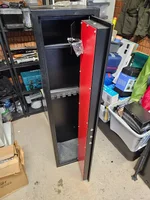
Fixing my cabinet

Jezza308

Well-Known Member
Hi All, I will be moving to the South Hams of Devon nearer Christmas. The property is a very thick walled very old farm house built of stone and infill. I believe fixing my cabinet using Rawlbolts will not work. I know I could fix to floor joists but I would rather not if I can avoid it. Has anyone found a type of fixing which will solve the problem or do I have to go the floor joists route? :???: Thanks, Jezza :tiphat:
 
Hi All, I will be moving to the South Hams of Devon nearer Christmas. The property is a very thick walled very old farm house built of stone and infill. I believe fixing my cabinet using Rawlbolts will not work. I know I could fix to floor joists but I would rather not if I can avoid it. Has anyone found a type of fixing which will solve the problem or do I have to go the floor joists route? :???: Thanks, Jezza :tiphat:

Test drill a spot in the middle of where the cabinet will go, then 10/12mm studding with cem fix.

Depth is ruled by the infill and wall.

I added a skirt of 50x50x6 angle around the cabinet with it bolted to both.

Tim.243
 
Use chemfix and threaded bar. I have a 19 century farmhouse made of stone and dust! Made the mistake of trying to fix my first cabinet with raw bolts etc....In the end I used a combination of tiger bolts, and 210mm hammer in fixings and them coach bolts into joists for good measure....second cabinet.....3 14mm holes, 3 lengths of 10mm threaded bar and a tube of chemfix.....done in less than 10mins.....although it does take about an hour for the chemfix to go off....
 
As above chemfast and 12mm holes and 10mm bar, this and bar about ft long, this is how I done mine in old house and this is how we hang rads in old buildings too.
 
I agree with resin and threaded car too. My cottage is a couple of hundred years old, with thick stone walls too. I first thought of foundation bolts, but worried that accidental overtightening would split the stone.
 
Cheers Tim Walls are roughly 2 ft thick (15th century house!!!!!!!) Test hole is a good idea

Common sense is not that common these days lol

Best advice is to make sure the holes are dust free and twist the studding around as you push it in, the thread gets a even coating also the material is not pushed out in one go.....


Tim.243
 
You probably already know, but if not cut the end of the stud going into the wall/chemfix @ 45-60 degree angle helps cut through while twisting/inserting the studded rod and get an even loading all around the fixing.
 
Last edited:
Another valuable tip, thanks Patjack, and thanks to you all, I had not heard of Chemfix but its obviously the solution for me. I am told the wall I had thought of using is probably made of Cob! I hope this does not alter the advice I have received. Many thanks to you all, Jerry :tiphat:
 
Another valuable tip, thanks Patjack, and thanks to you all, I had not heard of Chemfix but its obviously the solution for me. I am told the wall I had thought of using is probably made of Cob! I hope this does not alter the advice I have received. Many thanks to you all, Jerry :tiphat:

You will struggle to fix anything securely to a cob wall, as it's basically just rammed earth, not stone as you stated in your original post.
 
As said above.
Chem fix / chemical mortar / Fischer polyester resin etc.
Use threaded bar cut to the length you need. dont bother with 4" precut pieces.
Hopefully the wall is made of more than cob. The fixings will only be as strong as the wall that they are in. You will have to drill it to find out!
As the walls are so thick, you can use very long threaded rods. If you need to drill 18" deep holes to get a good fixing then do it. Remember the rod should reach the back of the hole you drill.
 
Another valuable tip, thanks Patjack, and thanks to you all, I had not heard of Chemfix but its obviously the solution for me. I am told the wall I had thought of using is probably made of Cob! I hope this does not alter the advice I have received. Many thanks to you all, Jerry :tiphat:

Yeah should hold in cob, if you can get a good deep hole not much bigger than the threaded bar and spray s.b.r or p.v.a in the hole and let it dry before chemfast it in.
 
Back
Top