6.5x55mm Viht N160 overpressure at 44gr - any wisdom?

zambezi

Well-Known Member
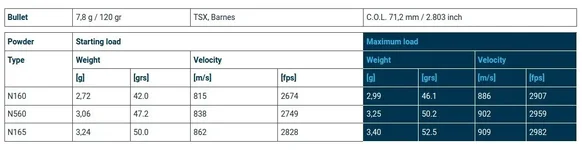
I have been developing loads for my 6.5x55mm and encountered an unexpected over-pressure scenario at a charge weight that was well below Vihtavuori's max value for the powder+projectile combination. I am using Viht N160 and the Barnes 120gr ttsx bullet in once-fired Sako brass that has been full-length resized and measured to be within SAAMI case spec. Primers are CCI large rifle #200.

The spent cartridges in the image below show some gas leakage past the primer, the cases were reluctant to extract from the breech and left residue on the bolt face.

Breech face to lands was measured to be 2.589". Cartridges were assembled to 2.337" ogive. [that value mimics Sako 493H factory sizing]

I have a theorey as to why it happened, but seek any additional wisdom/experience on this forum too.
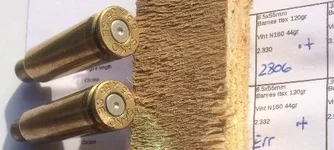
6.5x55_overpressure_Viht_44gr_N160.webp

Viht_N160_Barnes_120gr.webp


So...after I aborted further testing, I took some of my unfired cartridges and verified all external measurements to be as planned/intended. Next I dissasembled the rounds to check charge weights. All good. HOWEVER...what I found was that it took 10 really BRUTAL whacks with the inertia hammer to dislodge the bullets from the case necks. By contrast, Sako factory ammo comes apart with just two hits.

My working assumption is that I should not have applied any neck crimp at the end of the bullet seating sequence. The crimp was not excessive [invisible to the eye and measured to be half a thou'] but it certainly affected how snug the bullet was held.

My working theorey so far [subject to your offerings] is that the Barnes ttsx monoliths are quite a hard material. Even a visually small crimp translates to a significant mating of case and bullet. And that allows the over-pressure to occur even at safe/low charge weights. My other thought is that perhaps the Sako brass is harder than the average and I should anneal after every firing. Any ideas?
 
i reload sako brass with 120 prohunters 46.2 gr n160 never crimp and never had any issues shot a couple of hundred like that. why not reload a couple without the crimp and try them to see if theres any difference
 
I don't know about 6.5x55 , but i'v never had to crimp a rifle case . I just use good dies but I think you may have solved your own mystery try some without crimp as above working back up to your know max I think your get above that before you get the same result . imo there is no point pushing for a max plus fps ? if a lower one will do the same job , unless your target shooting or hunting at extended ranges your just burning ££ in powder . lol
 
there is no point pushing for a max plus fps

Agreed. But my target MV is 2750fps, or thereabouts. That is because the Barnes ttsx bullet needs 2000fps terminal velocity to fully deform. So for the Barnes to work out to 300m, I need something in the 2700-2800 fps arena. [most domestic deer are shot at sub 200m but I have taken African plains game at extended ranges.]


never had to crimp a rifle case

Point taken. I will test without the crimp.
 
Pressure is simply pressure. You either have too little, enough or too much. The one in the middle is what you are after. Pressure drives the bullet, not a given charge weight. The charge weight works in tandem with other variables to produce pressure.

As long as you can consistently repeat what you do, then work up a load that is safe and produces the desired results and continue doing that. If that includes applying a crimp, then do that.

I personally do not crimp. I concentrate on brass prep and uniform neck tension and enjoy a level of accuracy and consistency that is well in excess of what is needed. I will add, I am not loading for heavy recoiling cartridges. If I was loading something like a .375H&H for example, I would apply a crimp but then would be doing so to avoid bullet movement within the neck in unfired rounds as the rifle recoiled. It would not be for some type of additional consistency for accuracy or velocity purposes.

That said, it might not be the crimp you are applying.

The other things to consider are do you have a tight bore or chamber? Have you experienced these type of results when loading with the same powder and brass but with a different bullet? Does this Barnes bullet have a larger bearing surface?

I have a rifle that develops the desired amount of pressue with a charge weight that is just below what the book says is a minimum charge weight. Great, I burn less powder and enjoy stellar performance.

OAL wise, have you tried chambering a cartridge and extracting without firing to see if the bullet is marked by the rifling indicating it being jammed in the lands to the point where a pressure spike it happening? I never really take much notice of factory round lengths or what the books say. I am only interested in my own rifles, how much headspace they have and the OAL of cartridges so the bullet is between 25 and 30 thou back from the lands. That pretty much always works, ensures I am away from the rifling and allows a nice level playing field to work up from.

Book data is merely information. All rifles are different, even if only slightly. There are exceptions.

Good luck finding your load without pressure signs and well done for stopping and asking yourself some questions.
 
The one certain thing is that your load is too high for that brass. Primer leaks, hard extraction (and what appears to be case-head extrusion into the bolt-face ejector aperture followed by its being 'swiped' between the 'O' of SAKO and the 'E' of SE) are all serious over-pressure signs.

I've never used Sako brass in the 6.5X55mm, but have found it to be both heavy and extremely 'soft' in other common cartridges. I have read several times that Federal makes Sako brass and my experience of the make is that the two are certainly very simple. Many, many years ago, when 308 Win Boxer primed brass was hard to get and good once-fired examples were much sought-after, I soon found that Federal was a poor purchase. Many (genuine) once-fired cases already had slack primer pockets (with CCI-200s, the most widely available primer of that time) after the one firing with the factory load. I and others quickly ditched what we'd been led to believe were premium cases. None of this may apply to today's Fed/SAKO cases, of course, but I have to say I feel suspicious and it is at the least a bit of a coincidence. Moreover, unless you know the seller well, 'once-fired cases' may or may not be such, so loose primer pockets may result from more than one firing. (However, you also have the ejector mark on one of the illustrated cases and that is an unmistakable symptom of the case-head having been subjected to excessive pressure.)

Characteristics of different makes aside, case-head hardness can vary within a make quite considerably from lot to lot in some makes, producing the occasional 'soft' batch that won't take pressure.

As a first step in remedying your problem, I'd suggest buying a box of new Lapua brass and trying again. Lapua makes cases with very hard heads hence the company's claim to expect 10 or more firings. Its quality control is superb too, so significant lot to lot variation is rare. Don't crimp.

How old is your N160? Age, especially if the can has been opened and resealed many times and/or stored in too warm conditions, can affect actual burning speed / characteristics.

And of course, check all the usual things such as case-length (after resizing not after firing) being within CIP Max, bullet not jammed into the lands etc.
 
If I was loading something like a .375H&H for example, I would apply a crimp

I also reload .375, and the crimp there has not caused any over-pressure cases


The other things to consider are do you have a tight bore or chamber? Have you experienced these type of results when loading with the same powder and brass but with a different bullet? Does this Barnes bullet have a larger bearing surface?

My loads are a near 100% match to my preferred Sako factory purchases. I cannot know what powder they use, but their MV [2660-2740 fps] and ogive [2.337"]
measurements are my reloading benchmarks. In other words, the Barnes ttsx 120gr is the projectile that has passed down this barrel for most of its usage, with good accuracy and nil bad effect.


if the bullet is marked by the rifling indicating it being jammed in the land

It is not. Please refer to earlier statement: Breech face to lands was measured to be 2.589". Cartridges were assembled to 2.337" ogive. There is circa 0.200" jump space available. I will consider reducing the jump once I have a safe load. Note that I get 0.5 moa accuracy from factory loads set to 2.337" ogive, so that will be the last parameter I tinker with.


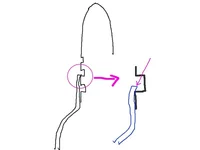
I have had one other epiphany regarding the neck crimp: I noticed that the case neck lip aligns to a cannelure "trough" when bullets are seated to a 2.337" ogive. So...the possibility exists for the neck crimp to result in a rolled lip penetrating the "trough". Rough image below. That might explain why the bullets were held so tightly.

Crimp_in_cannelure.webp
 
Many (genuine) once-fired cases already had slack primer pockets

The cases are genuine once-fired. They are my own Sako factory purchases and were fire-formed in the rifle for which I am now reloading.


I'd suggest buying a box of new Lapua brass and trying again

If tomorrow's testing with once-fired Sako brass that has not been crimped is similarly poor [at lower powder charges], I will buy some new Lapua brass.


How old is your N160? Age, especially if the can has been opened and resealed many times and/or stored in too warm conditions

Powder is brand new to me, date stamped by manufacturer in 2018. It is stored at approx 18'C.
 
I use 46gn of N160 with Barnes TTSX 120gn heads and never had to crimp - pushing them at 2950 fps. Very accurate and has performed on all deer (except CWD) Sako 85 Rifle.
Lapua Brass and Federal Primers.
 
I also reload .375, and the crimp there has not caused any over-pressure cases


My loads are a near 100% match to my preferred Sako factory purchases. I cannot know what powder they use, but their MV [2660-2740 fps] and ogive [2.337"]
measurements are my reloading benchmarks. In other words, the Barnes ttsx 120gr is the projectile that has passed down this barrel for most of its usage, with good accuracy and nil bad effect.


It is not. Please refer to earlier statement: Breech face to lands was measured to be 2.589". Cartridges were assembled to 2.337" ogive. There is circa 0.200" jump space available. I will consider reducing the jump once I have a safe load. Note that I get 0.5 moa accuracy from factory loads set to 2.337" ogive, so that will be the last parameter I tinker with.


I have had one other epiphany regarding the neck crimp: I noticed that the case neck lip aligns to a cannelure "trough" when bullets are seated to a 2.337" ogive. So...the possibility exists for the neck crimp to result in a rolled lip penetrating the "trough". Rough image below. That might explain why the bullets were held so tightly.

View attachment 148754
Should the top of the brass not touch/almost touch the top of the groove to prevent the bullet sliding into the case?
 
Should the top of the brass not touch/almost touch the top of the groove to prevent the bullet sliding into the case?

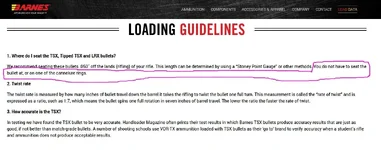
Not according to Barnes [see below]. The neck of a properly sized case will apply sufficient tension to hold a bullet provided bullet seating depth engages most of the neck. [neck crimping is suggested for high recoiling rifles to prevent bullet creep whilst cartridges are carried in the magazine during firing]


Barnes_cannelure_independent_seating.webp
 
Agreed. But my target MV is 2750fps, or thereabouts. That is because the Barnes ttsx bullet needs 2000fps terminal velocity to fully deform. So for the Barnes to work out to 300m, I need something in the 2700-2800 fps arena. [most domestic deer are shot at sub 200m but I have taken African plains game at extended ranges.]


Point taken. I will test without the crimp.
The crimp is not the issue. I crimp everything and I probably load for more cartridges than most on this site. I have loaded to MAX and beyond with crimps. Crimp or not, but it was not the crimp that caused the pressure issue.

Yes. Crimped loads will take a lot of beating with an inertia puller. That is normal.~Muir
 
Sako brass is equal to Norma/Lapua in my book. I don't bother with naming any one "the Best" since the all perform equally well for me.

I also do not crimp.

Something I would consider that hasn't already been mentioned is to check if there are any deposits in the throat area. TSX/TTSX have been known to shed a lot of copper and since you are developing a load....I.e. clean your rifle just to make sure.
 
The crimp is not the issue

Well...today I tried loads at 42gr, 42.5gr and 43gr and had no over-pressure events. These reloads were also in Sako once-fired brass from the same batch as the failed 44gr test load. only difference was no neck crimp. But it may well be that the tipping point for this brass is just above the 43gr N160 mark, crimp or no crimp.

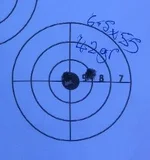
The real revelation in today's testing was that 42gr of N160 very nearly delivered my target MV! I had made just two loads at each of today's three test weights, so the sample is not huge, but the mean velocity delivered by 42gr N160 in my rifle is 2700fps. However, there was a 100fps difference between the two shots [4% deviation]. In practical terms, that does not amount to any real-world hunting problem. But it might suggest that charge weight is not the "sweet spot" loading. Accuracy at 100m is just fine:

42gr_accuracy_100m.webp

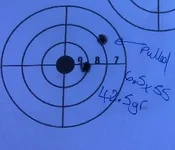
42.5gr N160 delivered a mean MV of 2776fps. More importantly, the spread in MV between the two 42.5gr shots was just 7fps. I am sure that accuracy is as good as the 42gr load but only more testing will confirm. [I pulled my second shot as someone unleashed lead from a vintage military caliber two bays to my right!]

42.5gr_accuracy_100m.webp


43gr N160 introduced a significant POI shift from all other loads. But grouping was fair, so I don't rule it out. I just do not think I need the extra grains to achieve adequate MV and accuracy goals. All shells extracted with ease, no primer or extractor/head marking issues presenting.

So now I am going to make even smaller changes to find the sweetest value between 42gr and 42.5gr. Finally I will test different jump distances to see if there is a better cartridge length than the Sako factory take of 2.337" ogive.
 
Zambezi just an observation as I am in a similar situation.
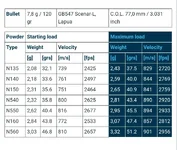
You haven't mentioned what rifle you are loading for and I think it is relevant because Viht have two sets of data. The data set you are using is 6.5x55 swe mauser and tends to have lighter loads for the older barrels. They also have data for 6.5x55 se/skan which tend to be heavier loads for modern rifles eg Sauer etc.
The bullet choice in the second data set is poor though, for example no data for the Barnes you are using or the 129gr Hornady SST that I am trying to create a load for.
 

Attachments

  • 20200208_154405.webp
    20200208_154405.webp
    63.6 KB · Views: 26
what rifle you are loading for

Blaser R8. Newish barrel with sub 600 rounds through it. I am sure the 44gr N160 powder charge I tried would not have been an issue for the barrel/breech on this rifle. But it was clearly too much for the brass. Per subsequent posts, I am likely to stick with a charge weight that does not overly tax the Sako brass.


Have you tried using a different primer?

Fair point. No I have not. Note the CCis are working a treat when I drop the charge weights. But if I cannot find an absolute sweet spot in amongst the lower charge weights, then I will probably change brass first, primers last. [I have some Hornady and Federal brass too]
 
Back
Top