6.5x55mm Viht N160 overpressure at 44gr - any wisdom?

Not sure that is the case for me or my Blaser. Per CD's equiry above, I am able to re-chamber a once-fired Sako factory cartridge without brutality. It definitely has less slop than an unfired cartridge, but bolt closes with firm push.
Maybe its just the thicker brass, everyone i know who has had or has a blaser has multiple barrels and has to fl. But they are all on lapua, are there any rub marks around the neck/rim after extraction?
 
Maybe its just the thicker brass, everyone i know who has had or has a blaser has multiple barrels and has to fl. But they are all on lapua, are there any rub marks around the neck/rim after extraction?

Nope. All looks kushti.

I have perhaps 500 Sako cases. Based on this excercise, I am going to reload conservatively, neck-sizing only. I now plan to discard twice-fired brass. When all my Sako brass is exhausted, I will switch to Lapua.
 
@zambezi you have certainly taken a logical and structured approach to this, it's the type of thing that I can really get into researching (science background) and will definitely do some more reading around. I'll have a look at a range of cases later and add anything that seems informative.

Cheers, Mick
 
I'm sorry for being absent after my initial barrage of comments. This confounded me, so I had to "read up" on the subject.

These are my conclusions (albeit not necessarily the truth).

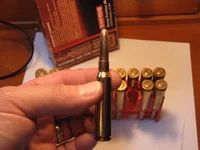
1. COAL is correct, but compared to what I am used to see (156 gr Norma Alaska):
1581508934995.webp
(https://picturearchive.gunauction.com/6340084048/12901621/07172014 canon 033.jpg_thumbnail0.jpg)

Loaded with 120 gr TTSX it looked more like an oversized .223. The C.I.P COAL is also given as 80 mm (3.150"), hence my earlier comment (I was wrong).

2. Seating the bullet per Vihatvuori load data makes it protrude into the case, restricting case volume and making a 44 gr load rate rise from ca 90% to ca 97% (per QL and GRT calculations) with pressure rise to follow.

I don't know if this was any help at all, but I do hope you get this sorted. I've contacted VV with my conclusions and we'll see if they ad a comment regarding this on the reloading data page...

Cheers!
 
Vihatvuori load data makes it protrude into the case, restricting case volume and making a 44 gr load rate rise from ca 90% to ca 97% (per QL and GRT calculations)

Interesting. Be good to hear what Viht say.

Although entirely subjective, I did compare air space on Sako factory loads vs my reloads by shaking cartridges near my ear. Both have air space [so, not compressed loads per se] and approx the same amount. If anything, my reloads have more air space than factory loads at the same 2.337" CBTO/ 2.888" COAL.
 
44 gr load rate rise from ca 90% to ca 97% (per QL and GRT calculations)

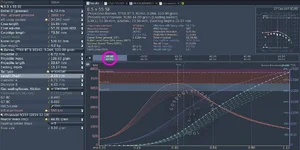
Agree. I noted that the GRT database values for the Barnes 30242 120gr ttsx were a little off. I made some minor tweaks to values and GRT on my PC also shows 97% pressure loading at 44gr N160 when I use a CBTO that mimics Sako factory ammo values

GRT_44gr_N160_97pc_at_CBTO2.337.webp

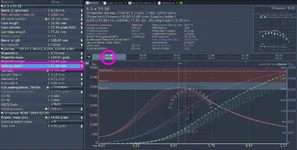
However, I know by rifle measurement that my breech to lands distance is pretty much 0.200" bigger than the factory CBTO of 2.337". It is 2.589". Barnes declare you should have a minimum 0.050" jump available for the 6.5mm 120gr ttsx. So I could ease the bullet out of the case by another 0.150" to a CBTO of 2.487 and thus reduce peak pressure to circa 93% according to GRT:

GRT_44gr_N160_93.5pc_at_CBTO2.487.webp
 
Decreasing COAL and thereby increasing jump to the lands actually reduces pressures and MVs. Contrary to common belief, deeper seated bullets increasing fill ratios to the point of charge compression doesn't increase pressures either, even at pretty brutal compression levels with extruded powders. (Anyone who has ever loaded 223 Rem with 77gn match bullets at the cartridge's SAAMI /AR-15 COAL of 2.26", or even much shorter 69gn bullets, for magazine operation is well aware of this as kernels audibly 'crunch' as the press is operated during bullet seating.)

There is a caveat here - charges of ball type powders shouldn't be heavily compressed for reasons I won't go into.

Internal ballistics programs such as QuickLOAD which show peak and overall pressures / MVs rising as COALs reduce are perfectly accurate as long as that COAL relates to the bullet ogive's position in relation to touching the rifling lands - eg the chamber itself only allows a COAL of say 2.900" in 6.5X55mm (compared to the 80mm/3.150" CIP Maximum COAL). However, if that same bullet is loaded to 2.900" giving a massive 250 thou' jump to the start of the rifling, pressures an MVs will reduce significantly, all other things being the same.

The reason for QL's apparent inaccuracies here is that as with all internal ballistics computation, a key input is combustion chamber volume of which that remaining inside the case with seated bullet is only part, albeit the major part. The key value however is that which applies when the bullet reaches the rifling and is either stopped dead, or at the least checked. It's the total amount of space (ie the active combustion chamber volume) behind the bullet that applies at that point that mostly determines PMax as the bullet will normally leave the case and reach the rifling before peak pressures are generated.

Note that this applies solely to rifle type cartridges and their relatively slow burning powders. Small capacity pistol and revolver cartridges employing fast burning powders are a very different animal and a bullet change that reduces remaining internal case capacity greatly can in itself be dangerous through producing a huge pressure spike. IIRC, this was an issue for the old Victorian era British service 450 calibre and WW1 .455 British revolver cartridges when handloaded. (They had a very short case compared to the US .45 Colt, .44 Special and other foreign equivalents.) This issue can still arise today in special / heavy bullet loadings of cartridges like the 9mm Para.

Returning to the rifle cartridges, especially the 19th century Mausers which were long-throated by design to handle very long, heavy RN FMJs as so well illustrated by @CerebralDistortion with his pic a few posts earlier, many such rifles produce disappointing MVs when loaded with modern bullets in actual rifles (as opposed to pressure barrels used in ballsitics labs) using the loads listed in manuals or calculated by QL. This usually applies to an even greater degree when loading for well used military surplus examples, particularly 7x57mm service rifles, where original long freebore chambers dictated by the early 173gn RNFMJ service bullet allied to considerable throat erosion through use produces very disappointing MVs allied to low pressure signs (case sooting and suchlike) when using charges that may well be considerably above the recommended starting levels in manuals.

A second reason for lower pressures and MVs than expected in this short COAL / large jump scenario is the longer the jump the bullet makes before entering the lands, the less of a check those lands make on its velocity and acceleration. If the bullet clears the chamber / throat area quicker and moves down the barrel more smartly, the overall combustion chamber volume (case capacity + volume of space behind the bullet) increases much more quickly than with a heavily checked bullet that starts out with less jump. The extreme case is that of the 'jammed' bullet seated at a COAL that sees its shoulder heavily engraved by the rifling on chambering the round - the bullet so seated struggles to get moving down the barrel at all and only does so when pressure has already risen to a relatively high figure behind it through charge burn and then its initial acceleration is slower allowing a more rapid pressure build-up behind. QL acknowledges this through its instruction to increase the 'shot-start pressure' value considerably.

If you don't believe this, loading manuals and data sheets used to give actual examples in times past but for some reason or other have now dropped this except for the Norma Reloading Manual where there is a single sentence stating that deeper bullet seating will normally reduce pressure / MV without any supporting data from an example. Viht in an early loading data fold-out pamphlet gave an example of this using a standard 7.62mm NATO round in which examples had the bullet seated progressively deeper in identical steps (can't remember now of what size). The first three or four reductions produced no change in PMax / MV, the final (deepest seated) one a reduction.

Anyone who does COAL seating tests (for grouping) over a reliable chronograph, all other factors the same (case / primer / bullet / powder and charge weight) will usually see this phenomenon. Here's one that I noted a year or two back trying to find a good COAL for the then new Sierra 183gn MK in 284 Winchester over Viht N165 where the charge weight had been worked up previously with the bullet barely touching the lands.

Base - original COAL 2.520 (C) just touching - 3 rounds ............. 2,738 fps Av / 13 fps ES

5 round deeper seated batches
2.500 (C)" ...................... 2,741 fps Av / 17 fps ES / 6.3 fps SD
2.490 (C)" ...................... 2,740 fps AV / 9 fps ES / 3.4 fps SD
2.480 (C)" ...................... 2,738 fps AV / 11 fps ES / 3.8 fps SD
2.460 (C) ........................ 2,728 fps AV / 12 fps ES / 5.9 fps SD

(COALs shown are obtained using a comparator and aren't actual COALs - so actual bullet positions are accurately changed by the amounts shown.)

So, a modest 10-12 fps MV reduction through a 60 thou' deeper seated bullet. Conversely, running the shortest and longest versions through QuickLOAD calculates increases of 20 fps MV and 2,091 psi PMax.
 
@Laurie , so the summary is: reducing the jump is not likely to reduce Pmax, despite ballistic app prediction that it will.

The reason ballistic apps like GRT suggest a Pmax drop follows shallower seating of the bullet is simply because the model utilises the combustion chamber volume pre-firing, but cannot predict dynamic combustion volume actually available at the point that bullet first engages the lands. Right?
 
Interesting thread. I use V160 in a 6.5x55 and have a box of Barnes TTSX 120s ready to try when I get time.
I have nearly always found the V160 tables a bit hot and more often than not had pressure signs a few grains below max. Nice to know it's not just me.
 
@Laurie Who am I to argue with you? But maybe a small discourse?

1. I have always considered it, since starting considering it, that changing the COAL in QL in effect is moving the lands. Then seating the bullet, in this case, so deep in the case, effectually is a reduction of cartridge total capacity when letting QL do the calculation. (I have to experiment a bit with this...)

2. Compressing a load is not compressing the possible expansion of gas when the powder is ignited. Therefore has got nothing with pressure levels to do at all. The same amount of powder results in the same amount if gas, compressed or not.

Or am I just being obtuse?

Otherwise I, as always, enjoyed reading what you wrote. Sir.
 
The range tests I did the other day suggested that I had a very accurate batch of loads in the 42gr to 42.5gr area. Something I will be retesting with variations on my next range opportunity. The measured MVs at 42.5gr N160 were 2770fps. I.e. adequate for me.

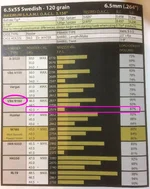
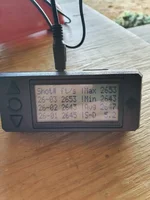
Interestingly, I see that Nosler reloading tables have identified 42.5gr N160 as the accuracy load for their 120gr ballistic tip.[in their manual an * marks the "accuracy load"] However they declare a lower MV than I measured on the range. [Nosler table predicts 2579fps, Chrony measured shots out my rifle at 2770fps. ]

I have relative confidence in my Chrony's accuracy based on 100m & 250m drop data. I.e. the measured MV on factory loads aligns to the Strelok predicted MOA turret adjustment required to hit targets at 100m and 250m.

Nosler_reload_data_6.5x55.webp
 
@CerebralDistortion I've not perhaps been clear enough, but your two points agree with what I've said.

Most people though don't understand that in QL, different COAL values are in effect moving the lands too, so they'll tell you that in a particular combination of chamber / bullet that seating the bullet deeper increases pressures in itself. ie that where the bullet / chamber match sees a COAL of say 3.000" with the bullet sitting just off the lands, then seating that bullet deeper to say 2.800" (200 thou' jump + whatever the original clearance was) will see a large pressure increase.

Thats' the QL equations side of the issue. What QL cannot quantify however is the effect of pressure reduction caused by an increase in bullet jump from say 20 thou' (@3.00" COAL) to a now 220 thou' jump (@ 2.800" COAL). Older loading handbooks, some reloading manuals and most shooters' actual experience is that that produces a reduction in both pressure and MV.

Where a large jump is caused by a high round count and resulting throat erosion, there is another possible factor at play that can seriously muddy the waters - whether that extra erosion induced freebore is smooth or rough. In some cases which as far as I can see usually involves very overbore cartridges, hot-burning double-based powders and rapid firing rates producing in combination very high barrel temperatures, the eroded section can be left very rough and pitted. In this situation, pressures can go through the roof thanks to additional friction impeding the bullet's being engraved and its passage down the bore. IME starting shooting many years back with surplus service rifles and 'well-used' (and some!) 7.62mm TR rifles, attempts to identify COALs close to the lands more often than not failed as the degree of erosion was such that the bullet was outside of the case mouth before it reached them. In these cartridges, the eroded section seemed to be smooth as pressures weren't ever a problem. My first 'decent' 7.62 TR job was a late 1960s Schulz & Larsen Mauser based rifle that the previous owner had bought new when TR replaced 303 Service Rifle as the NRA's prone discipline and had been shot in 2+20 round club comps almost every weekend for seven months of the year plus many higher round count regional and national ones too for around 20 years. I ended up using a 185gn Lapua D46 barely nipped in the case-mouth (it still wasn't on the lands) and as much Hodgdon BL-C(2) as I could stuff into the case, IIRC 5-6gn above the listed maximum load - and pressures were still fine. That bullet was getting a tremendous 'run' at the lands before hitting them.

On point 2), again that's just what I said or certainly intended to. However, there are many people around (probably a majority of handloaders in fact) who will argue that compressed loads are dangerous purely through compression.

With extruded powders, there might be a marginal pressure increase through some kernels in a heavily compressed charge being broken and this affecting their burning rate making them 'quicker'. The degree of this though will be very small in a conventional bottle-neck case design. I suppose that if you carried it through to a ludicrous extreme in a straight-wall design the whole charge could be mashed down into dust and behave like a fast burning pistol powder, but even there I'm not sure a conventional press and seater die could physically produce that amount of compression / damage.

In the 'old days', the argument against compressing ball powder charges was that unlike extruded tubular types whose performance is at least partly determined by kernel size and internal longitudinal hole diameter, ball powders rely more heavily on deterrents surface coatings. Crack the kernel open and a large untreated area is exposed to flame and ignites earlier / faster. Norma gives a different reason, that seems more likely to me at least. Ball powders sit very tightly packed even when uncompressed so the primer flame has a hard time getting between individual kernels making efficient and consistent ignition less likely. Compress the charge and this tendency is strengthened. Certainly over-compressed ball powder charges can cause problems. Winchester designed the .458 Win Mag dangerous game cartridge and launched it in 1956 as the first of its quartet of 'short magnums' with 3.340" COALs to fit the standard Model 70 action without needing expensive custom shop remachining. As with all Olin Corporation / Winchester cartridges it used in-house manufactured ball powders. Terry Wieland in his books on dangerous game cartridges argues that this is a perfect example of post-war US designs that are poor because they downsized from older British magnums and relied on 'increased efficiency', ie running at higher pressures with less leeway to cope with African ambient temperatures, more chance of extraction issues through swollen cases etc. Additionally, in the 458's case a very heavily compressed ball powder charge with a heavy case-bullet crimp was needed to barely get enough MV / ME for the 'big four'. In development testing and with fresh ammunition, Winchester satisfactorily achieved its performance targets, but after it had been on the market a while complaints flooded in of misfires, and squib loads that literally saw bullets bouncing along the ground not many yards ahead of the muzzle. Winchester retested - no problems and said the cartridge was fine. Complaints continued, increased in fact, to the point where sales were affected. Then Winchester looked at cartridges made a year or two earlier which had been sitting on the shelf - and the problems appeared with some of them. It turned out that heavy compression had caused the little round kernels to clump together into solid masses affecting ignition and subsequent charge burn.

With freshly loaded compressed extruded powder charges, the most likely problem is that of COALs being either inconsistent through the charge compression overcoming case-neck grip on the bullet giving inconsistent COALs to the detriment of precision, and/or increasing COAL to such an extent that the bullet is jam seated into the lands which will increase peak pressures.
 
I have the same manual and as a relatively new reloader the book data vs my reality was pretty concerning!

The range tests I did the other day suggested that I had a very accurate batch of loads in the 42gr to 42.5gr area. Something I will be retesting with variations on my next range opportunity. The measured MVs at 42.5gr N160 were 2770fps. I.e. adequate for me.

Interestingly, I see that Nosler reloading tables have identified 42.5gr N160 as the accuracy load for their 120gr ballistic tip.[in their manual an * marks the "accuracy load"] However they declare a lower MV than I measured on the range. [Nosler table predicts 2579fps, Chrony measured shots out my rifle at 2770fps. ]

I have relative confidence in my Chrony's accuracy based on 100m & 250m drop data. I.e. the measured MV on factory loads aligns to the Strelok predicted MOA turret adjustment required to hit targets at 100m and 250m.

View attachment 149333
 
as a relatively new reloader the book data vs my reality was pretty concerning

Me too. I now realise that all data tables are to be read as averages of what other loaders have experienced. They are not absolute values. The reality is that your rifle+powder+bullet set up may well behave very differently. It is a good lesson to learn early on. We hear it said often enough in reloading circles: "start with minimum loads and work up". Mileage may vary...
 
This post has been absolutely fascinating and highly educational.
The differences in results is quite staggering.
If you recall I had signs of obturation failure at 45.5gr of N160 using 129gr Hornady SST.
I loaded 5 rounds yesterday with 46gr of N160, no more black streaks, no pressure signs, all 5 rounds at 100yds within a thumbnail and attached are the chrono results. I was only offered the use of the chrono after my first 2 shots.20200212_142552.webp
This was using new Lapua brass. It will be interesting to see if I can reduce the powder slightly now the brass is fire formed.
 
I think
This post has been absolutely fascinating and highly educational.
The differences in results is quite staggering.
If you recall I had signs of obturation failure at 45.5gr of N160 using 129gr Hornady SST.
I loaded 5 rounds yesterday with 46gr of N160, no more black streaks, no pressure signs, all 5 rounds at 100yds within a thumbnail and attached are the chrono results. I was only offered the use of the chrono after my first 2 shots.View attachment 149381
This was using new Lapua brass. It will be interesting to see if I can reduce the powder slightly now the brass is fire formed.
i think you will find velocity drops on 2nd load as Lapland is tight necked when new, certainly tighter necked than any die I have
 
Further testing has reinforced my earlier data and the take away for me from all of this so far is the following:

  • Sako once-fired brass in my rifle consistently shows pressure issues at or above the 42.4gr N160 when pushing a Barnes 120gr seated to CBTO 2.337"
  • The accuracy loadings [best groups] always have two common factors:
    • Brass is neck-sized only and
    • charge weight is around the 42-42.3gr N160

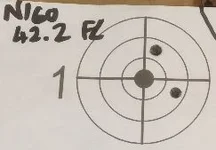
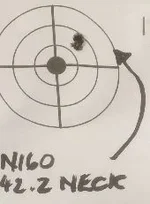
FL_42.2_N160_target.webp < Full length resizing gives variable POI, neck-sizing only gives hole-in-hole > Neck_42.2_N160_target.webp

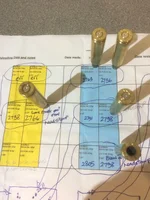
IMG_4087.webp There were zero pressure signs using the lowest charge weight at top of page [42.2gr N160] At 42.4gr the pressure issues started to manifest...

Based on today's data, I have made a further batch of neck-sized only 42.2gr N160 cartridges to confirm (a) accuracy seen on two previous testings and (b) check MV consistency

I have also made up some rounds at 42.3gr N160 which is 1/10 grain lower than any round that has shown pressure issues so far.

I have thrown away all twice-fired Sako brass as it does not seem to lend itself to multiple reloads.

Going forward, once I have settled on a charge weight [probably 42.2gr N160], then I will tinker with bullet seating depth. Provided accuracy remains good, I plan to reduce the jump.


Working theory regarding premature over-pressure
The only stand-out reason why the pressure may be higher at relatively low charge weights [lower than Viht tables and other reloaders on this forum] is the fact that the bullet is held VERY tightly by the brass. I have dissasembled 6 rounds now. 5 were my reloads, one was a Sako factory cartridge that I used as a reference case. The Sako factory cartridge took two hefty whacks on the inertia hammer. All 5 of my reloads took TEN spinach-and-weetbix fuelled swings to free up. That has to be a co-factor in pressure build up. There could be two reasons for this super neck tension that I can think of: (a) Sako brass is thicker so when RCBS applies outside resizer, inside dimension becomes too snug or (b) Sako brass must be annealed after every firing to return to more maleable metalurgical state.

Ideas?
 
Back
Top