Chainsaw not cutting straight

Not likely. But nice try. :)

Your mass differential hardening notion could only apply to the last few molecules of edge, which would then easily be removed as a small percentage part of the first bit of file swarf...the file would just scoop under the hard section.

If the temperature is raised enough to show tempering colours behind the edge, then tempering is what will happen...tempering/softening/toughening. The greater mass may absorb the heat rapidly, but will then subsequently temper the molecules of the edge as the heat evens out and runs back to the edge as the whole lot cools down...the heat can't just go one way and then not return!

Alan
I buy that.

What about the wheel rolling microscopic flakes of chrome onto the part of the tooth that the file meets (which is usually just steel)? The counter to that, of course, is the same as one's objection to the carbide inclusion hypothesis...
 
Not likely. But nice try. :)

Your mass differential hardening notion could only apply to the last few molecules of edge, which would then easily be removed as a small percentage part of the first bit of file swarf...the file would just scoop under the hard section.

If the temperature is raised enough to show tempering colours behind the edge, then tempering is what will happen...tempering/softening/toughening. The greater mass may absorb the heat rapidly, but will then subsequently temper the molecules of the edge as the heat evens out and runs back to the edge as the whole lot cools down...the heat can't just go one way and then not return!

As @CarlW said earlier you need to build in a quench to arrest the inevitable process of tempering/normalisation...notwithstanding whether there is enough carbon in the tooth steel in the first place.

Alan


This is why people should dress the chain with a file to keep an edge, loose the edge chain dulls, person leans on saw more, chain gets hot....

After a while the hand filing will roll the edge by the very nature of a chain in a bar moves so after time a grind/reprofile.

Just like using any hand tool correct position is key....
 
I buy that.

What about the wheel rolling microscopic flakes of chrome onto the part of the tooth that the file meets (which is usually just steel)? The counter to that, of course, is the same as one's objection to the carbide inclusion hypothesis...

You must bring a few decent sized drills and lathe bits (tool steel and carbide) when you come pick up your boiler clamps..

I will dress the grinding wheels Carl... :norty:
 
You must bring a few decent sized drills and lathe bits (tool steel and carbide) when you come pick up your boiler clamps..

I will dress the grinding wheels Carl... :norty:
I don't own a single blunt or un-ground tool, Tim. Slovenliness has no place at this side of the country... :p
 
I buy that.

What about the wheel rolling microscopic flakes of chrome onto the part of the tooth that the file meets (which is usually just steel)? The counter to that, of course, is the same as one's objection to the carbide inclusion hypothesis...

The phenomenon of some people finding the problem of filing after grinding and others not, may be explained by the differences in type of grind wheel used?

I tend to favour blunt files and/or the slightly different radii of grind wheel to file profile to explain the skating effect described...

Either way it is surprising that it only seems to be a complaint after re-grinding, and not the initial manufacturer's grinding.

Alan
 
Either way it is surprising that it only seems to be a complaint against subsequent re-grinding, and not the initial manufacturer's grinding.
Although the difference in quality of the wheels is likely to be enormous?
 
I don't own a single blunt or un-ground tool, Tim. Slovenliness has no place at this side of the country... :p

Well bring a few and we can test if the drill cut on both flutes or is the pied piper of hand grinding owning a penny whistle. Question is do you have any with a 4 facet grind...Rory has a few how to pictures
 
Well bring a few and we can test if the drill cut on both flutes or is the pied piper of hand grinding owning a penny whistle. Question is do you have any with a 4 facet grind...Rory has a few how to pictures
Better I spend my time teaching you how to get a decent surface finish from that lathe... 😁
 
Better I spend my time teaching you how to get a decent surface finish from that lathe... 😁

Grind the tool correct and you may have half a chance....we can test your hand feed on the mill as well... :rofl:

I will dig out my lead loading kit and pick up a car wing from the lads.. You have to leave with picking up something...
Even if it is just the coffee/tea cup.
 
Grind the tool correct and you may have half a chance....we can test your hand feed on the mill as well... :rofl:

I will dig out my lead loading kit and pick up a car wing from the lads.. You have to leave with picking up something...
Even if it is just the coffee/tea cup.
Hand feed? I've heard of that... :-|
 
I now have to go out and buy one of those ridiculous grinders in order to put this to the test. In the meantime, my instinct remains in the cooking-your chain-hard-is-a-myth camp... :p
I bought an electric grinder to save some chains that had been hammered in some timber where nails where common....it was ok for having to take a chain back but for the price of good chains (Oregon, husqy) you are as well replacing them I find...

I keep a few old chains for root cutting jobs and just try and keep my main chain clean and away from soil!
 
Back to the original question. I would say its a chain issue. I have a Husky 135 had it for years utterly reliable and starts without issue.

As stated get a Husky chain sharpener guide and decent files. Make sure the rakers are set correctly using the guide. Clamp bar in vice and sharpen you will find one way is easier than the other so try and get things uniform. Might only need a couple of passes to get chain sharp, I tend to do little and often.
New Oregeon chains are about £15 each, always have a spare.

There is nothing wrong with the Lidl chain sharpener, Gave one to friend years ago and us it on dull chains. Just brought one for myself two weeks ago. If you set it up correctly makes putting angles back on chain very easy and you can fettle with a file.

There are some very good videos on U tube on chain saw sharpening, have a look at some.

As previously said ensure bar slot is always cleaned out and oil holes clear. Occ take off any burrs with a flat file and regularly turn bar over.

Chain saws dont like nails, stones or dirt. Holly can be a real pain to cut dont know why but seem to collect stones.

Hope this helps

D
 
Back to the original question. I would say its a chain issue. I have a Husky 135 had it for years utterly reliable and starts without issue.

As stated get a Husky chain sharpener guide and decent files. Make sure the rakers are set correctly using the guide. Clamp bar in vice and sharpen you will find one way is easier than the other so try and get things uniform. Might only need a couple of passes to get chain sharp, I tend to do little and often.
New Oregeon chains are about £15 each, always have a spare.

There is nothing wrong with the Lidl chain sharpener, Gave one to friend years ago and us it on dull chains. Just brought one for myself two weeks ago. If you set it up correctly makes putting angles back on chain very easy and you can fettle with a file.

There are some very good videos on U tube on chain saw sharpening, have a look at some.

As previously said ensure bar slot is always cleaned out and oil holes clear. Occ take off any burrs with a flat file and regularly turn bar over.

Chain saws dont like nails, stones or dirt. Holly can be a real pain to cut dont know why but seem to collect stones.

Hope this helps

D

Good to see the chain done in the vice as the person filing is up right, when done on the floor etc the file angle goes to rat sh#t good feet body head position is important...
Those that have done the square block and square hole filing test will understand....
 
I bought a white elephant Stihl grinder - perhaps it is me but I cannot get on with it. It is getting as much use as my AMP MkII annealing machine. 🤡
At home I stick the saw in a bench vice and hand sharpen.
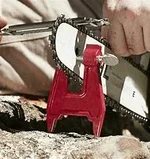
In the field I use one of these bad boys:-

1600436782700.png
 
As stated get a Husky chain sharpener guide and decent files.

Yes indeed. I only tend to use Oregon or Stihl files. Especially important with little garden size saws that use small files. A hedege laying client asked me to sharpen his saw once because he couldn't get it to cut.
It was some little Chinese made garden centre thing that came with its own (Micky Mouse) tool kit. None of my files were small enough so I used the ones supplied and they were lethal. The slightest pressure and they snapped like sticks. Nearly stabbed myself in the wrist with them. Needless to say they were utterly blunt as well. Couldn't even take the sap resin off. Had to send him up the agri store for some Oregon files.
 
Also when you are filing concentrate on the underside of the top plate, and the side plate will look after itself, it's the top plate that does most of the cutting, when you get good at it you can make a brand new chain out of the box sharper with a few well placed strokes, not that you'd need to for most applications
 
Back
Top