Knife project #7 - my first commission: Local scout leader wants a short bladed Karesuando

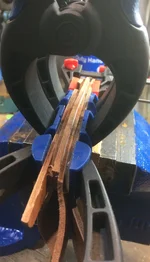
They are neodymium magnets, they are 10mm diameter x 5mm, I don't have a link but there are loads on ebay.
They never let go of the blade, but the glue gave up in the mdf after a while, maybe 40 knives, they are araldited into the angle plate and you have to watch your fingers when applying the blade blank, it has nipped me a few times, I leave the blade hanging off to one side and just have the handle 'stuck' to the plate so I keep a finger over the handle as well to make sure it doesn't leave the plate and loose the angle during grinding, it also tells me when it is to hot.
 
The belt sander restored a semblance of a bevel, but it has taken hours on the waterstones to get the blade back to mirror finish. Even then, it is not razor sharp at the tip. I may have one more crack at it tomorrow.

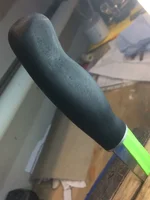
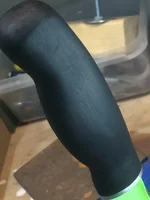
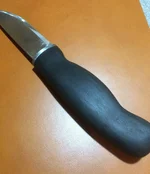
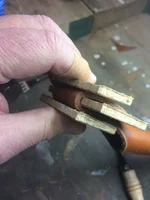
But shaping the handle went pretty well and I have applied one coat of hardwax. The Bog Oak looks like it will take a few coats to develop a uniform shell IMG_5891.webpIMG_5889.webp

But today threw up two useful learning points:

  • The black handle looked to be uniformly shaped/smoothed, but in the image on the left above you can still see some evidence of a coarser grit used during initially shaping. So, the darker and more uniformly coloured the material the more attention to final finish required.
  • I never applied a choil on any knives made with files. No need. But a belt finished bevel can [and did in this case] take the blade edge 1mm closer to the spine than the ricasso. That step now snags the edge of my waterstones. Had I cut a choil buffer zone, it would not.
 
Apparently my day will start with a walk. SWMBO.

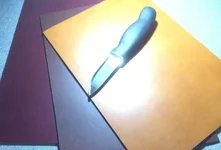
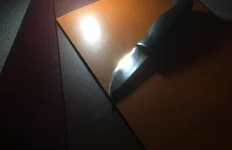
But later I hope to start the sheath. Of the three leathers I have available, I reckon the tan sits best against the jet black of the bog oak handle: IMG_5894.webp IMG_5895.webp IMG_5896.webp
 
Are you going to finish the handle more still? Or are you leaving it as is? Looks to still have a lot of sanding marks on it which would polish out? (Tell me to wind my neck in!!)
 
Are you going to finish the handle more still? Or are you leaving it as is? Looks to still have a lot of sanding marks on it which would polish out? (Tell me to wind my neck in!!)

LOL.

Photographed as it is with a side-light, even faint marks are thrown into relief. In the hand, I cannot see any of these marks. Nor can I feel them. I suspect that two more coats of hardwax and a burnish will make that which you can see in the photo disappear altogether.

From a practical perspective: this will be a working knife, not a cabinet-queen. I am certain the handle will sustain dings and wood-sap staining in very short order. I.e. markings garnered is usage will dwarf maker's imperfections.


Note to self: "take deerstalker.308 off Christmas list" ;)
 
Progress on the sheath would have proceeded more quickly today but for earlier heckling from the peanut gallery. So first part of my workshop time was spent with some 240 grit trying to remove last vestiges of marks on the handle. In some lights I can sometimes still spot the odd shadow. In my hand? nada. Time to move on.

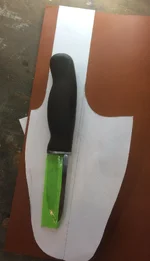
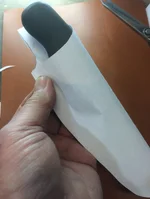
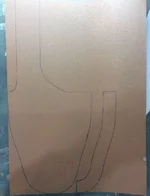
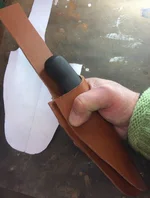
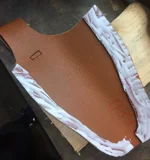
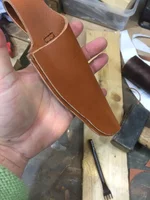
The owner of this knife wants to wear sheath on belt at right hip, knife spine facing forwards. First a dummy run using an A4 sheet of paper IMG_5898.webp. Repeated wrap-testing to help visualise whether shape will translate to chunky [4mm] leather IMG_5901.webp before transferring sheath template [and stitch-protecting welt] IMG_5903.webp. Next cut out leather shape and offer up to knife IMG_5904.webp. All good, so trimmed rough edges IMG_5906.webp.


I then glued welt to one side of sheath and re-waxed the handle of the knife. Should make good progress on sheath a.m.
 
LOL.

Photographed as it is with a side-light, even faint marks are thrown into relief. In the hand, I cannot see any of these marks. Nor can I feel them. I suspect that two more coats of hardwax and a burnish will make that which you can see in the photo disappear altogether.

From a practical perspective: this will be a working knife, not a cabinet-queen. I am certain the handle will sustain dings and wood-sap staining in very short order. I.e. markings garnered is usage will dwarf maker's imperfections.


Note to self: "take deerstalker.308 off Christmas list" ;)
Ha, apologies, it wasn’t a dig, genuine question, no offence intended (I’ll send you my address for the Christmas card now ok?)
 
The wife likes a fire. The central heating works just fine but if the outside temp drops even slightly, and there is wood to burn, then the logburner is stoked till its component parts groan.

So this morning was all about firewood prep.


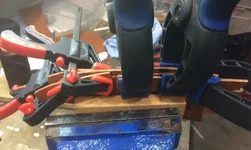
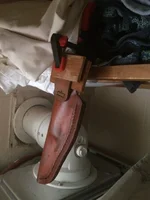
I finally got to do some sheath work after lunch. First up I stitched the belt loop IMG_5915.webp. Then I applied leather cement to the welt and the opposing side of the sheath IMG_5918.webp. This glueing is not structural. Rather, it holds the outer lips of the sheath in perfect alignment so that when I punch holes for the waxed stitching [which is what will hold the sheath together permanently] the leather does not squirm leading to mis-aligned holes. Clamped IMG_5919.webp with waste leather strips to prevent marking the hide with the clamps' jaws patternsIMG_5920.webp
 
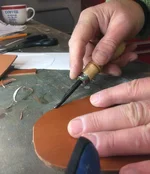
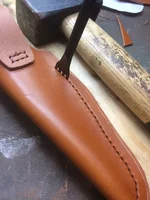
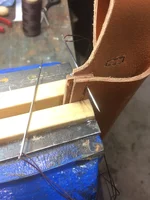
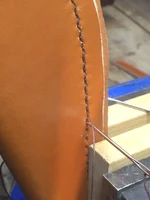
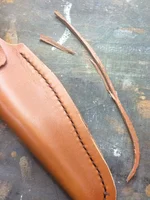
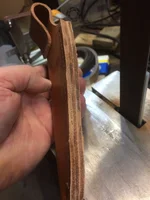
Rapid progress today. Sheath emerged from the glue clamps looking good IMG_5932.webp. Next the holes were punched IMG_5934.webp and then the workpiece offered up to the vice for stitching. I use waxed thread IMG_5935.webp and start two holes in from the end such that the last loops at either end are double stitched IMG_5937.webp. Once stitching was completed, I trimmed the excess welt material IMG_5938.webp and...
 
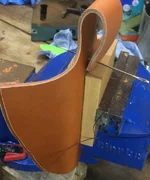
...buffed the edge on the belt sander IMG_5939.JPG before proceeding to the wet-forming. The knife is wrapped in 50cm of clingfilm to keep dry and slightly exaggerate girth, the leather is soaked until malleable [sub 3 mins]. I also cut some plywood formers to introduce a "belt profile" to the loop IMG_5940.JPG before suspending in the boiler cupboard to dry/harden over a couple of days IMG_5941.JPG. Nearly there...
 
The lovely folk at GFS made a steel delivery just before Christmas. So rather than make another RWL34 blade, I now have some AEB-L to play with...

It is a great stainless steel at a very accessible price. But there are any number of recipes for hardening it. See below. As best I can deduce from the sum of all of those is the recipe I have devised in graphic form below. Any other AEB-L experts out there with experience? Knowing what worked as well as the fails would be good.



View attachment 186184
ÀÈB -Ĺ is not good to harden in a forge at all . Dont know where that info came from but itsxair hardening and needs a oxygen free heat and crio as it suffers retained austenite ( failing crio a goodvfreezer can get close ) 1050 c is however correct but it must be steady and held .my AEB-Ĺ are done in a vaccume furnace ie no atmosphere but some use ht foil and a bit of paper inside to burn the oxygen in knifemaking kilns .
Use 01 tool for this knife imo . You can ht it in a diy forge and onecremper cycle at 180c for one hour will get you where you needs to be
O1 is as exotic as you want to go without the gear and it makes a cracking bushcraft knife , tough and takes and holds a great edge . O1 needs to have no dark shades in the colour before quenching in a medium fast oil 1 hour temper at 150 c min 180c if you want tougher with less edge retention not a major issue .
 
ÀÈB -Ĺ is not good to harden in a forge at all . Dont know where that info came from but itsxair hardening and needs a oxygen free heat and crio as it suffers retained austenite ( failing crio a goodvfreezer can get close ) 1050 c is however correct but it must be steady and held .my AEB-Ĺ are done in a vaccume furnace ie no atmosphere but some use ht foil and a bit of paper inside to burn the oxygen in knifemaking kilns .
Use 01 tool for this knife imo . You can ht it in a diy forge and onecremper cycle at 180c for one hour will get you where you needs to be
O1 is as exotic as you want to go without the gear and it makes a cracking bushcraft knife , tough and takes and holds a great edge . O1 needs to have no dark shades in the colour before quenching in a medium fast oil 1 hour temper at 150 c min 180c if you want tougher with less edge retention not a major issue .
If you want something you can work with i would send you something easier to ht underbtge circumstances of it not being for profit build
 
If you want something you can work with i would send you something easier

Thanks Bowlander. That's kind, but I have enough bar stock to be getting on with. But if you know anyone flogging a 72x2", PM me.

I am aware that 1080, 80CrV2, O1 and other high-carbon steels are easier to HT with the rudimentary kit I have. I have previously made knives from 1095 and 1080.

AEB-L is not my first attempt at HT of a stainless steel blade with the kit described above. I have already succeeded in making a 62Hrc RWL-34 knife.

I am clear that this AEB-L knife's HT is probably not top draw/absolutely uniform. But I want to dabble, so have offered this build for free. The owner knows the knife to be a prototype. I have asked for feedback in use.

In my limited experience, RWL-34 is easier than AEB-L to HT uniformly using the equipment above.
 
I build my own grinders when required, the imported ones have too many added costs , taxes and margins before they reach the end user .

Agreed, the factory 72x2" prices I have seen are eye-watering.

I am seriously thinking about building one.

What motor and controller do you use?
 
Project completed. Wet-formed sheath now set. Pleased with the result. But also critical of my errors. Learnt a lot on the way.

I will make some more AEB-L blades and get some other volunteers to test whether rudimentary HT passes muster. Per Bowman's post above, there can be issues with simplistic AEB-L HT. It will be interesting to get feedback from users.

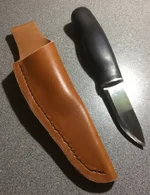
Anyhoop, here's the scoutmaster's finished knife:


IMG_5947.webp
 
Last edited by a moderator:
Back
Top