Zeroing the HMR

Musketeer

Well-Known Member
Yesterday I fitted a new scope to my rifle and set about zeroing it. I use a workmate and a piece of ply as a bench and a folding chair to get comfortable. I bore sighted and found that at 50 yards I was already on the paper. Within a few shots, I had it nicely grouped (1") although not perfect in the centre of the target.

I moved the target out to 100 yards and expected the poi to be close to the poa but it was 3 inches out and 2 inch group. I spent the next hour chasing zero around the poa without quite getting there. Click-click up, click-click right , then back again, It became very frustrating and I was clock watching as I had to go and do the school run. In the last few minutes, I moved the target back to 50 yards and adjusted it back to a pretty reasonable zero, a group of half an inch (3 shots), then put everything away for another day.

Shooting paper is much harder than shooting rabbits....

I know the wind had picked up after I moved out to 100 yards but not enough to make a difference (I would have thought).

Currently regretting changing over scopes as the one I removed was set up nicely :banghead:
 
If I haven't used the hmr in a while and I want to check zero I don't bother with anything more than a 10mph wind, it's just too much of a variable. Might also be worth trying a different ammo? Winchester 17gr are crap in my CZ, the Hornady 17gr work a treat though. Apparently they're even made in the same factory by the same people. Go figure 🤷🏻‍♂️
 
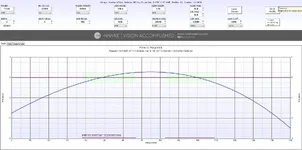
Zero at 42yds exactly. The HMR should put shots on top of another another at that range. It will then be bang on at 100yds.

Makes zeroing NV scopes much easier as well as normal scopes with low magnification ranges.
Not heard of that before, what's the reasoning? Is it the first zero, ie on the way up of the ballistic trajectory?

Sounds like a nice way to zero 👍
 
Not heard of that before, what's the reasoning? Is it the first zero, ie on the way up of the ballistic trajectory?

Sounds like a nice way to zero 👍

Yep all cartridges are different in terms of velocity and bullet weight so these primary or secondary zeros vary between them all. For my centrefires, this method would see you zeroing around the 65yd mark (from memory) for a 100yd zero which is still quite a distance to bore sight with ease on a small target. I tend to still bore sight and put one shot on paper at closer ranges and then work out what the elevation adjustment is for my required 100yd zero once lateral adjustements have been made.

Obviously easier to bore sight at 40ish yds than 100yds with the small breakdown A4 target holder that I have in my rifle bag, so zero can be had in 3 shots (incl the test shot at 100yds) as long as you correctly calculate how many more clicks you need to zero at a shorter distance. So for MOA adjustment on a scope at 42yds, you would need nearly 2.5 x the clicks that you would need at 100yds to see the same POI shift on target. I always draw a basic thick crosshair on my targets and use a ruler to mark 1" increments. That way I can just look through the scope and see exactly what adjustment I need to make. 1 shot on paper, adjust to get bang on at 42 yds (for the HMR) and then another shot to confirm. Move out to 100yds, shoot again to confirm then go home.

That is fine for the HMR where I am looking for an inch or so grouping at 100yds but for CF's where ultimate precision is needed well beyond 100yds, I would take more shots and finely adjust to enable small groups to be shot repeatedly. Depends on the rifle application.

For the HMR though, 42yds is a good distance to zero.
 
I always zero mine 20 mm high at 65 yards. It's far enough out to show up any loosening of the grouping, caused for example by a dirty bore, bad ammo batch etc, but close enough to minimise wind deflection and shooter error.
100 yards for zeroing is a waste of time unless you're in an indoor range or it's a perfectly still day, which it never is.
 
If I haven't used the hmr in a while and I want to check zero I don't bother with anything more than a 10mph wind, it's just too much of a variable. Might also be worth trying a different ammo? Winchester 17gr are crap in my CZ, the Hornady 17gr work a treat though. Apparently they're even made in the same factory by the same people. Go figure 🤷🏻‍♂️

I tested the popular ammo on both my HMR rifles and they like Hornady, it normally is a straight forward process to zero, but not this time. I think just finding a dry windless day is hard in itself.
 
Yep all cartridges are different in terms of velocity and bullet weight so these primary or secondary zeros vary between them all. For my centrefires, this method would see you zeroing around the 65yd mark (from memory) for a 100yd zero which is still quite a distance to bore sight with ease on a small target. I tend to still bore sight and put one shot on paper at closer ranges and then work out what the elevation adjustment is for my required 100yd zero once lateral adjustements have been made.

Obviously easier to bore sight at 40ish yds than 100yds with the small breakdown A4 target holder that I have in my rifle bag, so zero can be had in 3 shots (incl the test shot at 100yds) as long as you correctly calculate how many more clicks you need to zero at a shorter distance. So for MOA adjustment on a scope at 42yds, you would need nearly 2.5 x the clicks that you would need at 100yds to see the same POI shift on target. I always draw a basic thick crosshair on my targets and use a ruler to mark 1" increments. That way I can just look through the scope and see exactly what adjustment I need to make. 1 shot on paper, adjust to get bang on at 42 yds (for the HMR) and then another shot to confirm. Move out to 100yds, shoot again to confirm then go home.

That is fine for the HMR where I am looking for an inch or so grouping at 100yds but for CF's where ultimate precision is needed well beyond 100yds, I would take more shots and finely adjust to enable small groups to be shot repeatedly. Depends on the rifle application.

For the HMR though, 42yds is a good distance to zero.

I really like this approach.
 
I always zero mine 20 mm high at 65 yards. It's far enough out to show up any loosening of the grouping, caused for example by a dirty bore, bad ammo batch etc, but close enough to minimise wind deflection and shooter error.
100 yards for zeroing is a waste of time unless you're in an indoor range or it's a perfectly still day, which it never is.


Yes, I'm beginning to think you are right. Zeroing at a closer distance is looking like the way forward.
 
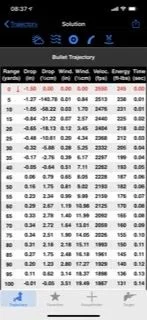
Strelok is a decent free app and will give you rough clicks and adjustments based on box speeds for factory or QL speeds for home loads. Obviously, nothing beats known speeds from a chrono. Strelok also gives trajectory tables, like the one above.
I boresighted and zeroed my 6.5x55 Mauser last weekend at 25yd, which gave a second zero at about 215yds. Got me well on paper and fine tuned from there at the 200 mark.

Regards

Mark
 
I'm lucky most of my shooting is in the shelter of woods, so not effected by wind so much. 4O yards is a good range to zero . Then check at 100 to confirm.
With no wind my 17 hmr is very accurate out to 120 yards.
My biggest bugbear is the noise. Because of this I have reverted back to .22 RF subsonics but limit most of my shooting to 60 yards.
I am using more and more the .222rem which is not much louder than the hmr and more effective .
 
I sold my .17HMR but when I had it I used Remington 17 grain ammo and 20 grain CCI.
They both seemed to shoot almost to the same spot at 150 yards. I find I can load my .22 Hornet for almost the same cost and more effective on a fox at 150yds and very terminal on the Wilfred's (Rabbits) with 45gr Sierra SP's.
 
I sold my .17HMR but when I had it I used Remington 17 grain ammo and 20 grain CCI.
They both seemed to shoot almost to the same spot at 150 yards. I find I can load my .22 Hornet for almost the same cost and more effective on a fox at 150yds and very terminal on the Wilfred's (Rabbits) with 45gr Sierra SP's.
I like my HMR, though I'd admit it's a it of a drama queen of a cartridge. It likes everything to be just so or it throws a fit.
I've stuck with mine because I don't reload and for a long time I was shooting rabbits in quite high numbers so it made sense. Those number have diminished considerably over the last few years and if that continues I'll probably go over to a .17 Hornet.
 
Stating the obvious I know, but the HMR is a light bullet and it get's it's destructive power from being driven at speed. A good combination with everything being equal, but also a bad combination for little things affecting it. I find anything more than a gentle breeze will affect it pretty much when you stretch the range to the extent that shooting a rabbit can amount to a game of Russian roulette. All you can do is zero with the ammo it likes and compensate for windage, although if it's gusting, it's anybody's guess. It is also more susceptible to the state of the barrel. Mine seems to start to go off after around 40 rounds. So I clean it and it then takes a few rounds to resume normal service.

I do like my .17hmr, but you've got to know it's limitations.
 
After reading the posts here and looking at an online app, I decided to give the 40 yard zero a go.

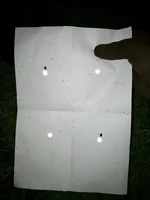
As you might imagine, it did not take much time to zero at this range with cloverleaf 3 shot groups. I had a play at different powers whilst doing so and confirmed that x16 is much harder to keep still than x8 and that the poi did not change through the different powers. X8 is my preferred power, even at 100 yards

Now happy with the 40 yard zero, I set up a target at 100 yards. I was very happy to see the target hit and on inspection, the poi was 1/2 " high and central. It is so much easier to zero at the closer range and still get a very workable 100 yard poi, as half a dozen rabbits discovered afterwards.
 
Back
Top